The China Mail - First radioactive rhino horns to curb poaching in S.Africa

USD -
AED 3.672504
AFN 65.000368
ALL 81.910403
AMD 376.168126
ANG 1.79008
AOA 917.000367
ARS 1431.790402
AUD 1.425923
AWG 1.8025
AZN 1.70397
BAM 1.654023
BBD 2.008288
BDT 121.941731
BGN 1.67937
BHD 0.375999
BIF 2954.881813
BMD 1
BND 1.269737
BOB 6.889932
BRL 5.217404
BSD 0.997082
BTN 90.316715
BWP 13.200558
BYN 2.864561
BYR 19600
BZD 2.005328
CAD 1.36855
CDF 2200.000362
CHF 0.77566
CLF 0.021803
CLP 860.890396
CNY 6.93895
CNH 6.929815
COP 3684.65
CRC 494.312656
CUC 1
CUP 26.5
CVE 93.82504
CZK 20.504104
DJF 177.555076
DKK 6.322204
DOP 62.928665
DZD 129.553047
EGP 46.73094
ERN 15
ETB 155.0074
EUR 0.846204
FJD 2.209504
FKP 0.735067
GBP 0.734457
GEL 2.69504
GGP 0.735067
GHS 10.957757
GIP 0.735067
GMD 73.000355
GNF 8752.167111
GTQ 7.647681
GYD 208.609244
HKD 7.81385
HNL 26.45504
HRK 6.376104
HTG 130.618631
HUF 319.703831
IDR 16855.5
ILS 3.110675
IMP 0.735067
INR 90.57645
IQD 1310.5
IRR 42125.000158
ISK 122.710386
JEP 0.735067
JMD 156.057339
JOD 0.70904
JPY 157.200504
KES 128.622775
KGS 87.450384
KHR 4033.00035
KMF 419.00035
KPW 900.021111
KRW 1463.803789
KWD 0.30721
KYD 0.830902
KZT 493.331642
LAK 21426.698803
LBP 89293.839063
LKR 308.47816
LRD 187.449786
LSL 16.086092
LTL 2.95274
LVL 0.60489
LYD 6.314009
MAD 9.185039
MDL 17.000296
MGA 4426.402808
MKD 52.129054
MMK 2100.115486
MNT 3570.277081
MOP 8.023933
MRU 39.850379
MUR 46.060378
MVR 15.450378
MWK 1737.000345
MXN 17.263604
MYR 3.947504
MZN 63.750377
NAD 16.086092
NGN 1366.980377
NIO 36.694998
NOK 9.690604
NPR 144.506744
NZD 1.661958
OMR 0.383441
PAB 0.997082
PEN 3.367504
PGK 4.275868
PHP 58.511038
PKR 278.812127
PLN 3.56949
PYG 6588.016407
QAR 3.64135
RON 4.310404
RSD 99.553038
RUB 76.792845
RWF 1455.283522
SAR 3.749738
SBD 8.058149
SCR 13.675619
SDG 601.503676
SEK 9.023204
SGD 1.272904
SHP 0.750259
SLE 24.450371
SLL 20969.499267
SOS 568.818978
SRD 37.818038
STD 20697.981008
STN 20.719692
SVC 8.724259
SYP 11059.574895
SZL 16.08271
THB 31.535038
TJS 9.342721
TMT 3.505
TND 2.847504
TOP 2.40776
TRY 43.612504
TTD 6.752083
TWD 31.590367
TZS 2577.445135
UAH 42.828111
UGX 3547.71872
UYU 38.538627
UZS 12244.069517
VES 377.985125
VND 25950
VUV 119.620171
WST 2.730723
XAF 554.743964
XAG 0.012866
XAU 0.000202
XCD 2.70255
XCG 1.797032
XDR 0.689923
XOF 554.743964
XPF 101.703591
YER 238.403589
ZAR 16.04457
ZMK 9001.203584
ZMW 18.570764
ZWL 321.999592
  • SCS

    0.0200

    16.14

    +0.12%

  • RBGPF

    0.1000

    82.5

    +0.12%

  • BCE

    -0.4900

    25.08

    -1.95%

  • CMSD

    0.0600

    23.95

    +0.25%

  • NGG

    1.1700

    88.06

    +1.33%

  • BCC

    1.8700

    91.03

    +2.05%

  • VOD

    0.4900

    15.11

    +3.24%

  • JRI

    0.0900

    12.97

    +0.69%

  • RIO

    2.2900

    93.41

    +2.45%

  • CMSC

    -0.0400

    23.51

    -0.17%

  • RYCEF

    0.2600

    16.88

    +1.54%

  • RELX

    -0.7100

    29.38

    -2.42%

  • GSK

    1.0600

    60.23

    +1.76%

  • AZN

    5.8700

    193.03

    +3.04%

  • BTI

    0.8400

    62.8

    +1.34%

  • BP

    0.8400

    39.01

    +2.15%

First radioactive rhino horns to curb poaching in S.Africa
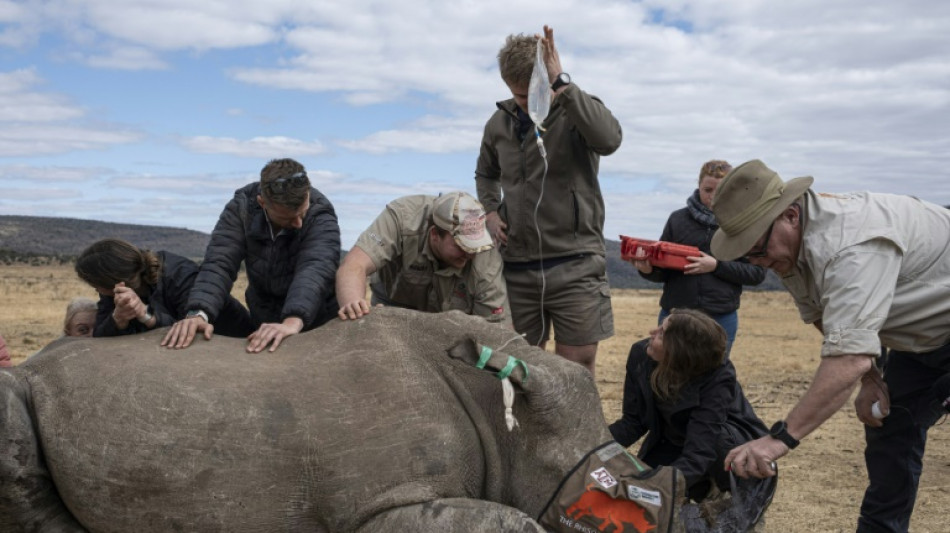
First radioactive rhino horns to curb poaching in S.Africa / Photo: © AFP

First radioactive rhino horns to curb poaching in S.Africa

South African scientists on Tuesday injected radioactive material into live rhino horns to make them easier to detect at border posts in a pioneering project aimed at curbing poaching.

Text size:

The country is home to a large majority of the world's rhinos and as such is a hotspot for poaching driven by demand from Asia, where horns are used in traditional medicine for their supposed therapeutic effect.

At the Limpopo rhino orphanage in the Waterberg area, in the country's northeast, a few of the thick-skinned herbivores grazed in the low savannah.

James Larkin, director of the University of the Witwatersrand's radiation and health physics unit who spearheaded the initiative, told AFP he had put "two tiny little radioactive chips in the horn" as he administered the radioisotopes on one of the large animals' horns.

The radioactive material would "render the horn useless... essentially poisonous for human consumption" added Nithaya Chetty, professor and dean of science at the same university.

The dusty rhino, put to sleep and crouched on the ground, did not feel any pain, Larkin said.

The radioactive material's dose was so low it would not impact the animal's health or the environment in any way, he said.

In February the environment ministry said that, despite government efforts to tackle the illicit trade, 499 of the giant mammals were killed in 2023, mostly in state-run parks. This represents an 11 percent increase over the 2022 figures.

Twenty live rhinos in total would be part of the pilot Rhisotope project whereby they would be administered a dose "strong enough to set off detectors that are installed globally" at international border posts originally installed "to prevent nuclear terrorism", a pleased Larkin said, sporting a green hat and a khaki shirt.

Border agents often have handheld radiation detectors which can detect contraband in addition to thousands of radiation detectors installed at ports and airports, the scientists said.

-'Best idea'-

Rhino horns are highly sought after on black markets, where the price by weight rivals that of gold and cocaine.

According to Arrie Van Deventer, the orphanage's founder, dehorning the rhino and poisoning the horns have failed to deter poachers.

"Maybe this is the thing that will stop poaching", the tall, slim-built conservationist said. "This is the best idea I've ever heard".

Wildebeest, warthogs and giraffe roamed the vast conservation area as more than a dozen team members performed the delicate process on another rhino.

Larkin meticulously drilled a small hole into the horn, hammered in the radioisotope, then finished off by spraying 11,000 microdots all over the horn.

About 15,000 rhinos live in the southern African nation, according to an estimate by the international Rhino foundation.

The last phase of the project would be the animal's aftercare following "proper scientific protocol and ethical protocol", said the project's COO, a bubbly Jessica Babich.

The team would then take follow-up blood samples to ensure the rhinos were effectively protected.

The material would last five years on the horn, which was cheaper than dehorning every 18 months, Larkin said.

C.Smith--ThChM