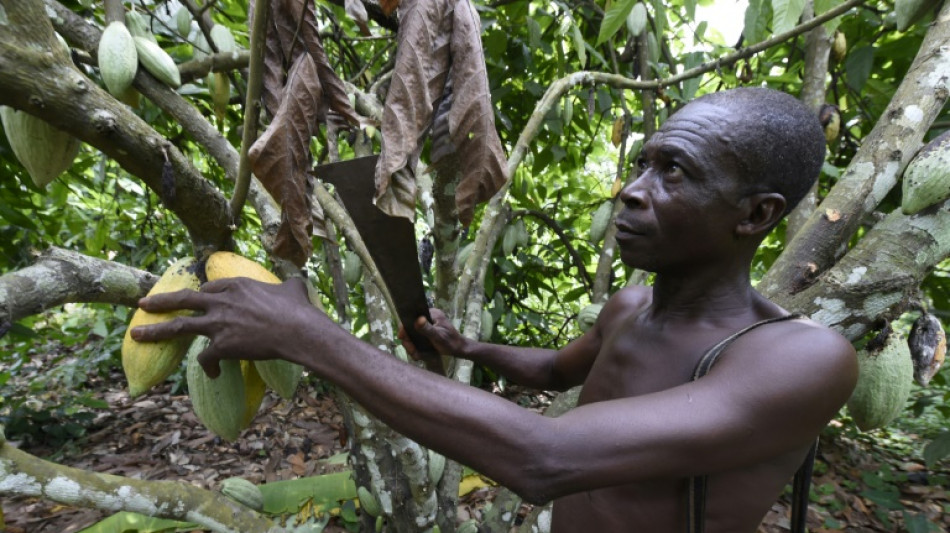
Nigeria seeks to cash in on soaring cocoa prices / Photo: © AFP

Booming cocoa prices are stirring interest in turning Nigeria into a bigger player in the sector, with hopes of challenging top producers Ivory Coast and Ghana, where crops have been ravaged by climate change and disease.
Nigeria has struggled to diversify its oil-dependent economy but investors have taken another look at cocoa beans after global prices soared to a record $12,000 per tonne in December.
"The farmers have never had it so good," Patrick Adebola, executive director at the Cocoa Research Institute of Nigeria, told AFP.
More than a dozen local firms have expressed interest in investing in or expanding their production this year, while the British government's development finance arm recently poured $40.5 million into Nigerian agribusiness company Johnvents.
Nigeria is the world's seventh biggest cocoa bean producer, producing more than 280,000 tonnes in 2023, according to the most recent data compiled by the UN's Food and Agriculture Organization.
The government has set an ambitious production target of 500,000 tonnes for the 2024-2025 season, which would move it into fourth place behind Ivory Coast, Ghana and Indonesia.
Adebola doubts Nigeria can reach the target this season, but he believes it is feasible in the next few years as there is rising interest in rehabilitating old plantations or establishing new ones.
He said Nigerian growers are much more exposed to the highs and lows of the global cocoa market than their peers in Ivory Coast and Ghana as prices are regulated in those countries.
Cocoa futures contracts in New York have fallen from their December record but they remain high at more than $8,000 per tonne. Cocoa prices typically ranged between $2,000 and $3,000 before the recent surge.
"Individuals are going into cocoa production at every level... to make sure they also enjoy the current price," said Comrade Adeola Adegoke, president of the Cocoa Farmers Association of Nigeria.
- 'Full-sun' monocrop -
Ivory Coast is by far the world's top grower, producing more than two million tonnes of cocoa beans in 2023, followed by Ghana at 650,000 tonnes.
But the two countries had poor harvests last year as crops were hit by bad weather and disease, causing a supply shortage that sent global prices to all-time highs.
Nigeria's cocoa has largely been spared so far from the worst effects of climate change, but expanding the crop could carry environmental risks.
The government has stepped up efforts to promote the long-unregulated sector via the National Cocoa Management Committee, which was established in 2022 to regulate the industry and support farmers.
But agriculture modernisation efforts have encouraged the development of "full-sun" monocrop plantations that only focus on growing cocoa beans, without the use of companion plants or trees.
A recent study in the journal Agroforestry Systems has raised concerns about this approach, saying monocrop farming can be less sustainable compared growing the bean alongside shade trees, promoting biodiversity and improving environmental health.
- Land and money? -
Scaling up the sector could also prove challenging because much of Nigeria's cocoa is grown by small-scale farmers.
Peter Okunde, a farmer in Ogun state, told AFP he lacks both the capital and land to expand his four-hectare (10-acre) cocoa plantation.
Land "is the major instrument farmers need... and the money to develop it", said Okunde, 49.
But John Alamu, group managing director of Johnvents, told CNBC Africa this week that "the problem is not land area".
Noting that Nigeria has 1.4 million hectares dedicated to cocoa production -- more than Ghana's 1.1 million, he told the broadcaster a more holistic approach was needed.
"These are things (other) governments have used to support farmers: provision of seedlings, training on good agronomic practices, a real focus on sustainable agriculture," he said.
"These are key things that will be responsible to take Nigeria back to its leadership position."
A.Zhang--ThChM