The China Mail - Pacific algae invade Algeria beaches, pushing humans and fish away

USD -
AED 3.672498
AFN 65.999773
ALL 81.973818
AMD 378.010114
ANG 1.79008
AOA 916.530447
ARS 1445.7622
AUD 1.435285
AWG 1.80125
AZN 1.701675
BAM 1.658807
BBD 2.01469
BDT 122.336816
BGN 1.67937
BHD 0.377
BIF 2964.288592
BMD 1
BND 1.274003
BOB 6.911584
BRL 5.248597
BSD 1.000305
BTN 90.399817
BWP 13.243033
BYN 2.865297
BYR 19600
BZD 2.011721
CAD 1.365769
CDF 2224.999941
CHF 0.775515
CLF 0.021898
CLP 864.480175
CNY 6.94215
CNH 6.935399
COP 3662.01
CRC 495.911928
CUC 1
CUP 26.5
CVE 93.521
CZK 20.555102
DJF 178.127969
DKK 6.32418
DOP 63.127629
DZD 129.961011
EGP 46.8977
ERN 15
ETB 155.859732
EUR 0.84705
FJD 2.2066
FKP 0.732184
GBP 0.737955
GEL 2.689805
GGP 0.732184
GHS 10.98271
GIP 0.732184
GMD 73.510149
GNF 8779.176279
GTQ 7.672344
GYD 209.27195
HKD 7.81248
HNL 26.422344
HRK 6.384802
HTG 131.225404
HUF 320.491503
IDR 16872.6
ILS 3.113155
IMP 0.732184
INR 90.211956
IQD 1310.388112
IRR 42125.000158
ISK 122.669412
JEP 0.732184
JMD 156.449315
JOD 0.708939
JPY 156.75302
KES 129.039839
KGS 87.449959
KHR 4037.199913
KMF 417.000436
KPW 900.030004
KRW 1462.830463
KWD 0.30734
KYD 0.833598
KZT 493.342041
LAK 21499.694667
LBP 89579.400015
LKR 309.548446
LRD 186.059136
LSL 16.159927
LTL 2.95274
LVL 0.60489
LYD 6.336511
MAD 9.181029
MDL 16.999495
MGA 4425.634414
MKD 52.199279
MMK 2099.783213
MNT 3569.156954
MOP 8.049755
MRU 39.901106
MUR 46.060158
MVR 15.460025
MWK 1734.461935
MXN 17.40415
MYR 3.946982
MZN 63.759847
NAD 16.159927
NGN 1368.090249
NIO 36.809608
NOK 9.77292
NPR 144.639707
NZD 1.669735
OMR 0.38449
PAB 1.000314
PEN 3.362397
PGK 4.348453
PHP 58.777504
PKR 280.076588
PLN 3.57332
PYG 6605.373863
QAR 3.645678
RON 4.314797
RSD 99.425967
RUB 76.575287
RWF 1459.984648
SAR 3.750159
SBD 8.064647
SCR 13.712043
SDG 601.501128
SEK 9.027399
SGD 1.27302
SHP 0.750259
SLE 24.550436
SLL 20969.499267
SOS 570.633736
SRD 37.869533
STD 20697.981008
STN 20.779617
SVC 8.752036
SYP 11059.574895
SZL 16.152192
THB 31.752499
TJS 9.362532
TMT 3.505
TND 2.89846
TOP 2.40776
TRY 43.539397
TTD 6.773307
TWD 31.650975
TZS 2584.99995
UAH 43.163845
UGX 3570.701588
UYU 38.599199
UZS 12269.30384
VES 377.98435
VND 25970
VUV 119.687673
WST 2.726344
XAF 556.374339
XAG 0.01329
XAU 0.000206
XCD 2.70255
XCG 1.802745
XDR 0.691101
XOF 556.348385
XPF 101.150088
YER 238.325034
ZAR 16.154445
ZMK 9001.191881
ZMW 18.580528
ZWL 321.999592
  • SCS

    0.0200

    16.14

    +0.12%

  • BP

    -1.1150

    38.085

    -2.93%

  • NGG

    -0.8850

    86.905

    -1.02%

  • CMSD

    0.0400

    23.91

    +0.17%

  • BTI

    0.0500

    61.68

    +0.08%

  • RIO

    -4.1500

    92.33

    -4.49%

  • RBGPF

    0.1000

    82.5

    +0.12%

  • GSK

    1.9800

    59.21

    +3.34%

  • RYCEF

    -0.0600

    16.62

    -0.36%

  • AZN

    2.0100

    189.46

    +1.06%

  • CMSC

    -0.0350

    23.485

    -0.15%

  • BCE

    -0.7300

    25.61

    -2.85%

  • BCC

    -0.8200

    89.41

    -0.92%

  • JRI

    0.1950

    13.345

    +1.46%

  • VOD

    -0.9550

    14.755

    -6.47%

  • RELX

    0.7200

    30.5

    +2.36%

Pacific algae invade Algeria beaches, pushing humans and fish away
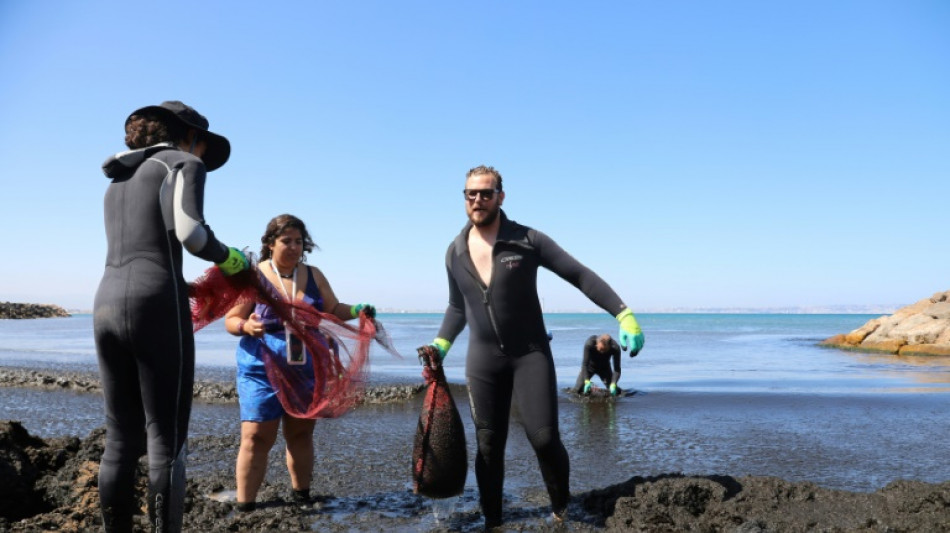
Pacific algae invade Algeria beaches, pushing humans and fish away / Photo: © AFP

Pacific algae invade Algeria beaches, pushing humans and fish away

At a beach near Algiers, brown algae native to the Pacific Ocean cover the golden sand, posing a threat to ecosystems native to the area and their stench repelling swimmers at the peak of summer.

Text size:

Following a recent government call to help clear beaches swarmed by the seaweed species known scientifically as Rugulopteryx okamurae, several volunteers and charities have stepped in.

"When it washes up, we can't swim," said Salim Hemmedi, a 43-year-old vacationer at a beach in Sidi Fredj, where volunteers raked up heaps of the plant.

"We hope the situation will improve so that we can enjoy ourselves... and that children can swim in peace."

The alga originates from temperate waters around Japan and the Korean peninsula in the northwest Pacific Ocean.

It was first spotted in Algeria in late 2023, according to Lamia Bahbah, a lecturer and researcher at the National School of Marine Sciences and Coastal Planning.

And lately, some have noted that it has been increasingly washed ashore.

Youcef Segni, a marine engineer and biologist, said the algae proliferated at a significantly higher rate than in 2023 and 2024.

"They invade the habitats of other algae in the seabed, which leads to the disappearance of some species," he said, adding that it can also displace some native fish.

- Fast reproduction -

In France, Spain and Portugal, the Rugulopteryx okamurae species has also been observed.

Earlier this year, Spanish football club Real Betis introduced kits repurposed from the seaweed to raise awareness about the issue.

A 2023 study by the Marine Drugs journal said the alga's invasive character led to "a replacement of the native biota and an occupancy rate that reached almost 100 percent in some locations" in Portugal.

In Algeria, the plant has been spotted in at least three of the country's 14 coastal provinces, including the capital where 16 beaches are affected, authorities said.

"Are the waters suitable for swimming? Yes," said Environment Minister Nadjiba Djilali during the cleanup campaign, adding there were no records of the plant causing allergies.

Researcher Bahbah said stopping its proliferation was "unfortunately impossible at this stage".

She said the plant reproduces at a high rate, both sexually and asexually.

The species can reproduce through fragmentation, meaning new individual algae can develop from fragmented pieces of other Rugulopteryx okamurae algae.

The algae spread mainly by clinging to the hulls of boats, and the Mediterranean's moderate temperature favours the seaweed's fast reproduction.

"We are going to fight it," said Fella Zaboudj, a state engineer in marine sciences, adding that researchers were monitoring its spread, development and evolution.

Zaboudj said research was also under way to determine whether the algae could be repurposed as fertiliser.

F.Jackson--ThChM