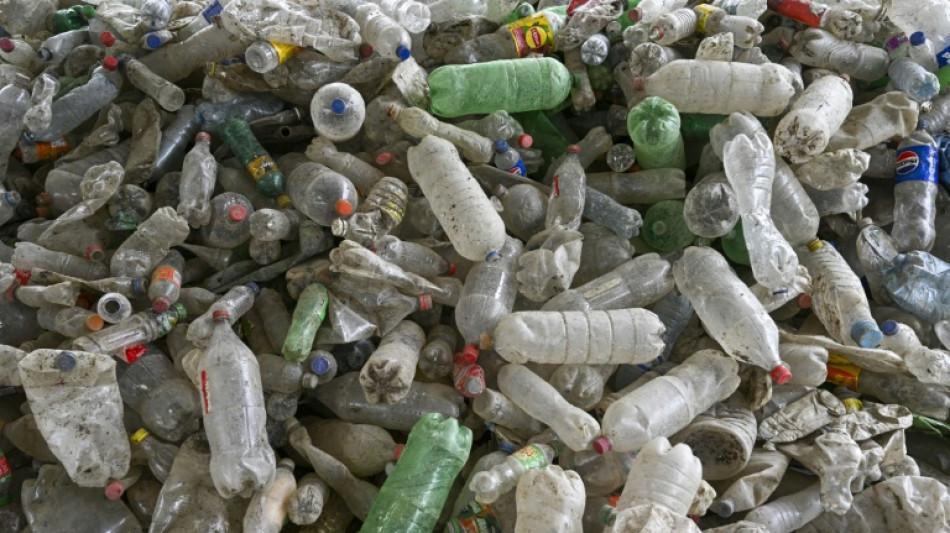
Talks for landmark plastic pollution treaty stretch into second week / Photo: © AFP

Talks in Geneva to craft a landmark treaty to tackle the global scourge of plastic pollution entered their second week on Monday, with countries still at loggerheads four days before a deadline.
Plastic pollution is so commonplace that microplastics have been found on the highest mountain peaks, in the deepest ocean trench and scattered throughout almost every part of the human body.
The 184 nations meeting at the United Nations to forge a first international accord returned to the negotiating table after a nominal day off.
Some countries held informal talks on Sunday to try to get things moving -- but no game-changing shifts occurred.
The first week of talks fell behind schedule and failed to produce a clear text, with states deeply divided at square one: the purpose and scope of the treaty they started negotiating two and a half years ago.
One African negotiator predicted the talks would conclude with a treaty by Thursday's deadline, even if it did not contain very much.
"We haven't worked for three years to come away with nothing," they told AFP.
Another diplomat said some of the informal discussions on the sidelines were now "moving very fast" and could produce answers that could then go forward for formal agreement.
"The fact that certain member states are willing to get into 'informal' informals -- these are ordinarily people whose ideology is far apart, so we're trying to come to a compromise kind of a text," he told AFP.
As for whether a breakthrough was on the cards, he said: "Let's see what happens on Tuesday -- today it's not clear."
- The rival camps -
A cluster of mostly oil-producing states calling themselves the Like-Minded Group -- including Saudi Arabia, Kuwait, Russia, Iran, and Malaysia -- want the treaty to focus primarily on waste management.
The United States and India are also aligned with this club.
On the opposite side, a growing faction calling themselves the "high ambition" coalition want more fundamental action written into the treaty.
Specifically, they seek to rein in plastic production, which on current trends is set to triple by 2060. This grouping also wants to phase out certain especially toxic chemicals.
The European Union, many African and Latin American countries, Australia, Britain, Switzerland and Canada all fall within this fold, as do small island states drowning in plastic trash they did not produce and cannot prevent from lapping up on their shores.
Palau, speaking for 39 small island developing states (SIDS), said "SIDS will not stand by while our future is bartered away in a stalemate".
They also discussed molecules and chemical additives that pose environmental and health risks.
- Consensus 'delusion' -
The treaty is set to be settled by universal consensus but with countries far apart, observers said the lowest-ambition countries are comfortable not budging.
"We risk having a meaningless treaty without any binding global rules like bans and phase-outs," Eirik Lindebjerg, global plastics adviser for the World Wide Fund for Nature, told AFP.
"Expecting any meaningful outcome to this process through consensus is a delusion," he said, urging the ambitious majority to go for a vote instead.
Claire Arkin, spokeswoman for the Global Alliance for Incinerator Alternatives, told AFP: "By calling for a vote, it would make this minority of countries who block the whole process realise they would lose it -- and force them to make compromises."
In total, 70 ministers and around 30 senior government officials are expected in Geneva from Tuesday onwards to try to help break the deadlock.
D.Wang--ThChM