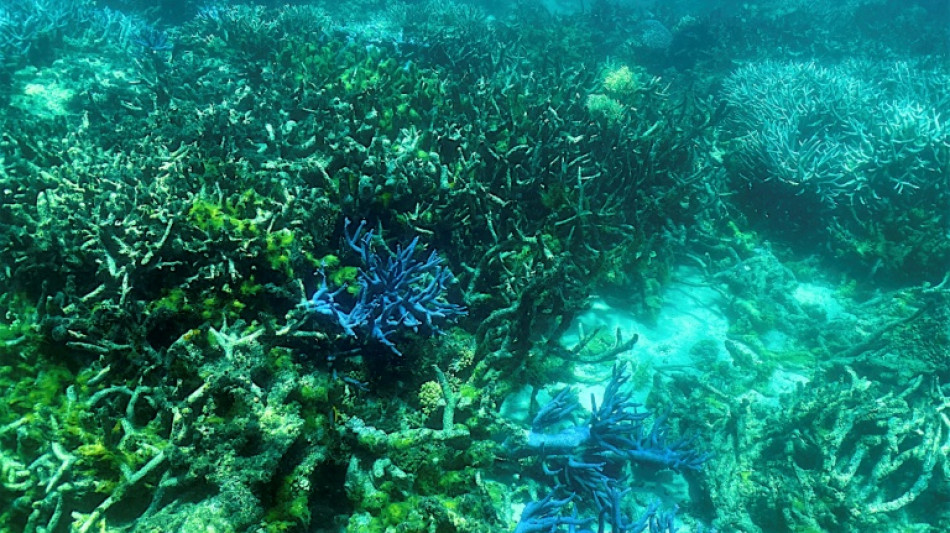
Top conservation group meets in UAE on growing threats to nature / Photo: © AFP

The world's top conservation body kicked off its world congress Thursday in the Emirati capital Abu Dhabi, where it will unveil its updated "red list" of threatened species a day later.
Hundreds of participants were meeting at the venue where the International Union for Conservation of Nature (IUCN), whose decisions help set the global agenda on environmental protection, will on Friday publish its list ranking plant and animal species from "least concern" to "extinct".
The congress, held every four years, sheds light on the dire state of the world's biodiversity. An increasing number of animals suffer from the destruction of their natural habitat, climate change, and water, air and soil pollution.
According to the United Nations's expert scientific panel on biodiversity (IPBES), biodiversity has declined every decade in the past 30 to 50 years.
In an update to its "red list" last year, the IUCN said that out of the 169,420 species studied, a total of 47,187 were classified as threatened -- more than a quarter.
The most impacted species were corals and amphibians, with more than 40 percent of each group under threat.
- UAE climate diplomacy -
The United Arab Emirates, a major oil exporter that also hosted the UN's annual climate talks in 2023 (known as COP28), is seeking a bigger role in setting the environmental agenda by hosting these events.
"The UAE has become a global convening power to bring countries together, bring all stakeholders on discussions that are very vital for our environment," UAE climate change and environment minister Amna bint Abdullah Al Dahak told AFP at the meeting.
"This is a platform where conversations can converge," Al Dahak said of the congress.
She called for translating "those conversations into pledges, into actions and into implementation plans", urging "more implementation plans and actions on the ground".
The IUCN congress last convened in the French city of Marseille in 2021.
The meeting revolves around votes on adopting resolutions.
Though not legally binding, the resolutions can "shape the international agenda" and "accelerate" work on treaties under discussion, an IUCN source told AFP, requesting anonymity to discuss the event freely.
"The Congress programme reflects the urgency and ambition of our time," said Shaikha Salem Al Dhaheri, Secretary General of the Environment Agency-Abu Dhabi and IUCN councillor from the West Asia region.
IUCN Director General Grethel Aguilar of Costa Rica said the upcoming announcements "reflect the scale of ambition and the real possibility of delivering the solutions we need to build a planet where people and nature thrive together".
- Synthetic biology debate -
The most closely watched vote revolves around two competing motions on synthetic biology -- a controversial technique widely used in the pharmaceutical industry and agribusiness.
It enables scientists to redesign organisms by engineering them to have new abilities.
One motion calls for a moratorium on the technology because "genetic engineering of wild species in natural ecosystems, including in protected areas, is not compatible with the practices, values and principles of nature conservation".
A competing motion argues that synthetic biology could complement conservation efforts, and says IUCN policy "should not be interpreted as supporting or opposing synthetic biology, per se".
Organisers expect 10,000 delegates and 5,000 civil society attendees.
The IUCN congress describes itself as the "world's largest and most inclusive nature conservation forum".
Its voting members include government agencies, national and international NGOs, and Indigenous groups.
I.Ko--ThChM