COP-and-trade? Tariffs, carbon tax weigh on climate talks / Photo: © AFP/File

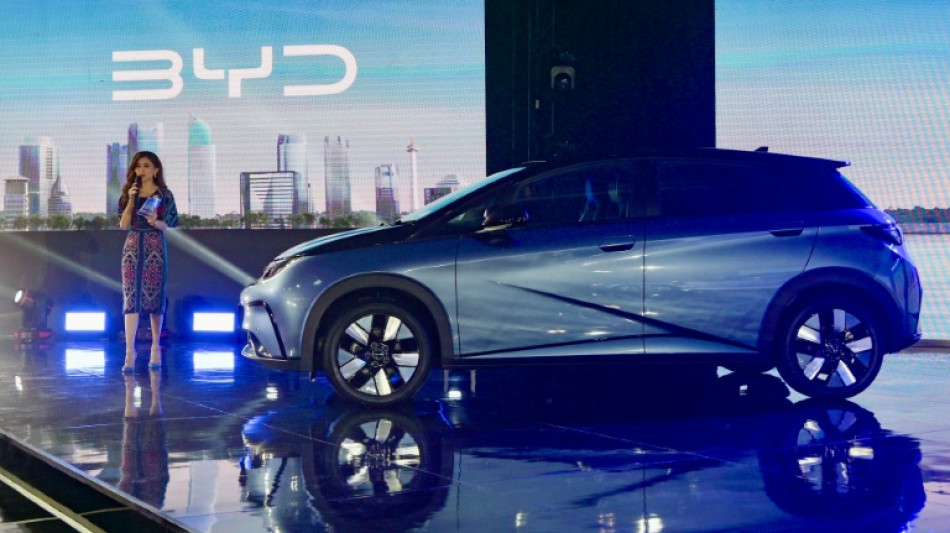
In Belem, the Brazilian city hosting COP30, it's hard to miss the BYD Dolphin Mini -- the Chinese hatchback that's dominating the local electric vehicle market, even as the company races to catch up in Europe and is absent in North America.
Trade-restrictive measures loom large over this year's UN climate summit, with China pushing for wider market access for its green technologies and major developing economies challenging Europe over its new carbon border tax on carbon-intensive imports like steel and fertilizer.
Even smaller developing countries whose exports aren't targeted by Europe's Carbon Border Adjustment Mechanism (CBAM) fear broader measures to come.
"Trade, at this COP, unlike previous COPs, has already been elevated," Li Shuo, director of the China Climate Hub at the Asia Society Policy Institute, told AFP. "We can already expect that trade will form the most prominent part of the outcome."
Traditionally, climate ambition and finance have dominated discussions -- how far major emitters will curb pollution, and how much money rich nations will provide to help developing countries adapt and accelerate their transition away from fossil fuels.
Countries including China, India and Brazil have repeatedly tried to put trade on COP agendas, without success. That's changing.
A draft text issued by the Brazilian presidency on Tuesday -- seen as paving the way for the final outcome text -- listed trade as the second of its four top bullet points.
- 'Free flow of green products' -
The tone was set earlier at a leaders' summit in November, when Chinese Vice Premier Ding Xuexiang urged countries to "remove trade barriers and ensure the free flow of quality green products."
The EU imposes steep tariffs on Chinese EVs -- reaching up to over 45 percent depending on the company -- while Canada and the United States go far higher still, exceeding 100 percent.
A Southeast Asian negotiator told AFP these realities rankle countries in Asia, which are buying up cheap Chinese green tech to accelerate their transitions, and find it "illogical" and "inconsistent" that Western nations are spurning the chance to do the same.
"We need to achieve the radical decarbonization of the global economy in the next two decades if we are to meet the Paris temperature goals," Alden Meyer of the think tank E3G told AFP.
"To the extent trade policies are creating barriers to achieving that objective, that's a legitimate topic."
The European Union's CBAM is another flashpoint.
The policy aims to level the playing field for industries covered by EU emissions rules by preventing companies from relocating to countries with weaker standards.
But major developing economies -- including India and South Africa -- are heavily exposed.
- CBAM and beyond -
"The Global North, having used carbon-intensive industries to develop themselves, are now throwing up the gates to the Global South," Mohamed Adow, of think tank Power Shift Africa, told AFP.
Concerns also extend beyond the sectors CBAM covers. An African negotiator from a cocoa-exporting country said the EU's paused deforestation regulations -- requiring proof commodities don't come from recently cleared land -- were another major worry.
The EU insists CBAM is not a trade policy but a climate one.
"Pricing carbon is something that we need to pursue with as many as possible, as quickly as possible," the bloc's climate commissioner, Wopke Hoekstra, said Monday. "We're not going to be lured into the suggestion that CBAM is a unilateral trade measure."
"Some countries say one thing here in negotiations, and they say another thing when we speak to them bilaterally," Sweden's Climate Ambassador Mattias Frumerie told AFP, explaining that privately some nations welcome CBAM as an incentive to decarbonize.
Brussels says CBAM was designed to comply with World Trade Organization rules.
Russia has launched a complaint, but with the WTO's dispute mechanism effectively paralyzed since 2019, opponents are seeking other venues to raise concerns, especially as the UK and Canada move forward with their own mechanisms.
David Waskow, director of the World Resources Institute's International Climate Initiative, said even if trade appears in the COP's final decision text, no one expects the summit to "magically" resolve these disputes. "They want to surface them, they want to poke each other," he told AFP.
"Sometimes doing that can lead to some recalibration of policy."
H.Au--ThChM