The China Mail - New frog species carrying eggs on back discovered in Peru

USD -
AED 3.67315
AFN 62.99978
ALL 82.659231
AMD 377.229857
ANG 1.790083
AOA 917.000365
ARS 1391.330248
AUD 1.443627
AWG 1.8025
AZN 1.703093
BAM 1.685671
BBD 2.013678
BDT 122.977207
BGN 1.709309
BHD 0.377557
BIF 2965
BMD 1
BND 1.28264
BOB 6.908351
BRL 5.153601
BSD 0.999815
BTN 92.79256
BWP 13.597831
BYN 2.973319
BYR 19600
BZD 2.010774
CAD 1.38765
CDF 2294.999618
CHF 0.795027
CLF 0.023121
CLP 912.92969
CNY 6.87275
CNH 6.87805
COP 3670.71
CRC 464.839659
CUC 1
CUP 26.5
CVE 95.496357
CZK 21.166702
DJF 177.720079
DKK 6.448302
DOP 60.499746
DZD 132.784304
EGP 53.522098
ERN 15
ETB 156.112361
EUR 0.862975
FJD 2.253799
FKP 0.758501
GBP 0.751705
GEL 2.689858
GGP 0.758501
GHS 11.000189
GIP 0.758501
GMD 73.502409
GNF 8780.000231
GTQ 7.648319
GYD 209.250209
HKD 7.83785
HNL 26.559099
HRK 6.500501
HTG 131.237691
HUF 330.801836
IDR 16937
ILS 3.13645
IMP 0.758501
INR 92.64165
IQD 1309.682341
IRR 1318875.000168
ISK 124.619772
JEP 0.758501
JMD 158.120413
JOD 0.709002
JPY 158.838995
KES 130.050137
KGS 87.449782
KHR 4010.502564
KMF 426.74984
KPW 899.943346
KRW 1513.109983
KWD 0.30945
KYD 0.833229
KZT 475.292069
LAK 21952.497707
LBP 89549.999673
LKR 315.172096
LRD 183.850277
LSL 16.945031
LTL 2.95274
LVL 0.60489
LYD 6.375012
MAD 9.324991
MDL 17.611846
MGA 4230.341582
MKD 53.193601
MMK 2100.405998
MNT 3572.722217
MOP 8.072575
MRU 40.130321
MUR 46.80971
MVR 15.449619
MWK 1737.000238
MXN 17.808298
MYR 4.027004
MZN 63.959624
NAD 16.944987
NGN 1379.980492
NIO 36.794904
NOK 9.65911
NPR 148.468563
NZD 1.73851
OMR 0.384499
PAB 0.999836
PEN 3.478037
PGK 4.323975
PHP 60.239654
PKR 279.202654
PLN 3.69855
PYG 6493.344193
QAR 3.645288
RON 4.399602
RSD 101.280984
RUB 80.300302
RWF 1463.214918
SAR 3.753609
SBD 8.042037
SCR 14.335449
SDG 601.000179
SEK 9.410604
SGD 1.283299
SHP 0.750259
SLE 24.550188
SLL 20969.510825
SOS 571.374393
SRD 37.364003
STD 20697.981008
STN 21.117322
SVC 8.748077
SYP 110.747305
SZL 16.786116
THB 32.639895
TJS 9.560589
TMT 3.51
TND 2.934847
TOP 2.40776
TRY 44.488503
TTD 6.785987
TWD 32.021199
TZS 2590.000315
UAH 43.749677
UGX 3724.309718
UYU 40.637618
UZS 12144.744043
VES 473.27785
VND 26335
VUV 120.24399
WST 2.777713
XAF 565.390002
XAG 0.013318
XAU 0.00021
XCD 2.70255
XCG 1.801759
XDR 0.710952
XOF 565.351019
XPF 102.791293
YER 238.650271
ZAR 16.850005
ZMK 9001.204886
ZMW 19.270981
ZWL 321.999592
  • RBGPF

    -13.5000

    69

    -19.57%

  • RIO

    1.5200

    94.81

    +1.6%

  • BCC

    -0.7700

    75.08

    -1.03%

  • BTI

    -0.5800

    57.89

    -1%

  • GSK

    0.8000

    55.99

    +1.43%

  • BCE

    0.1400

    25.38

    +0.55%

  • NGG

    2.2400

    86.84

    +2.58%

  • CMSC

    0.0900

    21.99

    +0.41%

  • CMSD

    0.0500

    22.15

    +0.23%

  • BP

    -0.8300

    46.17

    -1.8%

  • JRI

    0.2200

    12.52

    +1.76%

  • RELX

    0.0800

    33.23

    +0.24%

  • VOD

    0.1100

    15.13

    +0.73%

  • RYCEF

    0.9500

    16

    +5.94%

  • AZN

    3.5100

    200.73

    +1.75%

New frog species carrying eggs on back discovered in Peru
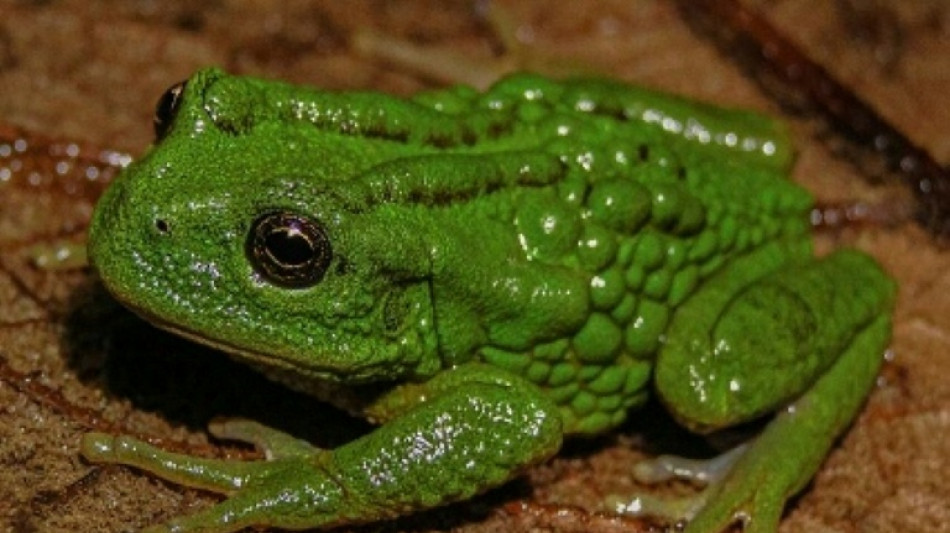
New frog species carrying eggs on back discovered in Peru / Photo: © Selva Institute for Sustainable Development Research/AFP

New frog species carrying eggs on back discovered in Peru

Scientists have discovered a new species of miniature marsupial frog in the Peruvian Amazon that carries its young in a natural pouch on its back, a research institute reported Wednesday.

Text size:

The new amphibian species, with the scientific name Gastrotheca mittaliiti, measures 2.7 to 3.3 centimetres (1 to 1.3 inches) and was discovered in a mountainous ecosystem in the Amazonas region bordering Ecuador.

The frog is bright green and has small protuberances on its back. The number of specimens in the wild is not known.

Its pouch enables the marsupial frog to nurture its young rather than, as other frogs, rely on aquatic environments for egg development.

The study says the amphibian is at "high risk" because its habitat is suffering the effects of climate change and the impact of fires started by farmers clearing the region.

"This is further evidence of the enormous natural wealth we possess... If we continue our research, there are many species still waiting to be discovered," Manuel Oliva, director of the Ceja de Selva Research Institute for Sustainable Development, part of the Toribio Rodriguez de Mendoza National University, told AFP.

The discovery was published in the New Zealand scientific journal Zootaxa and undertaken in collaboration with research departments at Florida International University and the University of Seville in Spain.

O.Yip--ThChM