Iraq fish die-off leaves farmers mourning lost livelihoods / Photo: © AFP

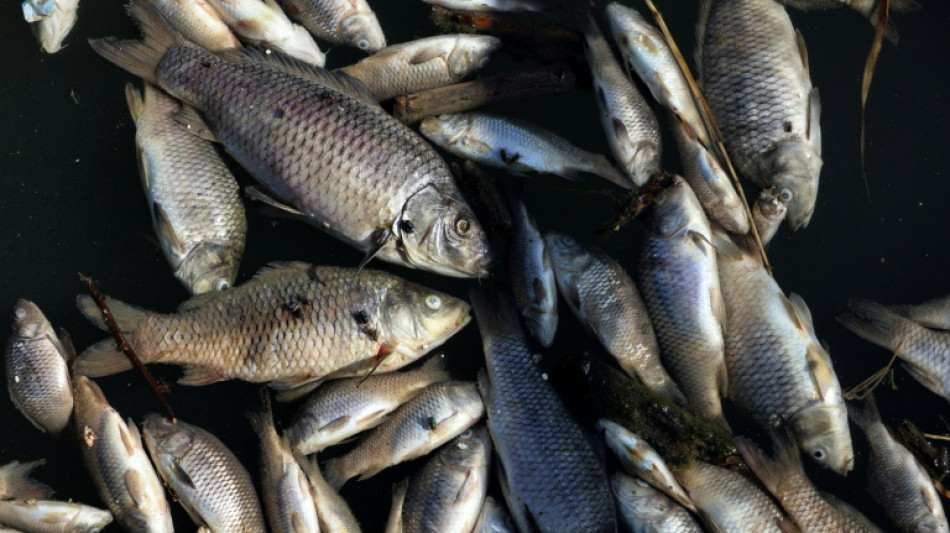
On the banks of Iraq's Tigris River, Haidar Kazem mourned 300 tonnes of the fish he had carefully raised in ponds wiped out by a flood of polluted water.
Water supplies in Iraq, the eastern half of what is known as the region's fertile crescent and which the United Nations ranks among the countries most affected by climate change, are in a dire state.
"In just two hours, my entire project was gone -- fish I had spent a year-and-a-half raising. I am back to zero," the 43-year-old fish farmer told AFP.
Earlier this month, after yet another very dry season, a brief spate of rain led authorities to open the gates of the Hamrin Dam, sending water into the Diyala, a tributary that is choked with untreated sewage.
The flood then swept the contaminated water into the larger Tigris, and the pollution was so severe that it was visible in satellite images.
Images from Copernicus Sentinel analysed by AFP show that, following the late-March rainfall, a noticeably dark stream flows from Diyala to the Tigris throughout the period from March 28 to April 12.
"No one told us that polluted water was headed our way," Kazem said, adding that the contaminated stream reached his ponds on April 5, killed all his fish and caused losses exceeding a million dollars.
Kazem buried his stock -- carp for Iraq's beloved grilled dish masguf -- and now spends his days cleaning their floating cages on the banks of the Tigris, haunted by the question: how will he save his livelihood?
"I don't know any other trade, and I don't have the money to restart," he said.
- 1,000 tonnes -
Arkan al-Shimari, the head of the agriculture department in Kazem's province Wasit, said that the sewage stream has killed more than 1,000 tonnes of fish.
According to authorities, several water treatment plants discharge untreated sewage into the Diyala River, which years of drought in Iraq have left low and notorious for its foul odour.
Environmental open-source investigator Wim Zwijnenburg said that the Diyala consistently appears darker than the Tigris due to wastewater discharge, its low depth and weaker currents.
Normally, it would gradually mix into the Tigris, but this time heavy rain created a stronger current in Diyala, sending a less-diluted polluted water into the Tigris, and "thus affecting downstream fisheries and potentially also water treatment plants".
As the situation worsened, authorities restricted water supply -- normally treated water from the Tigris -- in several areas of Wasit, reporting 20 documented cases of poisoning and rash.
Declining rain over recent years, coupled with rising temperatures, has brought water levels in the Tigris and Euphrates rivers to staggering lows, for which Baghdad also accuses upstream dams built by neighbouring Turkey and Iran.
- Black water -
Following the recent fish die-off, authorities vowed they would take the necessary measures to treat wastewater before discharge.
But decades of conflicts have left the country's infrastructure in a pitiful state and its water management systems in disrepair.
Iraq's new agency INA quoted a Baghdad official as saying that authorities will soon open seven more water treatment plants in the city.
In the town of al-Numaniyah, fish farmer Mazen Mansour, 51, gazed over the still water in his empty floating cages, which until recently held 38,000 fish he had been counting on selling next month.
Mansour said he did not realise polluted water had flooded the area until he saw his fish dying in the evening. He tried to save them by pumping air into his basins to provide oxygen, but it was too late.
"The water was black and filled with sewage," he said.
"All our work was gone in one night," added the father of four.
Now, he said, there is nothing he can do but wait and hope for compensation from the government.
"We urge the state to compensate us and hold those responsible accountable."
W.Cheng--ThChM