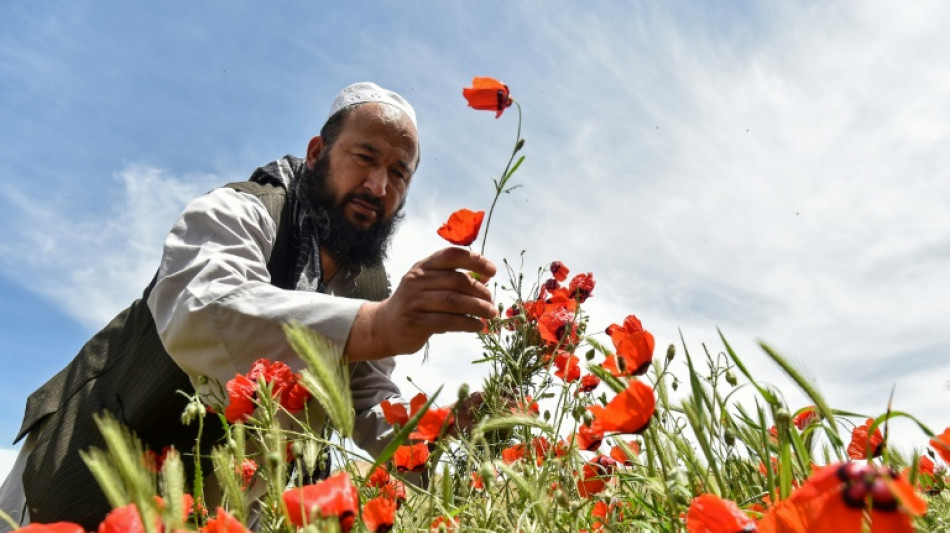
Afghans celebrate spring in bright red poppy fields / Photo: © AFP

In the middle of a field filled with bright red poppies, Afghans frolic among the spring flowers in a tradition deeply rooted in the country's north.
Families flocked to the valleys of Shirin Tagab district, near the border with Turkmenistan, to be among thousands of flowers that appeared after abundant rain.
"There has been a drought for almost 10 years. No flowers or greenery grew," said Ghawsudin, who only uses one name.
"This year has been very good, and God is merciful," said the 79-year-old, who drove for three hours just to see the flowers.
Mohammad Ashraf, a 35-year-old visitor, said he hadn't seen so many poppies for more than a decade.
"Now there are so many red flowers, and you see people come here for picnics," he told AFP.
The landscape in Shirin Tagab is brightened by the common poppy, not the opium poppy that authorities have banned.
- 'Vitality and freshness' -
Many Afghans living in the north used to travel to see the poppies after celebrating Persian New Year, Nowruz, in the city of Mazar-i-Sharif.
The Taliban government, which applies a strict interpretation of Islamic law, has stopped such celebrations each spring.
But the tradition of visiting the poppies, which are widely revered in poems and songs, has endured.
Oriane Zerah, a photographer who published a book about Afghans and flowers, said they are an integral part of daily life.
"As soon as an Afghan has a little space in their garden, they plant a flower. Even in displacement camps, there'll be a flower somewhere. They put them on their pakol, one of their traditional hats, and there are desserts made with flowers," she told AFP.
The poppy has also been associated with wartime in the country, with the flower often placed on the coffins of fighters, according to Afghan writer Taqi Wahidi.
"Dying in the path of the homeland, or in the path of religion and faith, was considered a kind of new resurrection and entry into a new life," he told AFP.
The same flower is widely used in countries, such as Britain, Australia and New Zealand, where people wear artificial poppies to remember those killed in past conflicts.
Nowadays in Afghanistan, however, the poppy "symbolises vitality and freshness", according to Wahidi.
"At the same time that nature is renewed, human beings also want to bring new colours into their lives," he said.
strs-qb-iw/rsc/lga
Z.Huang--ThChM