The China Mail - Nearly half the world's children exposed to three or more climate risks: UNICEF

USD -
AED 3.672503
AFN 63.000102
ALL 81.719319
AMD 368.120099
ANG 1.790403
AOA 913.116038
ARS 1429.508704
AUD 1.414197
AWG 1.8025
AZN 1.703759
BAM 1.684662
BBD 2.014307
BDT 122.763646
BGN 1.69088
BHD 0.37711
BIF 2991
BMD 1
BND 1.282253
BOB 6.910839
BRL 5.075897
BSD 1.000134
BTN 94.672782
BWP 13.41861
BYN 2.768827
BYR 19600
BZD 2.011413
CAD 1.399251
CDF 2320.999982
CHF 0.794475
CLF 0.022625
CLP 890.469848
CNY 6.76055
CNH 6.75866
COP 3491.45
CRC 454.982019
CUC 1
CUP 26.5
CVE 94.978251
CZK 20.830949
DJF 177.719764
DKK 6.448185
DOP 58.780714
DZD 132.879862
EGP 50.353703
ERN 15
ETB 161.237628
EUR 0.86271
FJD 2.21345
FKP 0.746148
GBP 0.745545
GEL 2.655033
GGP 0.746148
GHS 11.101445
GIP 0.746148
GMD 72.999944
GNF 8761.079479
GTQ 7.62406
GYD 209.236521
HKD 7.83465
HNL 26.744076
HRK 6.501102
HTG 130.714732
HUF 302.308004
IDR 17710
ILS 2.902595
IMP 0.746148
INR 94.74205
IQD 1310.156512
IRR 1375877.486468
ISK 124.590029
JEP 0.746148
JMD 158.526028
JOD 0.708998
JPY 160.260982
KES 129.419943
KGS 87.449787
KHR 4019.208821
KMF 425.99974
KPW 900.00035
KRW 1516.644991
KWD 0.30817
KYD 0.833473
KZT 489.555787
LAK 22021.999604
LBP 89562.850473
LKR 332.536555
LRD 182.018649
LSL 16.177014
LTL 2.95274
LVL 0.60489
LYD 6.359584
MAD 9.24575
MDL 17.396473
MGA 4155.30719
MKD 53.193004
MMK 2099.090156
MNT 3576.689019
MOP 8.070461
MRU 39.92506
MUR 47.119885
MVR 15.460112
MWK 1734.220557
MXN 17.21575
MYR 4.050982
MZN 63.891881
NAD 16.176944
NGN 1358.259637
NIO 36.806698
NOK 9.53335
NPR 151.476624
NZD 1.716398
OMR 0.384505
PAB 1.00006
PEN 3.401239
PGK 4.380015
PHP 60.419743
PKR 278.247736
PLN 3.667135
PYG 6123.407023
QAR 3.646058
RON 4.516101
RSD 101.239805
RUB 72.447504
RWF 1469.173289
SAR 3.752094
SBD 8.045573
SCR 13.116748
SDG 600.496166
SEK 9.402701
SGD 1.28289
SHP 0.746601
SLE 24.650007
SLL 20969.503664
SOS 571.527015
SRD 37.517951
STD 20697.981008
STN 21.103498
SVC 8.750743
SYP 110.532098
SZL 16.174171
THB 32.569599
TJS 9.270929
TMT 3.51
TND 2.926901
TOP 2.40776
TRY 46.290986
TTD 6.788552
TWD 31.533031
TZS 2629.998019
UAH 44.83735
UGX 3715.140944
UYU 40.562483
UZS 11980.705457
VES 581.95784
VND 26290
VUV 119.50104
WST 2.743493
XAF 565.02961
XAG 0.014299
XAU 0.000232
XCD 2.70255
XCG 1.802434
XDR 0.703376
XOF 565.02961
XPF 102.727985
YER 238.598182
ZAR 16.210095
ZMK 9001.184438
ZMW 17.580733
ZWL 321.999592
  • RBGPF

    0.0000

    60.72

    0%

  • CMSC

    0.0100

    22.34

    +0.04%

  • BCE

    -0.2369

    24.04

    -0.99%

  • RYCEF

    0.4600

    17.5

    +2.63%

  • GSK

    -0.8100

    52.23

    -1.55%

  • CMSD

    0.0600

    22.32

    +0.27%

  • BCC

    0.4500

    71.59

    +0.63%

  • NGG

    -0.2700

    81.57

    -0.33%

  • AZN

    -1.4800

    177.27

    -0.83%

  • RELX

    -0.9000

    32.84

    -2.74%

  • RIO

    0.5400

    105.89

    +0.51%

  • VOD

    -0.5300

    15

    -3.53%

  • JRI

    0.1135

    12.78

    +0.89%

  • BP

    -1.1900

    41.59

    -2.86%

  • BTI

    -1.2600

    61.06

    -2.06%

Nearly half the world's children exposed to three or more climate risks: UNICEF
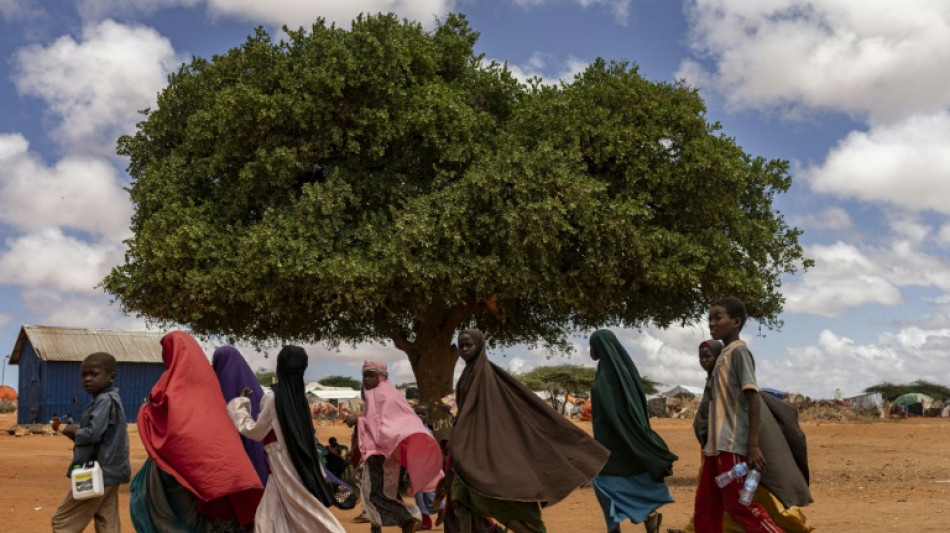
Nearly half the world's children exposed to three or more climate risks: UNICEF / Photo: © AFP

Nearly half the world's children exposed to three or more climate risks: UNICEF

More than one billion children face at least three overlapping climate hazards, UNICEF warned Monday, while highlighting the disproportionate impact in some regions of the world.

Text size:

For the report, the UN agency cross-referenced data showing where the roughly 2.4 billion children on the planet live with the geographic distribution of the eight most common climate impacts. They are coastal flooding, river flooding, drought, tropical storms, heat waves -- at least three days above a high temperature threshold, which varies by country -- extreme heat, wildfires and sandstorms.

The report primarily focuses on the 1.1 billion children who are exposed to at least three risks, with the most common combination being drought, extreme heat (above 35 degrees Celsius) and heat waves.

That combination affects some 296 million children, including 74 million in Nigeria, 34 million in Pakistan and 32 million in India.

The number of children in this three-or-more category has increased sharply over the past 20 years.

Almost all children -- some 2.3 billion -- are exposed to at least one risk. Two billion are exposed to at least two, while 364 million face at least four.

Of the 123,000 children exposed to seven or more climate hazards, some 46,000 are in Myanmar.

"Children are at the forefront of the impact of climate change," said UNICEF chief Catherine Russell.

As for the worst place for a child, "there isn't a super short answer," one of the report authors, Tom Slaymaker, told AFP.

- 'Hot spots' -

"But they're not all equal," Slaymaker said. "We do see some hot spots... it's really concentrated in Sub-Saharan Africa and parts of South Asia."

Countries with large populations of children -- including Bangladesh, India, Nigeria and Pakistan -- are at the top of the list for the number of children exposed to at least three hazards.

But in sheer percentage terms, countries in Sub-Saharan Africa -- particularly the Sahel -- have the largest proportion of children affected by hazards. The impacts are often exacerbated by governments' inability to cope with climate hazards.

Chad, for example, faces a humanitarian crisis with limited access to water, electricity and food. According to the report, more than 95 percent of kids in the country are exposed to at least three hazards -- one of the highest proportions in the world.

Other particularly vulnerable countries include 39 island states that face challenges such as limited freshwater, import dependence, and inability to easily shelter elsewhere after a disaster such as a hurricane.

- Nowhere to hide -

No country is truly spared, the report shows.

"In many countries, there will be small pockets of the population which are not exposed to these hazards," Slaymaker said. "They tend to be in the northern hemisphere, particularly so, parts of Scandinavia."

But that is because the report looks only at the eight most common risks worldwide, he stressed, noting that children in those countries may face other threats not covered in the report, such as melting glaciers or thawing permafrost.

abd/pnb/ksb/dw

L.Kwan--ThChM