UK museums at 'sharp end' of climate change challenge / Photo: © AFP

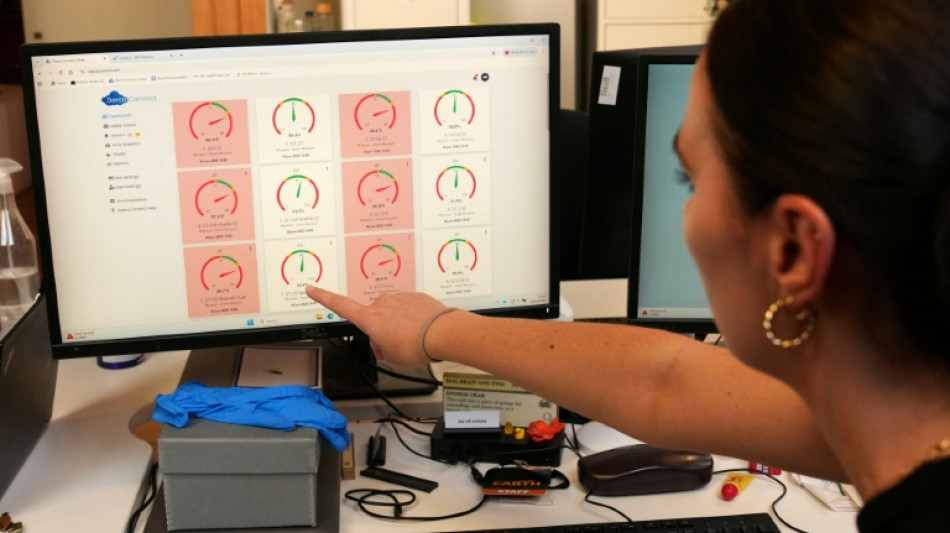
As visitors peered at skeletons and preserved animals in a London zoological museum during a UK heatwave, staff focused on a different attraction: a computer screen glowing with red and green temperature indicators.
With each one linked to a sensor in a different display case, the system allows staff to see when an exhibit is in danger of overheating.
Last year during a hot spell, staff arrived one morning to find an antique specimen jar -- containing a nearly two-centuries-old tabby cat -- had "blown out" amid the heat.
By monitoring temperatures in the display cases, staff at the Grant Museum of Zoology hope they can prevent damage to other exhibits by identifying any needing to be preventively decanted.
"They are very precious and valuable to us," said Tannis Davidson, head of zoology at the 200-year-old collection home to some 100,000 specimens covering every major animal group.
"We want to safeguard them for the next 200 years at least so students and researchers and members of public can enjoy the collection and learn more about the natural world," she told AFP.
But she said curators were having to deal with a whole "new set of challenges due to climate change and extended long periods of high temperatures within our spaces".
Emma Howard Boyd, chair of the independent National Heat Risk Commission, says the impact of climate change is no longer a distant threat but a present-day reality with the cultural sector at the "sharp end".
Last month's UK heatwave forced the closure of a number of London cultural attractions including the Young Victoria & Albert (V&A) museum, The Cutty Sark museum ship, Tower Bridge and some galleries at the V&A.
And the Met Office said Monday that the UK was entering its third heatwave of the year, although it was not expected to break any records.
- Heat, flooding -
Art works also require careful monitoring of temperature and humidity levels to prevent damage, according to Claire Teasdale of the National Trust heritage body.
"We're having more storms. We're having more wet weather and more extreme weather which is affecting everything," said Teasdale who manages the collections at Cragside, a 19th century mansion in northeastern Northumberland.
Cragside is home to an important art collection that includes works by J.M.W. Turner and John Everett Millais.
It was built to cope with "Victorian rainfall levels and not with 21st century rainfall levels," she said, adding rain and sunshine both hiked levels of potentially damaging humidity.
Six of the UK's 10 wettest years have occurred since 1998, the Met Office says.
Flooding poses another threat to cultural treasures.
The Museum of Making in the central city of Derby suffered major flooding in October 2023 during Storm Babet.
None of the industrial heritage museum's collections were damaged, but the cost of damage to the building was estimated at over £100,000 and the museum closed for nearly three months.
"Heat waves often end with flash flooding because of intense rainfall," added Howard Boyd who chaired a 2024 review of London's preparedness for more extreme weather commissioned by mayor Sadiq Khan.
- 'Windcatcher' -
John Calautit, lecturer in sustainable and low carbon technologies at University College London, said installing air conditioning was not a silver bullet for large spaces and historic buildings often subject to highly restrictive building regulations.
But he said experts were developing alternatives to provide ventilation and cooling based on the "windcatcher" principles used for centuries in architecture.
It is "a ventilation system which is attached to the roof which can capture air at higher altitude. It brings air flow into the space at higher volume ... and extracts air out of the space," he told AFP.
Modern-day systems incorporated some form of low energy cooling and had already been commercially produced and used in Middle Eastern countries, he said.
Howard Boyd argues museums and historic properties need to explore all options for climate resilience.
She envisages a future in which venues become community hubs offering people a refuge from the heat.
A joint UK-wide initiative launched last month by organisations including the British Film Institute highlights venues where people can find local spaces to keep cool.
har/jkb/yad
N.Wan--ThChM