Collapse of Amazon soy pact to unleash new deforestation: study / Photo: © AFP/File

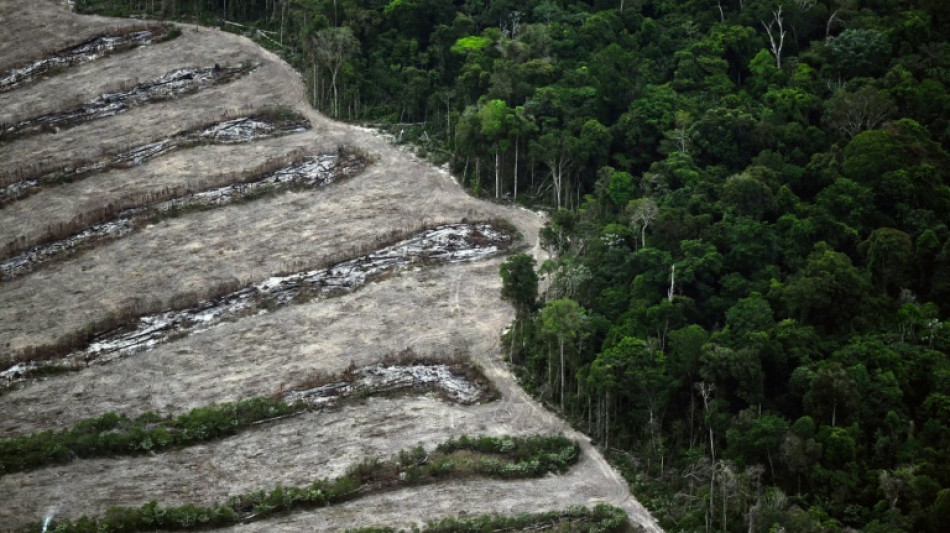
The collapse of a landmark Amazon soy pact will drive at least 1.4 million hectares (3.5 million acres) of extra deforestation in Brazil over the next decade, releasing carbon emissions equal to Canada's annual output, according to an analysis published Thursday.
The paper, published in Science, examined the rise and fall of the Amazon Soy Moratorium -- one of the world's most successful voluntary deforestation commitments -- under which soy traders agreed not to source or finance soy grown on land deforested after July 2008.
When the Moratorium began in 2006, nearly a third of annual soy expansion came from deforestation. After it took effect, deforestation linked to new soy fields fell to nearly zero.
"It generated very positive effects and results," not only environmentally but also by opening new markets, co-author Tiago Reis of World Wildlife Fund-Brazil, told AFP.
"It gave the assurance that soy was not causing more Amazon deforestation."
But the agreement came under attack starting three years ago, driven by lobbying from soy farmers, who filed a $200 million lawsuit against the traders.
Brazilian antitrust authorities also investigated the Moratorium's signatories over allegations they were behaving like a cartel.
Finally, laws passed by Mato Grosso and other soy-producing states stripped tax breaks from companies that adopted eco-friendly sourcing commitments beyond what the law required.
Though those laws are being challenged in Brazil's Federal Supreme Court, they have effectively dealt the agreement a death blow, with the moratorium abandoned in January.
The forecast is grim, according to the authors, who included researchers from the University of Wisconsin-Madison, DePaul University and the University of Illinois Urbana-Champaign.
They project 1.4 million hectares of additional deforestation by 2036 -- roughly two million soccer pitches -- equivalent to 745 million metric tons of carbon dioxide, which is comparable to Canada's annual greenhouse gas emissions.
That's also roughly 17 percent of the total area deforested across the Brazilian Amazon over the past decade.
Such outcomes would seriously undermine progress since leftist President Luiz Inacio Lula da Silva returned to power in 2023, with deforestation in the Brazilian Amazon falling to its lowest level in a decade in the first half of the year, according to figures released last week.
Beyond legal deforestation, the report's authors estimate tens of millions more hectares of "undesignated" public forest -- land that is neither protected nor privately or Indigenous held -- could come under pressure from land grabs, given its suitability for soy.
Reis explained that while cattle farming is often the initial method of claiming ownership of such land, soy is actually the strongest indirect driver of Amazon deforestation "because it's the most valuable commodity that can be produced."
The authors recommend a combination of stronger deforestation enforcement in Brazil and more ethical sourcing by soy importers, including the EU and China. Companies, banks and financial institutions, they say, also need to demand deforestation-free soy more forcefully.
"It's outrageous if we consider that we are living in a climate crisis with heat waves, super El Nino coming up," said Reis.
The weather pattern, compounded by climate change, is set to bring severe drought and wildfire risks to northern South America, imperiling the rainforest further.
A.Zhang--ThChM