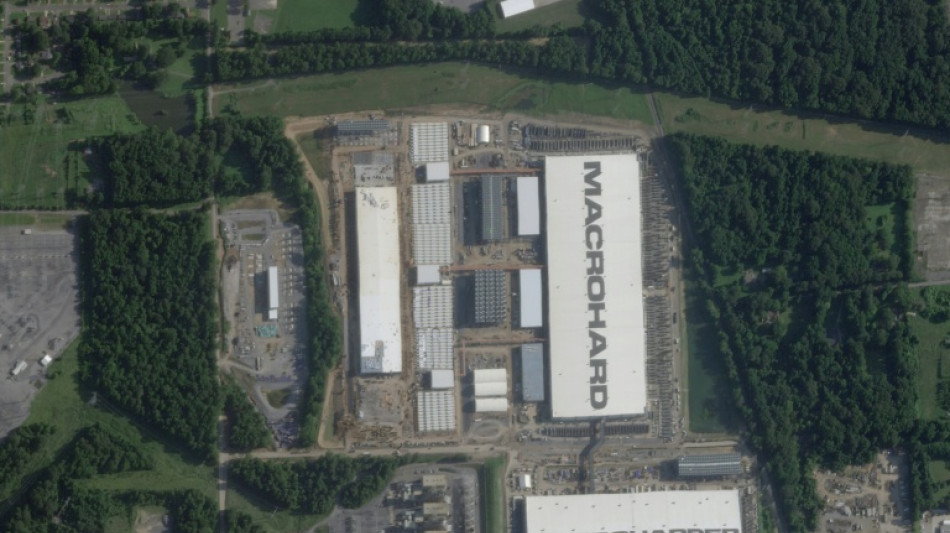
AI's hunger for power sparks US private gas plant boom / Photo: © 2026 Planet Labs PBC/AFP

As US tech companies race to build the data centers fueling the AI boom, they are increasingly putting up their own power plants -- off the grid and running on gas -- to get online faster.
Analysis by the research firm Cleanview, shared with AFP, identified around 60 data centers planned for the coming years with a combined 97 gigawatts of "behind-the-meter" generation into the early 2030s -- around the total installed capacity of Mexico.
The climate implications could be enormous.
The precise figure depends on how many are built, how efficient the turbines are and how often they run, but even with very conservative assumptions, the plants would easily top 200 million tons of carbon dioxide emissions a year.
That's equal to annual emissions of more than 46 million gasoline-powered cars.
The latest addition to the tally -- a 7.5 GW plant in Texas powering Amazon data centers -- shows how analysts often have to piece together clues to link projects to hyperscalers.
The plant got air pollution permits in January, Amazon received construction permits last week, and satellite imagery confirmed clearing had begun at the site named in the plant's air permit records. Cleanview then confirmed the link with Amazon directly.
- Poor efficiency -
Alongside greenhouse gases, gas plants emit fine particulate matter, linked to a range of heart and lung problems; nitrogen oxides, which aggravate respiratory disease; and hazardous air pollutants including mercury, formaldehyde and benzene.
"Powering data centers with behind-the-meter generation that relies heavily on dirty gas or diesel turbines is a surefire way to needlessly pump a variety of hazardous pollutants into local communities' air while worsening climate change," John Rogers, associate director of energy analytics at the Union of Concerned Scientists, told AFP.
"These dirty plants, which are also subject to less public accountability, are unacceptable when record heat and fires are showing us that we need to change course," said Yuqi Zhu, a senior policy analyst at Natural Resources Defense Council.
The practice began as an oddity, exemplified by Elon Musk's decision to truck in mobile gas turbines to an xAI data center in Memphis in 2024. xAI still accounts for most of the two gigawatts online today.
But Cleanview's analysis finds nearly every hyperscaler is pursuing such projects, including Meta, Microsoft and Oracle. AI labs including OpenAI and Anthropic have signed leases for more than 10 gigawatts of behind-the-meter power.
Instead of the equipment utilities normally buy, they have turned to more exotic and more polluting options, including trailer-mounted generators, turbines originally designed for aircraft and warships, piston engines of the kind commonly found in vehicles, and refurbished turbines from industrial operations.
- Test case -
Development tilts toward Republican-leaning states, with Texas far in the lead at more than 40 gigawatts announced.
The NAACP civil rights group has filed suit against xAI, accusing it of unlawfully operating turbines in Mississippi to power its Memphis data center.
"We are concerned that if this case is decided against us, data centers across the country will be emboldened to go forward," Laura Thoms, enforcement director at Earthjustice, which is co-representing the NAACP, told AFP.
President Donald Trump's administration has created a voluntary "Ratepayer Protection Pledge," under which signatories promise not to pass data center costs on to residential consumers, something Thoms fears will only accelerate the problem.
Gas was already enjoying a renaissance before Trump returned to office, according to data compiled by Atlas Public Policy.
After years of decline, new announced fossil fuel capacity for the grid hit a low in 2022, rebounding the following year as the AI boom took hold.
"In the first half of 2026 alone, we're already seeing that the announced new (fossil) capacity is higher than it's been in the last 10 years, so that's a pretty significant sign," said Rachel Reolfi, a senior policy analyst at the group.
O.Tse--ThChM