Once a legend, humpback whales make comeback in Brazil / Photo: © AFP

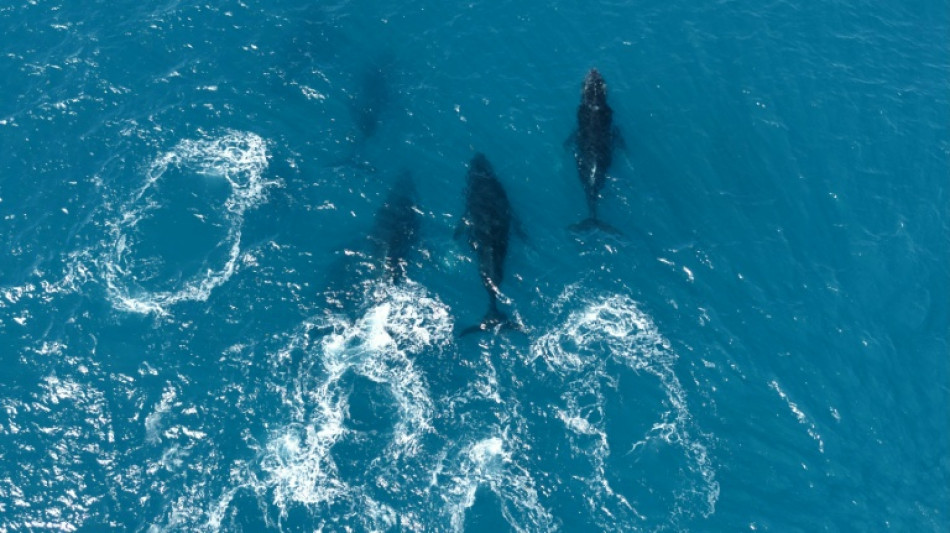
Female humpback whales off the coast of Brazil now have their pick of mates, who slap the water with their tails and jostle for attention -- a scene that would have been unthinkable a few decades ago.
Driven to near-extinction in the 1980s, there are now about 35,000 humpback whales in the South Atlantic, almost half of the world's total.
The warm waters off the coast of Brazil are the largest breeding ground for Southern Atlantic humpbacks. Males compete for the chance to mate, and females give birth and nurse their calves.
They also offer a bonanza to scientists who come each year to the Abrolhos archipelago off the coast of the state of Bahia to record and study hundreds of the cetaceans.
Four decades ago, no one even knew there were whales in Brazil, said Enrico Marcovaldi, founder of the Humpback Whale Institute (IBJ) -- one of Brazil's leading organizations researching and protecting the species.
The first time he saw one, he mistook it for a rock.
"They were legends. We had never seen one," Marcovaldi told AFP.
Humpback populations have thrived since a worldwide moratorium on commercial whaling in 1986.
The following year, Brazil banned the practice by law and later declared the Abrolhos breeding grounds a protected area.
In 2014, the humpback whale was removed from Brazil's list of threatened species, and its population has continued to thrive ever since.
- Family ties -
Wearing a life jacket and helmet, and armed with a crossbow, biologist Fabio Fontes pursues a group of males who are competing to mate with a female.
From his small boat, he fires an arrow that pierces the back of one whale before dropping into the water. He retrieves it with a sample of skin and blubber attached.
A team of scientists and journalists, including AFP, follows Fontes's moves from a catamaran.
Milton Marcondes, the IBJ's research coordinator, explained that the samples can be used to establish family ties between the whales, known for one of the longest migrations of any mammal on the planet.
Years ago, the researchers discovered that a humpback born in Abrolhos was related to another spotted off South Georgia, a remote island some 4,000 kilometers (2500 miles) to the south.
The finding helped establish the migration route of the animals, which can reach up to 16 meters (roughly 50 feet) long as adults and weigh as much as six elephants.
- AI identification -
A pattern of white markings against the black of a humpback's tail is its fingerprint -- a unique pattern that allows researchers to identify individual whales from photographs.
The comparison, which once required many pairs of eyes and hours of work, can now be done in seconds by Happy Whale, an artificial intelligence platform that has already identified 8,300 Brazilian humpbacks.
The tool helped uncover a world record: one humpback identified in Brazil was spotted more than 15,000 kilometers away off Australia's east coast, according to research published in May.
"We are seeing that populations in the Southern Hemisphere are much more interconnected than we imagined," Marcondes told AFP.
These days, the whales face threats from maritime traffic, fishing nets, and warming seas caused by climate change, which threatens the krill they survive on.
The IBJ has received financial support from Brazil's state oil company Petrobras for 30 years.
Petrobras, which drills for oil off Brazil and recently made new discoveries off the coast of the Amazon, supports several species recovery projects in the country.
In October, the Abrolhos archipelago was designated a "Hope Spot" by Mission Blue, founded by oceanographer Sylvia Earle, recognizing its rich biodiversity and importance to marine conservation.
M.Chau--ThChM