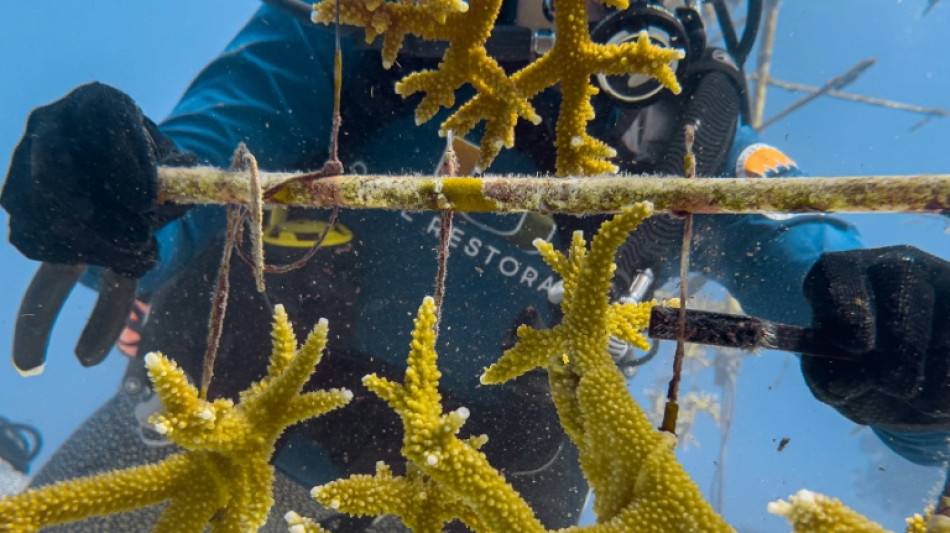
As oceans warm, Florida scientists hunt for heat-resistant coral / Photo: © AFP

Off Florida's coast, a team of scientists and trained volunteers in scuba gear descends to the ocean floor and begins planting young coral onto a reef and examining how others are faring in the increasingly warm waters.
It is part of a long-running "Rescue a Reef" program run by the University of Miami that aims to advance conservation efforts and raise public awareness.
Part of that work involves researching which coral species are able to better withstand rapidly warming oceans as a result of human-caused climate change.
"Certain species may be more resilient, where they're able to better survive and recover from thermal stress events," program manager Devon Ledbetter explained to AFP during a recent dive to Rainbow Reef about three miles offshore from Key Biscayne.
Coral reefs support vibrant marine ecosystems, but also act as breakwaters, protecting coastlines from storm-driven erosion and flooding.
The situation, however, is increasingly dire.
A record-breaking marine heat wave that began in 2023 left two ecologically vital coral species, elkhorn and staghorn, "functionally extinct" in Florida's Coral Reef, highlighting the growing dangers a warming climate poses for the world's oceans.
The National Oceanic and Atmospheric Administration believes that this fourth global coral bleaching event likely concluded in mid-2025. But the arrival of a very strong El Nino could bring a return to more widespread bleaching -- including in Florida's waters.
During the expedition, the participants go about their tasks diligently. Some coral species with fast-growing branches are planted onto "coral trees" that look like old television antennas and are suspended in the water column, with floats to keep them upright.
Others are placed onto table frames fixed to the ocean floor, and yet others are mounted onto plugs, screwed into a three-hole "cookie" and planted onto the reef.
These are given predation umbrellas to protect them from the hungry fish having a nibble.
Researchers place color reference charts around newly planted coral to record the pigmentation, a method used to monitor its health and detect early signs of heat stress.
Coral is made up of tiny individual animals called polyps, which maintain a symbiotic relationship with microscopic algae that live within their tissues.
When the algae are stressed by heat or pollution, however, they leave, causing the coral to "bleach" and become vulnerable to disease and death.
"Anecdotally, we've seen that Mountainous Star Coral tends to be the most resilient to bleaching and thermal stress," Ledbetter explained. So far, this summer the program has planted 615 coral, with 228 of those part of the thermal bleaching study. Their results are then given to state environmental and wildlife authorities.
The program began in 2015 and Ledbetter explained it exists both to serve science and educate the public -- but also to rebuild the ecosystem "one coral at a time."
The risks have never been higher. Even with the end of the fourth global bleaching event, sea surface temperatures are still higher than 25 to 30 years ago, when the first global coral bleaching event occurred, according to recent research published by NOAA in the journal Coral Reefs.
A.Zhang--ThChM