Malaysia's 'elephant whisperer' fights to save Borneo's endangered giants / Photo: © AFP

Deep in Malaysia's Borneo jungle, wild shouts fill the air as a Bornean elephant is darted and her angry herd rallies to protect her.
The downed elephant is one of only around 1,000 Bornean elephants left in the wild, and the team that darted her is working to protect the endangered species by minimising growing conflict between the animals and local communities.
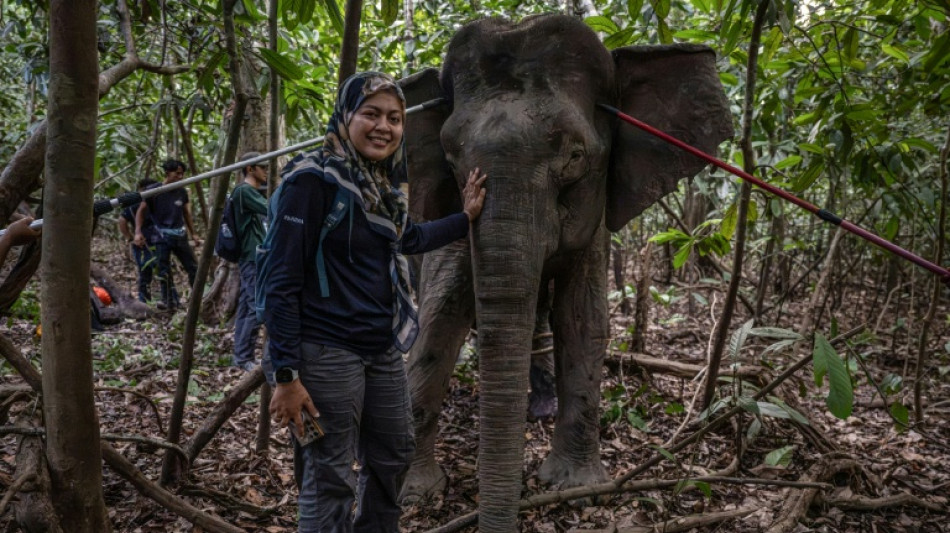
Once the herd has been chased off, conservationist Farina Othman and her team move in to attach a tracking collar to the animal.
The collar allows them to alert villagers if the elephant strays too near.
It is also key to a programme Farina is designing to create "corridors" for elephants roaming a fragmented landscape of virgin forest patches, hemmed in by vast oil palm plantations and villages.
Farina has studied these elephants for years, earning her the nickname "Borneo's elephant whisperer" as well as the prestigious Whitley Award for conservationists.
"It's Pigtail," she whispered, stroking the tranquilised elephant's trunk and nodding to the distinctive tail that prompted its nickname.
The team works fast -- the dart's sedative effects last only half an hour, and the herd can still be heard nearby. Overhead, there are flashes of lightning as a tropical thunderstorm approaches.
As soon as the collar is securely fastened and blood samples are taken, the team, accompanied by AFP journalists, retreat into the forest before Pigtail rouses.
- 'Conflict inevitable' -
For the past 40 years, Bornean elephants have lost more than 60 percent of their habitat in Sabah, in northern Borneo, to logging and, later, oil palm expansion, according to the International Union for Conservation of Nature, which listed the animal as endangered in 2024.
Lower Kinabatangan, a floodplain in eastern Sabah of around 400 square kilometres, is home to around 160 elephants.
But "only half of that is now a space left for the elephants," said Farina, a Malaysian academic who heads local conservation group Seratu Aatai, or "Solidarity" in the local Sungai language.
When the animals venture into private property or nearby villages, "conflict is inevitable", she told AFP.
In a recent incident, a herd of 20 elephants stomped into palm oil smallholdings and three villages, terrifying residents.
No one was injured, but the incident prompted calls for stronger deterrents, including upgraded electric fencing.
"People don't feel safe around elephants, and that's when conflict happens," Farina said.
The animosity worsens when the animals, especially adventurous bulls,which can weigh up to five tonnes, cleverly bypass electric fencing to feast on palm trees or saplings.
That is why Farina and her team of 17 conservationists prioritise coexistence.
"We're working to increase people's tolerance, to increase connectivity space for elephants and to find a long-term solution," she said.
Based in Sukau, a hamlet on the crocodile-infested banks of the Kinabatangan river, Seratu Aatai runs an outreach programme in plantation schools, distributes information pamphlets and has designated "community wildlife guardians" who help usher away elephants that have wandered into human habitation.
"Before, we didn't know how to manage living near them," said homestay owner Firah Kazenn, 21, who recently encountered elephants behind her home in Sukau.
"The elephants were unmonitored, and many were lost to conflict. Now, with the Seratu Aatai unit, they are protected, and the community is actively involved too," Firah told AFP.
"We've learnt safe ways to guide the elephants away when they come too close to our homes, without harming them," she added.
- 'Win-win situation' -
Farina believes the best way to protect the animals is by creating "elephant corridors" -- pathways through plantations connecting patches of habitat.
She is hoping to convince seven plantations in the area that elephants are "an ecological reality, rather than an occasional disturbance".
But it will be a challenge.
Fierce competition driven by tight, volatile margins means many producers are not keen to sacrifice land for corridors, said Muhammad Al Shafieq bin Mustafa, a former plantation manager in Sukau and now a palm oil industry specialist.
"Those plantations that do commit and are willing to work with people like Farina often do not get the recognition that they deserve or the financial support that they need, especially from Western palm oil buyers," he told AFP.
Industry-funded conservation associations say plantations have made progress in becoming sustainable palm oil producers but face difficult economic realities.
"It needs to be a win-win situation between the planters and also the wildlife," said Daniel Pamin, conservation and sustainability executive at the Malaysian Palm Oil Green Conservation Foundation.
Farina believes change will come.
Before, locals used the Malay word "halau", meaning "chase away" or "banish", when talking about elephants.
"Now, we are working to get people to say... 'walking' or 'escorting' out the elephant."
H.Ng--ThChM