The China Mail - Ghana reaches $3 billion IMF deal

USD -
AED 3.672504
AFN 64.503991
ALL 81.046102
AMD 360.780113
ANG 1.789785
AOA 917.000367
ARS 1523.143125
AUD 1.422273
AWG 1.8025
AZN 1.70397
BAM 1.745704
BBD 2.012675
BDT 123.586379
BGN 1.747831
BHD 0.377114
BIF 2995.403222
BMD 1
BND 1.277279
BOB 11.766859
BRL 4.965204
BSD 0.999331
BTN 94.818583
BWP 13.766234
BYN 2.934172
BYR 19600
BZD 2.009729
CAD 1.40025
CDF 2316.000362
CHF 0.825078
CLF 0.025294
CLP 995.510396
CNY 6.67805
CNH 6.670604
COP 3150.41
CRC 456.018209
CUC 1
CUP 23.982684
CVE 98.420137
CZK 21.719504
DJF 177.944392
DKK 6.67165
DOP 61.293346
DZD 134.335699
EGP 55.079216
ERN 15
ETB 162.538225
EUR 0.89267
FJD 2.237204
FKP 0.74764
GBP 0.747692
GEL 2.590391
GGP 0.74764
GHS 11.586558
GIP 0.74764
GMD 74.000355
GNF 8843.664926
GTQ 7.638684
GYD 209.291739
HKD 7.84235
HNL 26.828223
HRK 6.728204
HTG 130.968001
HUF 327.370388
IDR 18093.85
ILS 3.10555
IMP 0.74764
INR 94.945504
IQD 1514.883742
IRR 1832375.000352
ISK 121.780386
JEP 0.74764
JMD 158.593297
JOD 0.70904
JPY 156.860385
KES 129.754095
KGS 87.448604
KHR 4082.652742
KMF 439.503794
KPW 899.999961
KRW 1323.525039
KWD 0.31069
KYD 0.832775
KZT 453.715357
LAK 22486.722899
LBP 89486.053465
LKR 331.81595
LRD 170.375329
LSL 16.556076
LTL 2.95274
LVL 0.60489
LYD 6.399786
MAD 9.815504
MDL 18.037221
MGA 4519.123488
MKD 54.987281
MMK 2100.187629
MNT 3599.924651
MOP 8.073191
MRU 39.936627
MUR 47.160378
MVR 15.460378
MWK 1732.762083
MXN 18.668404
MYR 4.085304
MZN 63.903729
NAD 16.556076
NGN 1332.060377
NIO 36.774222
NOK 9.35739
NPR 151.709734
NZD 1.750854
OMR 0.38297
PAB 0.999241
PEN 3.431874
PGK 4.475387
PHP 63.618038
PKR 276.527424
PLN 3.92999
PYG 5779.443924
QAR 3.642612
RON 4.779804
RSD 105.321038
RUB 80.331771
RWF 1476.413621
SAR 3.751558
SBD 8.07458
SCR 13.982238
SDG 601.503676
SEK 9.931804
SGD 1.276904
SHP 0.7473
SLE 22.950371
SLL 20969.504398
SOS 571.07154
SRD 37.649504
STD 20697.981008
STN 21.868166
SVC 8.743696
SYP 13001.999685
SZL 16.555541
THB 33.770369
TJS 9.208462
TMT 3.51
TND 2.983978
TOP 2.40776
TRY 49.703804
TTD 6.789842
TWD 32.585804
TZS 2645.601821
UAH 45.239791
UGX 4402.195742
UYU 40.076762
UZS 11958.762887
VES 879.788904
VND 25842.5
VUV 119.07444
WST 2.767685
XAF 585.553409
XAG 0.018551
XAU 0.000250266221
XCD 2.70255
XCG 1.800955
XDR 0.707052
XOF 585.553409
XPF 106.448878
YER 236.103589
ZAR 16.57373
ZMK 9001.203584
ZMW 20.091043
ZWL 321.999592
SSP 5745.690365
MXV 2.106972
  • RYCEF

    0.4000

    19.71

    +2.03%

  • CMSC

    0.0000

    20.4

    0%

  • BTI

    0.4200

    56.05

    +0.75%

  • BP

    0.2800

    44.43

    +0.63%

  • RBGPF

    1.6000

    67

    +2.39%

  • RIO

    -0.1500

    94.41

    -0.16%

  • AZN

    -0.4300

    166.15

    -0.26%

  • GSK

    0.4600

    49.7

    +0.93%

  • BCE

    -0.4100

    20.56

    -1.99%

  • NGG

    -0.2500

    75.24

    -0.33%

  • VOD

    -0.0400

    16.58

    -0.24%

  • RELX

    -0.4500

    33.07

    -1.36%

  • BCC

    -0.5500

    76.59

    -0.72%

  • CMSD

    -0.0300

    20.27

    -0.15%

  • JRI

    -0.2500

    10.77

    -2.32%

Ghana reaches $3 billion IMF deal
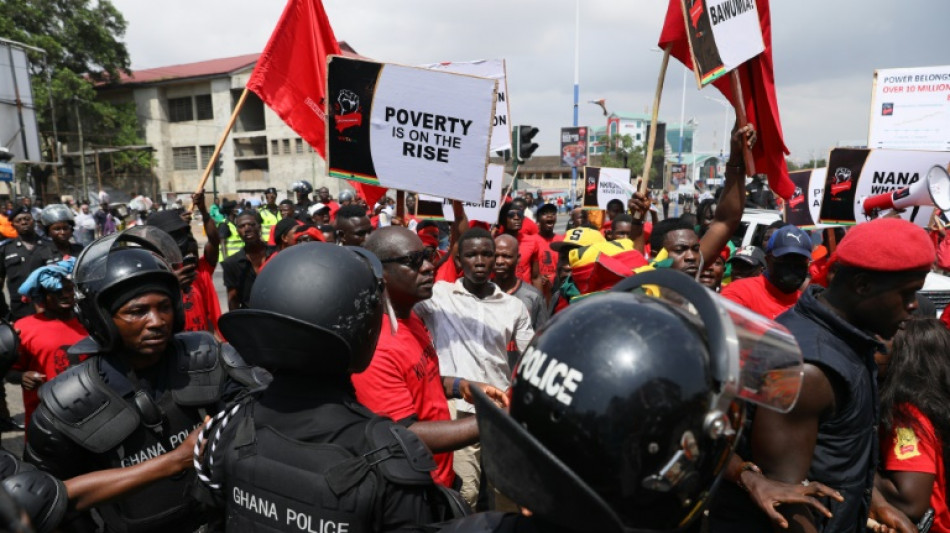
Ghana reaches $3 billion IMF deal / Photo: © AFP

Ghana reaches $3 billion IMF deal

Ghana on Tuesday agreed on a $3 billion credit deal with the International Monetary Fund (IMF) as part of the country's battle to end its worst economic crisis in decades.

Text size:

The West African state is facing more than 40 percent inflation, a risky debt burden and a sharp decline in its cedi currency since the start of the year.

The IMF said Ghana's government had committed to "a wide-ranging economic reform program" that will restore stability and debt sustainability.

"These are really grave times and in a really difficult economic environment," Finance Minister Kenneth Ofori-Atta told reporters in Accra.

"But this now today paves the way for the IMF management and executive board to approve Ghana's programme request early, hopefully, next year."

The three-year IMF loan agreement has yet to be approved by the fund's board.

The programme also aims to reduce inflation, strengthen the economy's resilience to external shocks and improve market confidence in the country, the IMF said.

A top cocoa and gold producer, Ghana also has oil and gas reserves, but its debt has soared and like the rest of sub-Saharan Africa it has been hit hard by fallout from the Covid pandemic and the Ukraine war.

The crisis forced President Nana Akufo-Addo's government to reverse its position earlier this year and seek IMF help as economists warned of a default on debt payments.

The government has already announced a domestic debt swap as part of the programme to ease a crunch in payments and is soon expected to release details about restructuring foreign debt.

- 'Good news' -

IMF mission chief Stephane Roudet said IMF board approval for the deal would come after Ghana's creditors give assurances and the debt exchange programme is shown to be sufficient.

"What is very important for the IMF is that the government strategy as a whole be sufficient to put debt on a sustainable path and to bring debt sustainability over the medium term," he said.

The government has already increased VAT by 2.5 percent and frozen state-sector hiring to help trim spending and boost domestic revenues.

Officials say vulnerable groups will be protected, but critics are concerned the government programme will lead to more austerity.

"Ghana having reached a staff level deal with the IMF is quite good news, although we have yet to get the full details. But on the whole, it will facilitate the final approval," Ghanaian economist Daniel Anim Amarteye said.

"The government really needs the bailout to bring about macroeconomic stability and credibility."

Debt payments currently gobble up more than half of government revenues. A 50 percent slide in the cedi against the dollar has also increased Ghana's debt values by $6 billion this year.

Major credit ratings agencies have downgraded their outlook on Ghana, reflecting market worries that the country risked missing debt payments.

The IMF negotiations came after a new tax on electronic transactions, known as the E-levy, faced resistence and failed to generate expected revenue levels for the government.

Z.Huang--ThChM