The China Mail - NATO debates raising defence spending target

USD -
AED 3.672501
AFN 65.000326
ALL 80.892919
AMD 361.32971
ANG 1.789785
AOA 916.999859
ARS 1525.770399
AUD 1.426076
AWG 1.80125
AZN 1.700372
BAM 1.745603
BBD 2.015941
BDT 123.789462
BGN 1.747831
BHD 0.377732
BIF 3002.048312
BMD 1
BND 1.278595
BOB 11.765756
BRL 5.0436
BSD 1.000919
BTN 94.841883
BWP 13.749922
BYN 2.959737
BYR 19600
BZD 2.012996
CAD 1.40324
CDF 2316.000101
CHF 0.821855
CLF 0.024903
CLP 980.119732
CNY 6.67805
CNH 6.673525
COP 3197.66
CRC 456.813374
CUC 1
CUP 24.020564
CVE 98.41267
CZK 21.64665
DJF 178.22224
DKK 6.669799
DOP 61.426136
DZD 134.856023
EGP 55.181899
ERN 15
ETB 163.9445
EUR 0.89233
FJD 2.24975
FKP 0.746996
GBP 0.747575
GEL 2.590175
GGP 0.746996
GHS 11.600632
GIP 0.746996
GMD 72.99968
GNF 8858.324817
GTQ 7.649259
GYD 209.368334
HKD 7.83968
HNL 26.867244
HRK 6.728601
HTG 131.144176
HUF 326.895018
IDR 18074
ILS 3.107096
IMP 0.746996
INR 94.803897
IQD 1517.355874
IRR 1832375.000007
ISK 121.479582
JEP 0.746996
JMD 158.89648
JOD 0.709062
JPY 157.024498
KES 129.806428
KGS 87.449101
KHR 4071.869115
KMF 439.501063
KPW 899.999961
KRW 1324.496669
KWD 0.31046
KYD 0.834099
KZT 448.369735
LAK 22529.164472
LBP 89631.371779
LKR 332.234038
LRD 170.644961
LSL 16.508029
LTL 2.95274
LVL 0.60489
LYD 6.41191
MAD 9.82386
MDL 17.976204
MGA 4538.679186
MKD 54.926488
MMK 2100.035197
MNT 3598.866322
MOP 8.08237
MRU 39.995002
MUR 47.11987
MVR 15.459594
MWK 1735.587351
MXN 18.75362
MYR 4.083994
MZN 63.903439
NAD 16.507071
NGN 1331.889945
NIO 36.836045
NOK 9.35976
NPR 151.747191
NZD 1.760055
OMR 0.384506
PAB 1.000919
PEN 3.438519
PGK 4.482268
PHP 63.519501
PKR 277.015213
PLN 3.898945
PYG 5738.944945
QAR 3.658368
RON 4.769403
RSD 104.893972
RUB 81.501091
RWF 1479.33272
SAR 3.742715
SBD 8.07458
SCR 13.775995
SDG 601.503214
SEK 9.91506
SGD 1.277575
SHP 0.7473
SLE 23.920227
SLL 20969.504398
SOS 572.043164
SRD 37.735503
STD 20697.981008
STN 21.867776
SVC 8.757313
SYP 13001.999685
SZL 16.505197
THB 33.741501
TJS 9.203388
TMT 3.51
TND 2.982913
TOP 2.40776
TRY 49.617098
TTD 6.792399
TWD 32.558968
TZS 2646.654982
UAH 45.101592
UGX 4288.761748
UYU 40.127988
UZS 11917.905419
VES 879.788897
VND 25851.5
VUV 118.676507
WST 2.769234
XAF 585.330098
XAG 0.017878
XAU 0.000245845518
XCD 2.70255
XCG 1.803868
XDR 0.707052
XOF 585.330098
XPF 106.446977
YER 236.097801
ZAR 16.5147
ZMK 9001.198572
ZMW 20.093362
ZWL 321.999592
SSP 5745.343966
MXV 2.116716
  • RYCEF

    0.4000

    19.71

    +2.03%

  • CMSC

    0.0000

    20.4

    0%

  • BTI

    0.4200

    56.05

    +0.75%

  • BP

    0.2800

    44.43

    +0.63%

  • RBGPF

    1.6000

    67

    +2.39%

  • RIO

    -0.1500

    94.41

    -0.16%

  • AZN

    -0.4300

    166.15

    -0.26%

  • GSK

    0.4600

    49.7

    +0.93%

  • BCE

    -0.4100

    20.56

    -1.99%

  • NGG

    -0.2500

    75.24

    -0.33%

  • VOD

    -0.0400

    16.58

    -0.24%

  • RELX

    -0.4500

    33.07

    -1.36%

  • BCC

    -0.5500

    76.59

    -0.72%

  • CMSD

    -0.0300

    20.27

    -0.15%

  • JRI

    -0.2500

    10.77

    -2.32%

NATO debates raising defence spending target
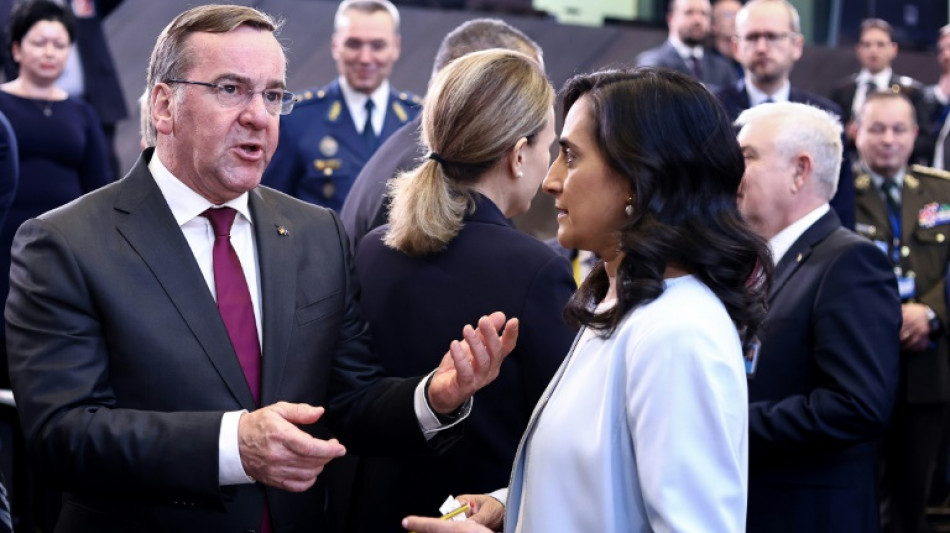
NATO debates raising defence spending target / Photo: © AFP

NATO debates raising defence spending target

NATO members relaunched debate Wednesday on the thorny issue of ramping up national defence spending targets as Russia's war on Ukraine has upended security.

Text size:

Moscow's nearly year-long all-out invasion of its neighbour has seen a string of European allies commit to spending billions more on their armed forces.

Some at the US-led Western military alliance are now pushing to enshrine the increases by using an upcoming summit in Vilnius in July to raise NATO's current target of two percent of GDP.

Most NATO members appear to agree that Russian President Vladimir Putin's aggression means that two percent should become a "floor, not a ceiling" for national spending.

"I believe that simply wanting to approach the two percent target will not be enough. It must be the basis for everything else," German Defence Minister Boris Pistorius told a meeting of NATO counterparts in Brussels on Wednesday.

But some nations are reluctant to make the target too ambitious or the commitment too concrete.

"The two percent is okay, but we must also guarantee that we have some flexibility because the countries are different," said Luxembourg's Defence Minister Francois Bausch.

The Western military alliance set the two-percent guideline around 16 years ago, but the 2007-2008 economic crisis saw many cut budgets.

Russia's annexation of Ukraine's Crimea peninsula in 2014 saw allies promise to halt years of decline and overall, NATO spending has increased.

But, despite pressure from the United States for European members to spend more, as of last year only nine of the 30 allies were estimated to have made the grade.

- 'Increasers' vs 'deniers' -

A senior US official said the alliance was split into several camps

At one end were the "increasers", such as the Baltic states and Poland, closer in proximity to Russia and pushing for a more ambitious level such as 2.5 percent.

At the other were the "deniers", such as Canada, Italy, Luxembourg and Spain, which argue they are too small or that contributions such as overseas operations should be taken into account.

The official said the United States did not have a specific new figure in mind, but there was a lot to do as NATO pushes to restructure its forces, replenish depleted weapons stockpiles and modernise equipment.

"Taken together, I think the obvious conclusion is two percent is not enough," the official said.

"I'd say that's where the majority of the allies are."

Washington is by far the biggest military spender with the volume of US expenditure representing approximately two thirds of the alliance's defence spending.

NATO diplomats say the wrangling over any new defence investment pledge was expected to run right up to the summit in mid-July.

European heavyweight France also backed the two-percent minimum but said additional spending must be well focused.

"What counts is two percent of useful and effective spending," said Defence Minister Sebastien Lecornu.

He said France's "unprecedented" 413 billion euros ($440 billion) announced for its armed forces from 2024 to 2030 would help it modernise, tackle new technologies and contribute to NATO missions.

X.So--ThChM