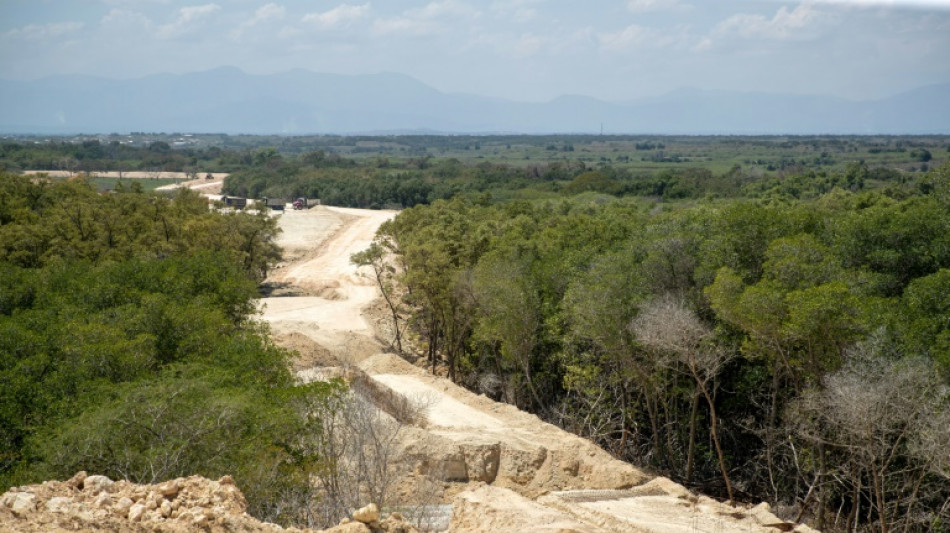
Dominican border wall threatens environment, mangroves / Photo: © AFP/File

The anti-migrant wall being built in the northwest of the Dominican Republic crisscrosses a thick mangrove forest and threatens the ecosystem by depriving it of water, environmental groups warn.
The Dominican government wants to build a 160 kilometer (100 mile) concrete fence along the 380 kilometer border with Haiti to prevent illegal migrants from entering, and to "protect" the country from Haitian gangs with growing influence.
Each year, between 100,000 and 200,000 Haitian immigrants are deported (171,000 in 2022) in an atmosphere of xenophobia and high tension between the two neighbors that share the mountainous Caribbean island of Hispaniola.
But the Dominican Academy of Sciences believes that the damage to the wetlands in Monte Cristi National Park in the northwest of the country is simply "irreparable."
The Ministry of Defense, which is carrying out the work, asserts that "only 6 square kilometers (2.3 square miles) have been affected", or 0.04 percent of the wetlands.
Yet from the top of a hill, Roque Taveras, an official of the Ministry of the Environment, pointed to a section of wall 250 meters (820 feet) long which crosses the wetlands.
The watercourse of "the gorge which feeds the mangrove has been interrupted," he pointed out to AFP.
Work has been temporarily halted on this section by order of environmental authorities, who are demanding the construction of 16 culverts that would allow water to flow.
On both sides of the trench in the middle of the mangrove, which can reach more than 20 meters (65 feet) high, lie the trunks of felled trees.
- Rich ecosystem -
"This mangrove, the red mangrove, was hundreds of years old. How long does it take for a new mangrove to reach this size?" asked Taveras, referring to promises of reforestation.
The national park's ecosystem is rich with four types of mangroves that grow in the Dominican Republic, he explained.
"The red (Rhizophora mangle), the white (Laguncularia racemosa), the black (Avicennia germinans) and the buttonwood (Conocarpus erectus)."
The mangroves are home to the blue crab (Cardisoma guanhumi), nicknamed "Paloma de Cueva" (cave pigeon) by the Dominicans.
This crustacean, whose claws can reach 15 centimeters (six inches) in length, is one of the species classified as "vulnerable" by the authorities due to the reduction of its habitat but also to excessive trapping for human consumption.
There are also small fiddler crabs (Leptuca pugilator), gray pigeons (Patagioenas inornata), several species of herons and some rare caimans.
In addition to ecosystems, the wall also has "a very negative impact" on local tourism, Hiciar Blanco, 49, president of Manzanillo EcoAventura, an agency which organizes visits and promotes the preservation of the region.
"It has already started to affect us because it was an area where we came to show the mangroves to tourists," he says.
When the border fence is complete, "we won't have easy access," he points out, because much of the mangrove forest is on the Haitian side.
He also voiced disappointment that an ecological watchtower project from the University of Pennsylvania was ignored by the authorities.
Local fishermen who "feed their families through responsible fishing" will also have "problems," said the conservationist, who sports a sailfish tattoo on his forearm.
He said the upheaval created by the wall will upset the sensitive balance of fish species.
M.Zhou--ThChM