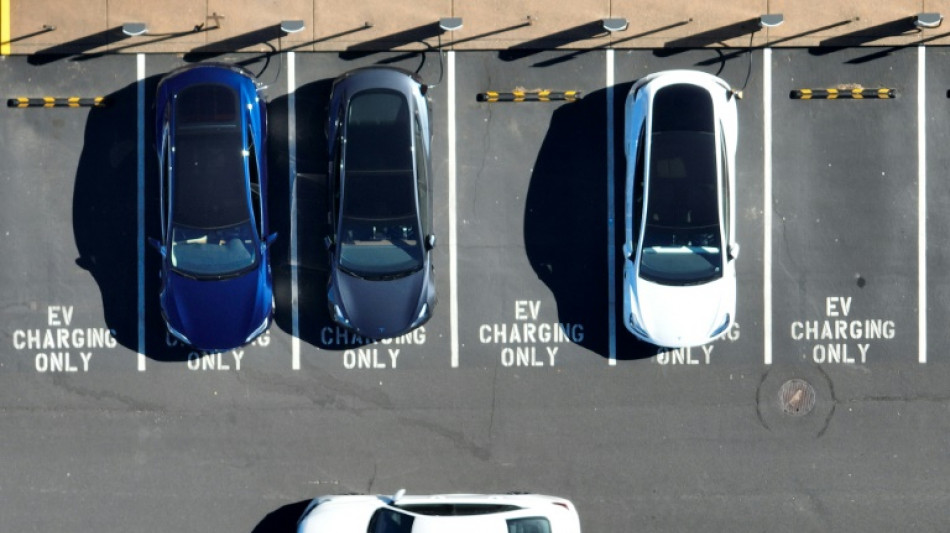
US expands access to EV subsidies in proposed rules / Photo: © GETTY IMAGES NORTH AMERICA/AFP/File

US officials proposed Friday guidelines that widen access to electric vehicle subsidies, bringing relief to countries like Japan and potentially the EU amid their fears of being excluded from Washington's spending bonanza.
President Joe Biden's ambitious climate action plan, the Inflation Reduction Act (IRA), funnels some $370 billion into subsidies for America's energy transition, including tax breaks for US-made electric vehicles (EVs) and batteries.
Guidelines released Friday by the Treasury Department spell out requirements that EV batteries have to meet for vehicles to qualify for a full $7,500 consumer tax credit.
While the IRA stipulates that a percentage of critical minerals in the battery must be sourced from America or countries it has free-trade pacts with -- initially leaving Japan and the European Union in the cold -- Friday's announcement signals room for maneuver.
The rule "could include newly negotiated critical minerals agreements," said the Treasury Department in a statement.
It added that 21 countries, Japan among them, are included.
The confirmation comes days after the United States and Japan unveiled a deal on critical minerals trade to reinforce supply chains in a sector dominated by China.
The EU and US are currently in talks for a similar pact as the transatlantic partners seek a way to end their spat over Washington's subsidy plans.
European leaders have been concerned that EU-based energy and auto companies will be shut out or move to the United States.
European Commission Executive Vice-President Margrethe Vestager told reporters in Washington this week that the whole world was "behind the curve" when it came to net-zero industries and that an acceleration was needed in Europe, the US and other countries.
"What we're trying to solve now is that the acceleration that we were about to have in Europe is not potentially stopped while you have an acceleration in the US," she said.
But following Friday's announcement, US Senator Joe Manchin added that the Treasury's guidance "completely ignores the intent" of the IRA in bringing manufacturing back to America.
"American tax dollars should not be used to support manufacturing jobs overseas," he said.
- Alternate supply chains -
"Given China's currently dominant position in the clean energy supply chain, we need to work with our allies and partners to build a resilient alternate supply chain that can meet the demand among American consumers," said a senior Treasury official on condition of anonymity.
A US official told reporters that the new rules create incentives for countries' production to go towards US partners or America itself, instead of passing through China.
Rare earth elements and minerals such as lithium are increasingly important given their use in clean energy technologies, but the United States is set to face gaps in supplies when it comes to meeting projected demand for EVs.
Under the IRA, eligible clean vehicles may not contain battery components made by a "foreign entity of concern" starting in 2024, and should not contain critical minerals extracted, processed or recycled by such an entity from 2025.
But US officials held off providing further details Friday on this provision.
The rules released by the Treasury added that eligible vehicles for the tax credit should not exceed a retail price of $80,000 for a van, pickup truck or sport utility vehicle, or $55,000 for other vehicles.
The notice will be published in the Federal Register on April 17.
G.Tsang--ThChM