One family, five candidates: dynasties rule rural Thailand / Photo: © AFP

Politics is a family affair for the Thienthong clan, one of Thailand's most enduring political dynasties, with five members running in next month's general election, for two different parties.
They are one of a number of families woven into the fabric of Thai politics -- the most famous of which is the Shinawatras, whose patriarch Thaksin was prime minister from 2001 to 2006 and continues to loom large from exile abroad.
The financial rewards of elected office -- an MP earns around $3,500 a month -- may be little more than loose change to these ultra-wealthy clans, but the influence it brings can be highly profitable to their business interests.
The Thienthong family built their wealth on a successful logistics business in their eastern heartland -- which includes a major border crossing to Cambodia -- and have dominated the region's politics since the 1970s.
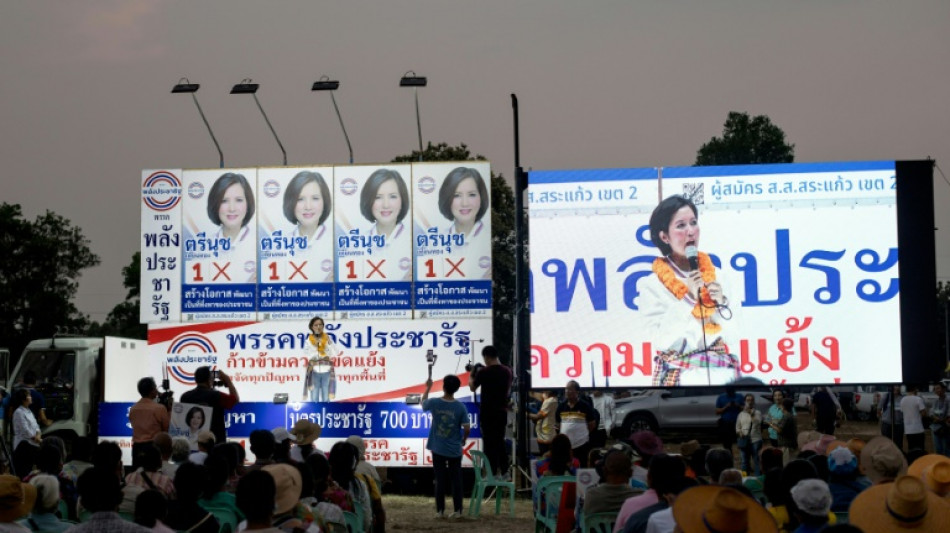
In the run-up to the May 14 vote, theirs is the name plastered on campaign posters along the rough country roads of poor, rural Sa Kaeo province.
Kwanruen Thienthong, her daughter Treenuch and nephew Sorawong are all contesting the three constituency seats up for grabs in Sa Kaeo.
Sorawong is running for Pheu Thai, the main opposition party riding high in the polls, while the two women are with the army-backed Palang Pracharath Party (PPRP) which led the outgoing ruling coalition.
Sorawong's brothers are also running for Pheu Thai: Surachart in a Bangkok constituency, and Surakiat, on the party list.
"Politics is politics. Family is family. We have different standpoints in politics but we're still family," Sorawong tells AFP.
Treenuch began her career as an MP with a forerunner party of Pheu Thai more than 20 years ago but switched to PPRP, was re-elected in 2019 and serves as education minister.
For voters in Sa Kaeo the family's track record on the ground matters more than party names or political ideology.
"They go down to every area and when there's work or there are requests for help from the locals, they help," Treenuch supporter Sirinthip Sawangkloi told AFP at a noisy rally.
- Local base -
Rural Thailand is threaded with the influence of these rich, powerful clans and part of their local support rests on personal as well as political interventions.
"When my cousin died, I went to ask them to be in charge of the funeral and they did, so that's why I cannot abandon them," Boonma Noinamkhum, another Treenuch supporter, told AFP.
To voters, they can offer a measure of local stability and influence in a kingdom with a turbulent political history, marked by a dozen coups since the end of absolute monarchy in 1932.
Pasuk Phongpaichit, an economist at Bangkok's Chulalongkorn University, said this flourished in the upheavals that shook Thailand in the 1970s and 1980s.
"In that period... they could make a lot of money and influence from a system with no rule of law, and symbiotic relationship with local military, local police and influential bureaucrats," Pasuk told AFP.
"Once they became rich, they could establish power over the local MPs. They then saw an opportunity to enter politics."
But political power was not enough to save Thaksin, a former telecoms tycoon ousted in a coup in 2006 and now living in self-exile abroad to avoid corruption charges he says are politically motivated.
Despite these reverses, Forbes still values his fortune at over $2 billion, though this puts him only 14th on its Thai rich list, far behind the Chearavanont brothers who own Thailand's biggest conglomerate, CP Group.
And the Shinawatras' influence in Thai politics has not waned: Thaksin's sister Yingluck was PM from 2011-14 and his daughter is one of Pheu Thai's candidates for the job this time.
- Resilience -
For nearly 50 years, in the National Assembly and in the cabinet, the Thienthongs have been part of the Thai political landscape and in the 1990s, they had a reputation for making or breaking governments.
Aside from the five candidates this year, Treenuch's brother Thanit was elected as an MP five times, last time defeating another Thienthong, Sonthidej.
But in the wake of the youth-led street protests calling for political change in 2020, the upcoming election could mark a turning point for these clans, said Pasuk.
"This election has two systems. The one that has been dominated by political families, and the new generation of young voters who are more likely to find parties with ideology and long term programmes more attractive. Which one will win this time? It is very uncertain," she told AFP.
But the dynasties have shown a remarkable resilience and adaptability to survive in the topsy-turvy world of Thai politics.
S.Davis--ThChM