'Future Yugoslavs' emerge in Serbia to resist nationalism

Every year, a small group of elderly people in well-worn World War II uniforms bedecked with Communist paraphernalia queue in Belgrade to pay their respects to their former leader, Josip Broz Tito.
But decades after the bloody breakup of the Yugoslav federation, a younger contingency has also begun to fill the ranks to commemorate Tito's death and pine the loss of a socialist federation that once united a divided region.
Amid the virulent nationalism that is common in Serbia and across much of the Balkans, these young people are embracing the "Yugoslav" identity of old.
A growing number went so far as to register as "Yugoslav" during a recent census in Serbia.
Ivan Cvetkovic, a 23-year-old economics student in Belgrade, was among the declared Yugoslavs.
One of his parents is Croatian, the other Serbian -- "a mixed marriage" -- so he does not consider himself to be more one nationality than the other.
"In the Balkans, we share the same language, history and mentality," he told AFP. "Being Yugoslav is just natural for me."
- The rise and fall -
Formed in the ashes of World War II by Tito and his band of socialist partisans, Yugoslavia stretched from the Adriatic coast bordering Italy to the frontier with Greece to the south, comprising six republics and two autonomous areas.
For over four decades, the federation largely prospered compared to other socialist nations, with its citizens able to travel abroad and enjoy comfortable living standards at home.
But following Tito's death in the early 1980s, the country began to tear at the seams. Nationalism returned with a vengeance, sparking a series of wars in which more than 130,000 died.
Bosnia, Croatia, Montenegro, North Macedonia, Slovenia and Serbia were carved from the ruins, while Kosovo has struggled for decades for its own independence.
Yugoslavia was relegated to the dustbin of history and the ambitious goal of uniting the disparate ethnic and religious groups in the region under a single identity lay in tatters.
But for those nostalgic for the prosperity and salad days of their youth, being Yugoslav carries a powerful meaning.
"I am Yugoslav... It will be like that until my death," said Zivko Mitrev, 78, who travelled from Northern Macedonia to put flowers on Tito's grave.
- 'Resistance' -
The rebirth of the Yugoslav identity is still in its infancy but is increasingly palpable, especially in Serbia.
During the country's last census, in 2022, approximately 27,000 people declared themselves Yugoslavs, up from 23,000 in 2011 -- a rare jump in numbers for a country with a falling population.
For many, it is also a form of protest.
"I see Yugoslavianism as a type of resistance, a more responsible and more natural form of anti-nationalism," Viktor Ivancic, a prominent journalist from Croatia, told local media.
"If someone can be a Serb or a Croat based on their nationality, then I can be a Yugoslav based on my lack of nationality."
In Serbia, authorities recognise around 20 ethnic minorities. This entitles the communities with public funding to help preserve their culture, along with certain electoral advantages at the ballot box.
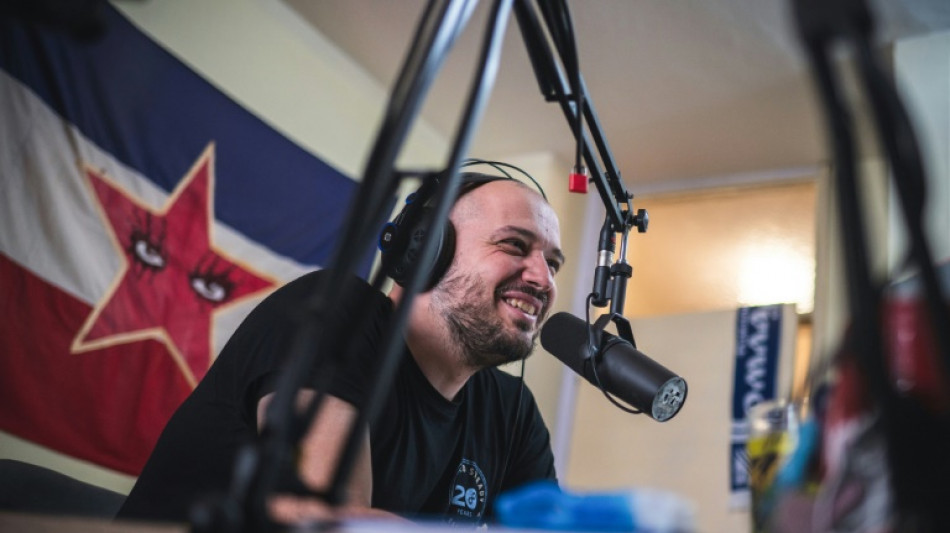
Some, like the popular Serbian author and radio host Dasko Milinovic, are hopeful this official status will be extended to the Yugoslavs, who outnumber about half of the official listed minorities.
For Milinovic, Yugoslavia's dissolution decades ago should stand as no barrier to recognising the group.
"The kingdom of Ruthenia died a long time ago but the Ruthenians still exist.
"Wallachia has been gone for a while.
"The Roma, as far as I know, never had a country but they are still Roma," he told AFP.
Over a decade ago, Serbian officials dismissed a formal bid to recognise Yugoslavs, citing a lack of "language, alphabet and literature".
Milinovic described the government's response as laughable, saying Yugoslavia had an official language, two alphabets and was home to the acclaimed author Ivo Andric, who won the Nobel Prize for literature.
"All nations are invented and represent a political idea. The nation does not exist in a natural state, otherwise bears, birds and squirrels would have one," Milinovic said.
- 'The future' -
A renewed push for recognition, however, might find a receptive audience, according to one official.
"As a citizen of this country that upholds liberal beliefs, of course I support this," Tomislav Zigmanov, Serbia's human and minority rights minister, told AFP.
If the community is able to gather 11,000 signatures -- or 40 percent of people who registered as Yugoslavs in the census -- then the initiative could potentially be adopted.
And while many have embraced the Yugoslav identity in a fit of nostalgia, for Milinovic and others their decision is more about creating a better future where progressive ideas trump nationalism.
"We are not ex-Yugoslavs. We are future Yugoslavs," Milinovic said. "This is not about former Yugoslavia but the future one."
K.Lam--ThChM