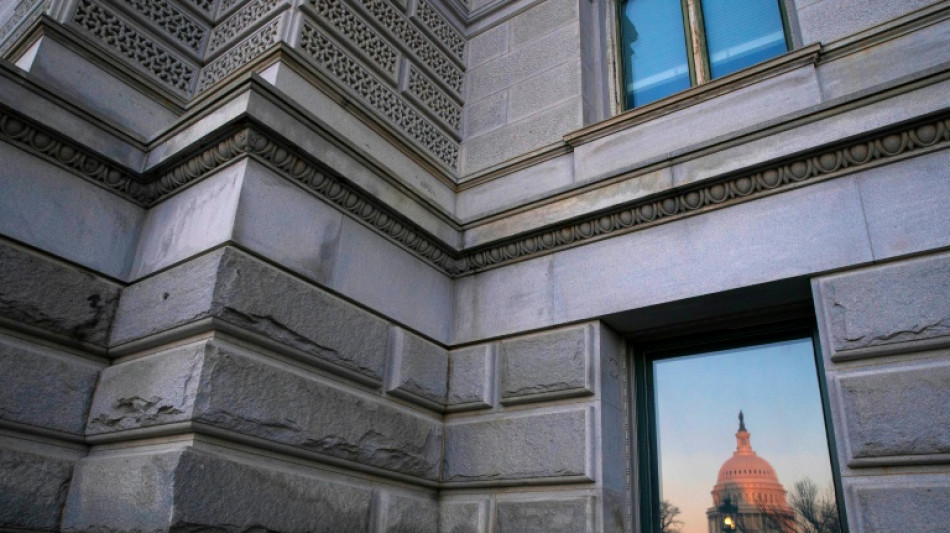
What happens if the US fails to raise its debt ceiling? / Photo: © GETTY IMAGES NORTH AMERICA/AFP/File

President Joe Biden and Republicans in Congress have resumed crunch talks aimed at averting a damaging US debt default, which Treasury officials recently warned could come as early as June 1.
Biden has maintained that default would have "catastrophic" consequences, and is urging Republicans to agree to a "clean" increase to US borrowing limits -- known as the debt ceiling -- before the deadline is reached.
Republicans have pushed back, insisting they want an agreement from Democrats to commit to less spending in future in order for their support to extend the nation's borrowing authority.
Here is what could happen in the United States, and around the world, if the US fails to raise the debt ceiling:
- What would it mean for financial markets? -
If the Treasury is unable to meet all of its financial obligations, analysts forecast that US stock markets would likely suffer a sharp, temporary shock.
Along with a decline in US stocks, interest rates would spike, especially Treasury yields and mortgage rates, Moody's Analytics economist Bernard Yaros told AFP.
"That would lead to higher borrowing costs for consumers, for corporations," he said.
Households or businesses who fail to receive federal payments owed would likely pull back on near-term spending due to their loss of income, while consumer confidence may worsen, hurting the economy, Yaros said.
But any shocks are expected to be short-lived, with politicians likely to respond forcefully to any meaningful market reaction.
"I also would expect that once the deal's done the markets bounce back," Citigroup Global Chief Economist Nathan Sheets told AFP.
"I don't think that this episode is likely to be sufficiently long-lived that we should be calculating lower GDP forecasts," he said.
- What would it mean for government? -
Even if the United States misses the so-called X-date -- when the government runs out of money to meet all its financial obligations -- it will still have options.
It could, for instance, choose to prioritize debt repayment and delay other payments -- such as to federal agencies, Social Security beneficiaries, or Medicare providers.
This is the most likely scenario, according to Wendy Edelberg, senior fellow in economic studies at the Brookings Institution.
During a similar debt ceiling stand-off in 2011, Treasury officials drew up contingency plans to prevent a default on Treasury securities, and to ensure the Treasury would continue to pay interest on those securities as they come due.
A government shutdown would be unlikely, although federal workers' paychecks could be delayed, Edelberg said.
- What would it mean for global economy? -
Even if the US misses the X-date but continues repaying investors, the consequences of the political failure to reach agreement would likely ripple through global markets.
The government's inability to pay all its bills "would raise serious doubts about the nation's creditworthiness, sap the confidence of lenders, call into question the dollar's place as a reserve currency, and increase federal borrowing costs," Paul Van de Water from the nonpartisan Center on Budget and Policy Priorities wrote in a recent blog post.
"Under the present circumstances, even the serious threat of a US default could be enough to roil markets and further damage the global economy," he said.
In the unlikely event of a default, the consequences would be substantial, according to Eric Dor, director of economic studies at IESEG business school in France.
"The interest rates charged by investors on bonds issued by the United States would rise sharply," as would private debt, which uses US government debt as a benchmark, he said.
"This increase in the cost of credit would cause a drop in business and household investment, as well as in consumption, and thus a sharp recession in the United States," Dor continued, adding it could also cause a recession in Europe and elsewhere.
"A default would destabilize the global financial system, which depends on the stability of the dollar as the world's safe asset and primary reserve currency," Jean Ross from the nonpartisan Center for American Progress wrote in a recent article.
"A loss of confidence in the dollar could have far reaching economic and foreign policy ramifications, as other countries, particularly China, would use default to push for their currency to serve as the foundation of global trade," she said.
- Could US debt be downgraded? -
As the X-date draws closer, investors are nervously watching the ratings agencies for signs of a possible downgrade to US debt.
This last happened back in 2011, when a similar debt ceiling stand-off led ratings agency S&P to lower its US credit rating from AAA to AA+, drawing bipartisan outrage.
Even if the United States hits the debt ceiling but continues paying its bills, the ratings agencies will likely take note, according to Nathan Sheets from Citi, underscoring the need for a negotiated agreement ahead of time.
"Debates about whether or not you pay occurring periodically is typically not a feature that you would associate with a top credit" rating, he said.
W.Cheng--ThChM