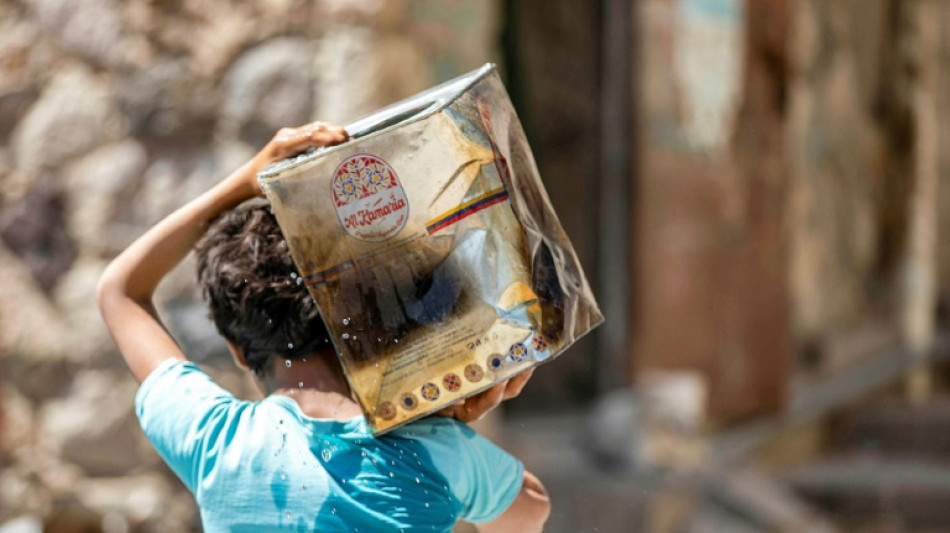
Children in war-scarred Yemen line up for water, not school / Photo: © AFP

Every day at dawn, 14-year-old Salim Mohammad leaves home to fetch water, trekking through his city in southwestern Yemen to join the queues at the nearest public dispenser.
He and his three siblings walk at least a mile (1.6 kilometres) and wait, sometimes for hours, hoping to fill their jerry cans and make it back in time for school.
"My arms and my back hurt from the load I carry every day," Mohammad told AFP from the family's makeshift apartment, a former grocery store, in the city of Taez.
"We wake up in the early morning and leave home with our father, sometimes even at night, to collect water," he said.
The teenager's plight is common in Yemen, which had ranked among the world's most water-stressed countries even before conflict broke out in 2015 between Iran-backed Huthi rebels and a Saudi-led coalition supporting the ousted government.
The dire mix of war and climate change has only aggravated the country's water woes.
Fighting has ravaged critical infrastructure while rising temperatures and varying precipitation have further hit supply, experts and aid groups say.
Yemen's groundwater is being depleted at twice the rate it is being replenished, according to the Food and Agriculture Organization of the United Nations (FAO).
At the current rates, the Arabian Peninsula's poorest country could completely run out of groundwater within 20 years, the FAO says.
"We wake up every morning and race after water," said Mohammad's mother, Umm Mujahid.
"Sometimes we get it, sometimes we don't... it's a competition," the 35-year-old said, as her children filled containers at the public tank, one of several around the city.
- 'Tragic consequence' -
The family fled fighting in the Red Sea port city of Hodeidah to move to Taez, a government holdout that has been surrounded and besieged by the Huthis for years.
Yemen's third-biggest city suffers from some of the worst shortages in a country where about 14.5 million people -- nearly half of the population -- do not have access to safe drinking water, according to the FAO.
The country's piped water network reaches less than 30 percent of Yemenis, forcing millions to rely on private companies or unsafe wells, said Ralph Wehbe of the International Committee of the Red Cross (ICRC).
"Children are particularly vulnerable," said Wehbe, the deputy head of the ICRC's delegation in Yemen.
With water in such short supply, many parents need the help of their children in obtaining it.
"They are forced to spend hours collecting water for their families... instead of going to school," he told AFP from Sanaa.
"This is a tragic consequence of the water crisis."
And the scarcity of water can have extreme repercussions.
Last month, a video circulating on social media purported to show a girl stabbed to death by her neighbour in the capital Sanaa over access to a water tank. AFP could not independently verify the footage.
In April 2022, local media reported a deadly accident in Taez when a water truck ran over women and children waiting to collect water.
The search for water has become part of daily life in the city, where young boys and girls can often be seen lugging containers nearly half their height, and once filled, very heavy for a child to carry back home.
- 'Not a drop' -
Samir Abdulwahid, the director of Taez's water authority, said the city is currently fed by 21 water wells as opposed to 90 before the war, blaming the Huthi siege.
"Water availability in Taez is around 0.7 litres per person per day," he said.
"Many areas in Taez, around 60 percent of the city, have not received a drop of water since the start of the war."
Children are bearing the brunt of the crisis, Abdulwahid said.
"The children are not going to school," he told AFP. "They are forced to go to distribution points instead to get their share of water."
The University of Notre Dame's Global Adaptation Initiative ranks Yemen as one of the region's most climate-vulnerable countries.
Rising sea levels and flash floods make groundwater salty and introduce pollution including sewage, according to Maha Al-Salehi, a researcher with Yemeni environmental consultancy firm Holm Akhdar.
"The water crisis in Yemen does not only include diminishing availability, but also poor quality, accessibility and affordability," she told AFP.
"This doesn't only put Yemenis on the ground in extreme water insecurity but also food insecurity as the majority of the water goes to agriculture."
Even if Yemen's conflict is resolved, water shortages will persist, Wehbe said.
"The issue of water scarcity is going to continue even if Yemen were to return to peace tomorrow," he said.
X.So--ThChM