Norway's quest for 'black gold' from used car batteries / Photo: © AFP

Wearing a white lab coat and with a gas mask within reach, Ole Jorgen Gronvold measures the humidity of an intriguing dark powder touted as the planet's next "black gold".
But this "black gold" -- a term that usually refers to oil -- is actually good for the Earth.
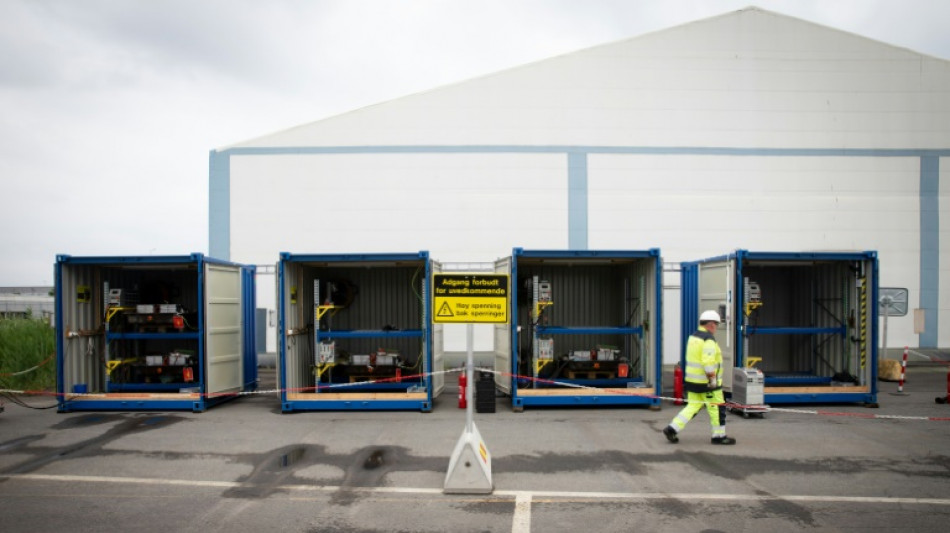
In southeastern Norway lies Europe's biggest plant for recycling used or defective electric car batteries, turning them into a powder, or "black mass", made up of nickel, manganese, cobalt, lithium and graphite.
These so-called critical minerals -- essential components in many clean energy technologies -- will be reused to make new batteries, key cogs in the transition to a decarbonised economy.
"The higher the quality of the components, the easier it is to use them for recycling," said Gronvold, a laboratory technician at Hydrovolt, a joint venture between Norwegian aluminium giant Norsk Hydro and Swedish electric battery maker Northvolt.
The Hydrovolt plant opened last year in the port city of Fredrikstad.
Within the next few months, the site is expected to be able to process 12,000 tonnes of lithium-ion battery packs per year, the equivalent of 25,000 electric car batteries.
Industry leader Norway, where electricity is almost exclusively generated by renewable energies, is the uncontested world champion of zero-emission electric cars, with the latter accounting for more than 80 percent of new car registrations.
- 'Mine above ground' -
Emptied of electricity, the imposing battery packs -- they weigh half a tonne each -- are methodically taken apart to recover up to 95 percent of the materials.
The aluminium is recycled by Norsk Hydro, while the "black mass" powder is sold to battery makers.
"This is the black gold that gives us life", said Glenn Ostbye, the acting head of Hydrovolt, leading a tour of the plant clad in a safety helmet and goggles.
The "black gold" is touted as eco-friendly as it comes from the recycling process rather than being mined in faraway countries.
"Battery recycling is, in many ways, an alternative to mines. We have sort of built a mine above ground", Hydrovolt's director of operations Andreas Frydensvang said.
"A battery can be transformed into a new battery to infinity", he said.
The recycling also helps boost Europe's independence when it comes to critical minerals, with the Covid pandemic and the war in Ukraine highlighting the continent's problematic dependence on imported raw materials.
In Europe, "we have big markets for products but we don't actually have so much of our own resources", Julia Poliscanova, head of electric mobility at the non-governmental organisation Transport & Environment.
"Globally speaking, we're not a mining superpower for copper, cobalt or nickel", she said, adding that recycling waste was an obvious option.
"And you can recycle a lot quicker than you can start up a new mine".
- European independence -
According to Transport & Environment, a European clean transport campaign group, recycling old batteries could cover between at least eight and 12 percent of Europe's critical mineral needs in 2030, and between 12 and 14 percent in 2035.
The European parliament recently adopted regulations aimed at making batteries more sustainable and more easily recyclable.
But, insisted Poliscanova, Europe also needs to stop exporting its precious "black mass" to third countries, primarily China and South Korea, and develop its own hydrometallurgic processing plants.
This other crucial link in the recycling chain, which makes it possible to extract the metals contained in the powder, is still low-scale in Europe, handled only by a few companies such as Revolt in Sweden and Eramet in France.
Government subsidies are also needed so that the many planned battery plants can see the light of day, creating an ecosystem favourable to recyclers, Poliscanova said.
The Fredrikstad plant is a pilot project and the blueprint is expected to be exported, with Hydrovolt planning a second site "in a year or two".
"The most important thing for us is the degree of adoption of electric cars, so that there is a reservoir of end-of-life batteries," said Frydensvang.
"We're therefore looking at countries like Germany, France and a little in the United States."
L.Kwan--ThChM