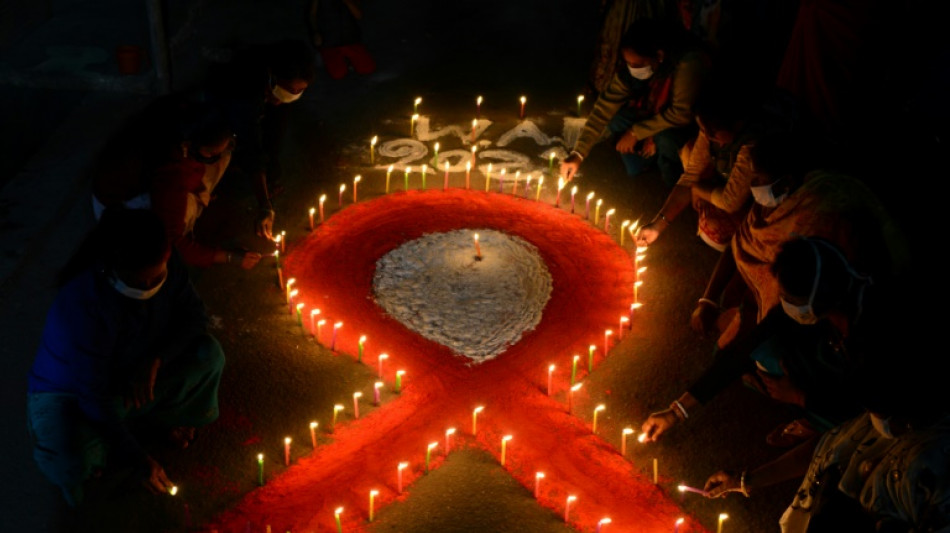
'End of AIDS' still possible by 2030: UN / Photo: © AFP

"The end of AIDS" is still possible by 2030, the United Nations insisted Thursday, but cautioned that the world's deadliest pandemic could only be halted if leaders grasped the opportunity.
"AIDS can be ended" as a public health threat, the UNAIDS agency said, as it outlined a roadmap of investment, evidence-based prevention and treatment, empowering civil society and tackling the inequalities holding back progress.
UNAIDS said ending the pandemic was, above all, a political and financial choice.
"We are not yet on the path that ends AIDS," the agency's executive director Winnie Byanyima said, but "we can choose to get on that path".
The UN first set out in 2015 the target of ending AIDS as a public health threat by 2030.
Byanyima said the greatest progress on HIV -- the virus that causes AIDS -- was being made in the countries and regions that have invested strongly.
She cited eastern and southern Africa, where new HIV infections have dropped by 57 percent since 2010.
Botswana, Eswatini, Rwanda, Tanzania and Zimbabwe have already achieved what are called the 95-95-95 targets.
This means that 95 percent of those living with HIV know their status; 95 percent of those who know they have HIV are on life-saving anti-retroviral treatment; and 95 percent of people on treatment to achieve viral suppression -- and therefore highly unlikely to infect others.
At least 16 other countries are close to achieving the target.
They include eight in sub-Saharan Africa -- the region where 65 percent of HIV-positive people live -- and Denmark, Kuwait and Thailand.
- 39 million living with HIV -
In a report, UNAIDS said that two decades ago the AIDS pandemic seemed unstoppable, with more than 2.5 million people acquiring HIV each year and AIDS claiming two million lives annually.
But the picture is now dramatically different.
UNAIDS said that in 2022, 39 million people globally were living with HIV, of whom 29.8 million were accessing anti-retroviral therapy. Those missing out include 660,000 children.
The numbers on anti-retroviral treatment have near-quadrupled from 7.7 million in 2010.
Furthermore, 82 percent of pregnant and breastfeeding women living with HIV had access to anti-retroviral treatment in 2022, compared to 46 percent in 2010 -- which has led to a 58 percent drop in new infections in children.
Around 1.3 million people became newly infected with HIV last year -- down 59 percent from the peak in 1995.
Meanwhile 630,000 died from AIDS-related illnesses, and it is still the "number one killer" in countries including Mozambique, said Byanyima.
"Overall, numbers of AIDS-related deaths have been reduced by 69 percent since the peak in 2004," the report said.
- 'Dependent on action' -
"The end of AIDS is an opportunity" for today's leaders to be remembered as "those who put a stop to the world's deadliest pandemic", said Byanyima.
"We are hopeful, but it is not the relaxed optimism that might come if all was heading as it should be. It is, instead, a hope rooted in seeing the opportunity."
Laws that criminalise people from key populations, or their behaviours, remain in place in many nations, UNAIDS said, giving the example that criminalisation, and stigmatisation, of drug injectors prevents them from coming forward for treatment.
HIV continues to impact key populations more than the general population, it added.
In 2022, compared with adults aged 15-49 in the general population, HIV prevalence was 11 times higher among men who have sex with men; four times higher among sex workers; seven times higher among people who inject drugs; and 14 times higher among transgender people.
G.Tsang--ThChM