Lebanon economic crisis means more work for craftsmen / Photo: © AFP

Among meandering alleyways in the historic market of Lebanon's southern city of Sidon, cobblers and menders are doing brisk business, as an economic crisis revives demand for once-fading trades.
At Ahmed al-Bizri's shoe repair store, nestled among old stone arches and a crowded warren of shops and stalls, workers are busy adjusting a woman's sandals and replacing the worn-out sole of a man's shoe.
"Repairs are in high demand," said Bizri, 48, who learned the trade from his father.
People from all walks of life "come to us to repair their shoes: rich, poor, average workers, public servants, soldiers," he added.
Since late 2019, Lebanon has been in a state of economic collapse that the World Bank says is one of the worst in modern times.
The Lebanese pound has lost around 98 percent of its value against the US dollar, and most of the population has been plunged into poverty.
Bizri said his work "has increased 60 percent" since the crisis began, adding that people now prefer to spend up to one million Lebanese pounds (around $11 on parallel markets) to fix old shoes rather than buy new ones.
"Even people who had shoes hidden away for 20 years are bringing them out for repair," he said with a smile, boots hanging from rusty hooks and coloured laces on the walls around him.
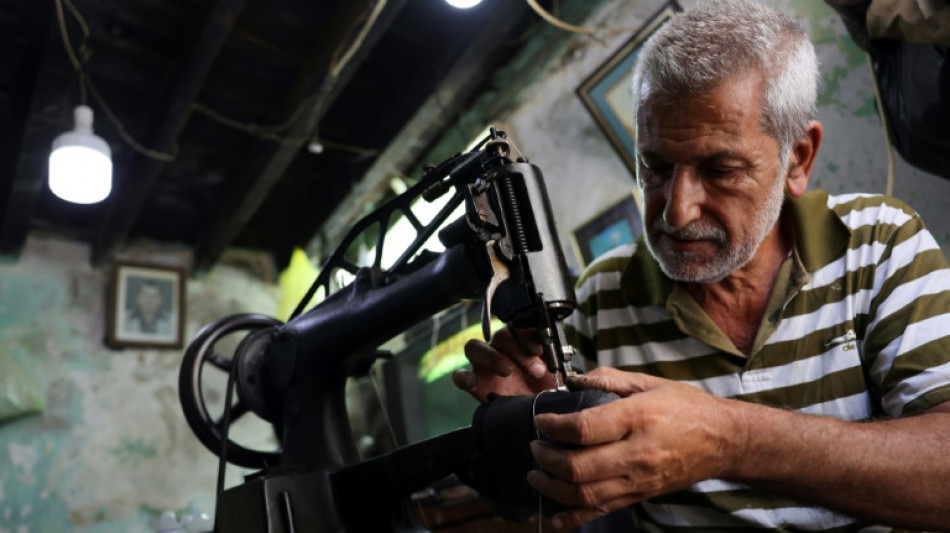
In a shop nearby in central Sidon, fellow cobbler Walid al-Suri, 58, works with an old manual sewing machine that clicks and clacks as he pumps the pedal with his foot.
He stitches up a hole in the side of a shoe and trims the thread, covering it with black polish to camouflage the repair.
"It's true that our work has increased," he said from his workshop, a tiny space with faded green walls filled with shoes of all kinds.
But "there are no profits because the price of all the materials has gone up, from glue to needles, thread and nails," he said.
- 'Suffocating' -
In Lebanon, a country dependent on imports, inflation has soared.
In 2022, inflation averaged 171 percent, according to the World Bank -- one of the highest rates worldwide.
"We pay for everything in dollars, not in Lebanese pounds," said Suri, who repairs around 20 shoes a day.
For that, he said he earns about $11, hardly enough to cover the basic needs of his family of three.
Some people have asked him to repair shoes that were verging on unfixable because they had no money for new ones, he said.
Elsewhere in the coastal city, Mustafa al-Qadi, 67, is mending duvets under the soft light of a window during one of Lebanon's long power cuts.
The bankrupt state provides just a handful of hours of electricity a day.
Qadi uses thick thread and deftly sews stitches into a duvet spread out on the floor, other quilts folded and rolled up around him.
"Most people patch things up" even if they are made cheaply, said Qadi, who is also an upholsterer.
"The circumstances are extraordinary -- unfortunately our currency has no value," he said, his glasses slipping down his nose as he worked.
Despite the crash, Lebanese officials have failed to enact reforms demanded by international donors that would unlock bail-out funds.
Unemployment reached more than 29 percent last year, according to the World Bank.
"We hope this situation will end because we're suffocating," Qadi said.
- 'Forced' to repair -
In a store bearing an old-fashioned hand-painted yellow "Repairs" sign, tailor Mohammed Muazzin, 67, works away, surrounded by spools of thread and clothes waiting for attention or ready for pickup.
A woman in hijab and long robe holds up a dress to inspect Muazzin's adjustments, while another in a tank top and flowing hair waits to ask about repairing a pair of torn jeans.
"People used to buy trousers, wear them a few times and then get rid of them. Today, they give them to their brother or another relative," said Muazzin, who has been a tailor for four decades.
Even though he has up to 70 clients a day, he said that before the crisis "our earnings were higher".
Areen, 24, an unemployed teacher who declined to provide her surname, is among those who have come to Muazzin for repairs.
"The tough circumstances have forced us" to go to tailors instead of buying new clothes, she said, wearing a soft-coloured headscarf.
"Before, we would throw away clothes, shoes and bags or give them to those in need," she said.
"Now we try to get the most out of them."
M.Chau--ThChM