Threatened Ethiopian cabaret lives to dance another day / Photo: © AFP

A beloved monument to Ethiopia's traditional cabaret culture, the historic nightclub Fendika is running on borrowed time, having just escaped demolition.
Two decades earlier, Fendika was one of 17 "azmari bet" (a venue hosting performances by Ethiopia's azmari musicians) in the Kazanchis district, a neighbourhood harkening back to Addis Ababa's jazz-fuelled era.
Today, it is the only one still standing, says Melaku Belay, the 43-year-old owner and director of Fendika.
Comparable to medieval troubadours, the azmari are itinerant poet-musicians from rural Ethiopia, who improvise songs while playing the masenqo, a single-string bowed lute made of wood, horsehair and raw hide.
Their songs are rich in metaphors and double meanings, humorously mocking their audience, civil society and even powerful elites -- reflecting a freedom of expression rarely seen in Ethiopia.
Under the watchful eyes of Melaku, an internationally-renowned dancer and choreographer who took the reins in 2008, Fendika grew to become a cultural hub.
Its nondescript entrance and dilapidated walls -- covered with faded posters -- belie the thriving life inside, where patrons can browse its library, attend performances and visit a gallery exhibiting the work of young Ethiopian painters.
In addition to the azmari, Fendika hosts Ethio-jazz performers and bands revisiting the country's musical traditions.
It is usually packed with Ethiopians and foreigners, many enjoying a glass of beer or tej, an Ethiopian honey mead.
- 'A very unique place' -
The club is "a very unique place" to learn about Ethiopia and its mosaic of ethnic traditions, according to Addis-based American researcher Luana DeBorst, a regular visitor to Fendika.
"Ethiopia is in a bit of a crisis in terms of how it defines ethnic borders and Fendika brings people together, no matter what region they are from and that's a very powerful thing in a divided" country, the 27-year-old told AFP.
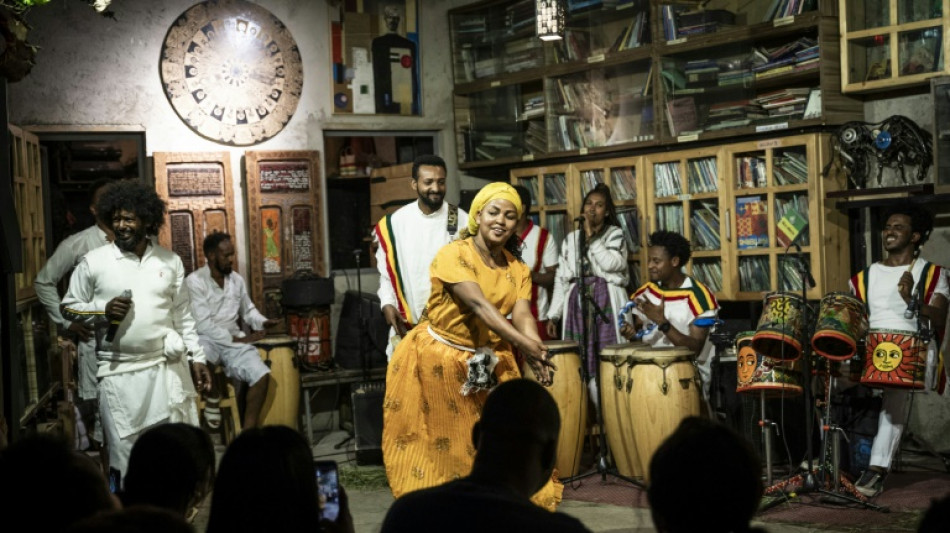
The star attraction remains Ethiocolor, an in-house band founded in 2009 by Melaku, that has performed in Europe and the United States.
Comprising dancers and musicians from various generations and regions, Ethiocolor aims to be a bridge between tradition and modernity but also bring together the cultures of more than 80 communities in Ethiopia.
As the amplified sound of krars -- Ethiopian lyres -- reverberated across the stage, Melaku displayed his virtuosity, mixing elements from the Amharic eskista dance tradition with steps from other regions.
The charismatic performer is the soul of Fendika, a place he discovered 25 years ago, buoyed by "a passion and love for dancing".
A homeless school dropout, Melaku survived on the tips he earned at Fendika before the club's owners allowed him to sleep indoors, on the floor.
"I... then completed high school while performing at night and studying during the day," he told AFP.
"That's how I started."
- 'Never be demolished' -
Now owner Melaku regularly encourages his employees to go on stage.
Meselu Abebayew, a drummer with Ethiocolor, waited tables at Fendika 16 years ago.
He "learned to dance and play the drum, and finally became a sound engineer".
"I travelled around the world because of this place", said the 32-year-old, who also founded his own group, Gungun.
Another member of Ethiocolor, Emabet Woldetsadik "started as a cleaner, then became a cashier, then a waitress, but now I am a dancer and singer."
Fendika "changed my entire life", the 30-year-old told AFP.
"As an Ethiopian dancer, I am responsible for showcasing and preserving my culture."
But Fendika's performers and patrons alike had a shock last month when the municipal government announced plans to demolish the club to make way for a luxury hotel.
It was a reminder of the development drive that has taken over Ethiopia's capital since 2008, with old structures increasingly forced to cede space to new buildings.
The club "is a vital place" for Ethiopia's artists, said Eden Mulu, a painter and designer who has previously exhibited her work there.
"Fendika is the place where we meet to share ideas and ideas flow and where we support each other," the 30-year-old told AFP.
"Our identity is our history and culture. If that is destroyed, you become a copycat of others' cultures," said Ethiocolor drummer Meselu.
After a wave of opposition, the municipality offered a surprise reprieve to Fendika, asking Melaku to come up with a proposal to develop the land.
His ambitious dream is to build a multi-storey structure next to Fendika that can house a performance hall, recording studios and an artists' residency.
The financing could take a while, but after a 25-year love affair with Fendika, he is willing to wait.
"I promised myself, Fendika will never be demolished," he said, smiling.
U.Feng--ThChM