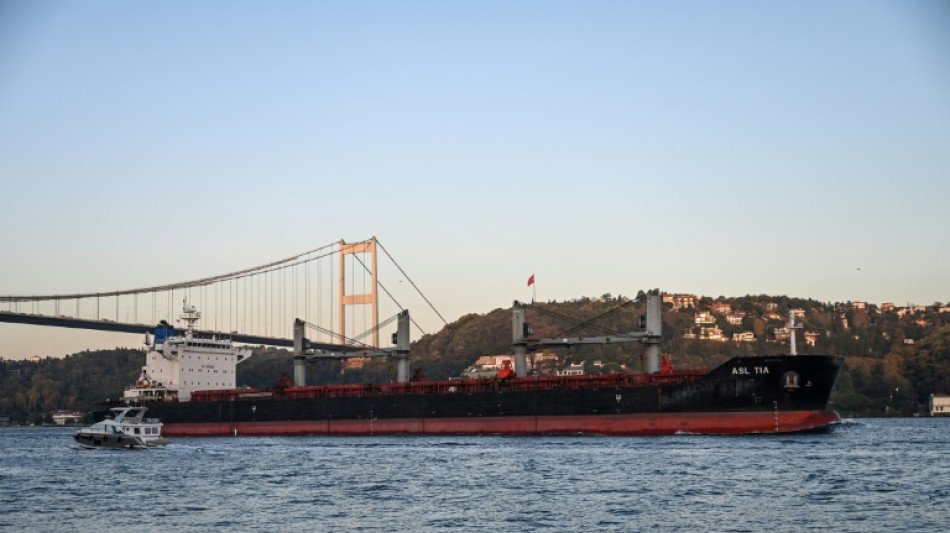
Collapse of Ukraine grain deal to have medium-term impact / Photo: © AFP/File

The collapse of the Black Sea export corridor, which allowed the export of more than 32 million tonnes of Ukrainian grain over the past year, should have little immediate impact but over the medium term create market tension and push up food prices.
- Little immediate impact -
The situation is very different from February 2022, when Russia invaded Ukraine, which cut off shipping in the Black Sea, the main export route for Ukrainian agricultural products.
Kyiv was the world's top exporter of sunflower seed oil and the fourth-largest for wheat and corn, and its exit from global market sent prices to record highs in May.
The opening of the export corridor on August 1, 2022, helped ensure supplies for importing nations and bring down prices, even if the conflict has cut Ukrainian farm output.
Wheat output is forecast to drop to 17.5 million tonnes in the 2023-2024 season from 33 million tonnes in the 2021-2022 season.
For corn, production is expected to fall to 25 million tonnes from 42 million tonnes.
"In 2023-2024, Ukraine should export six million tonnes less of wheat and 10 million tonnes less of corn," said Gautier Le Molgat, an analyst at Agritel, which provides data and analysis on agricultural markets.
The lack of immediate impact is partially due to timing: it is currently harvest season in the northern hemisphere.
"Future needs will be clear at the end of the harvest," said Le Molgat.
"It is a calm period on the markets which reacted little to the news of the suspension of the deal," he added.
European wheat futures edged higher, while they fell in the United States.
Moreover, Russia's refusal to renew the deal was expected and it had already worked to undermine it.
Over the past months "we've observed a bottleneck in the Bosphorus with very slow traffic," due in particular to a low number of Russian inspectors for the ships using the corridor, said Edward de Saint-Denis, a trader at commodities trading firm Plantureux & Associes.
- Land routes -
Even before the Black Sea corridor was opened the EU had created "Solidarity Lanes", land and river routes designed to facilitate the export of EU agricultural products via Europe.
The Farm Foundation, a think tank that specialises in agricultural issues, estimates that half of Ukraine's agricultural exports already takes these routes.
"One of the questions that needs to be asked is if the EU, which has taken half of the Ukrainian grain on offer since the start of the conflict, has capacity to re-export these volumes," said Olia Tayeb Cherif, research director at the Farm Foundation.
The EU would like to improve its ability to transport by harmonising the rail gauge with Ukraine.
"They can increase the tempo a bit, but that doesn't solve the problem of the volumes in question," said Saint-Denis.
- Medium-term concerns -
There is currently no lack of wheat on the global market. But, "most exportable wheat is in Russia with 12.5 million tonnes of stocks, and it is the cheapest wheat in the world," noted Damien Vercambre at the Inter-Courtage commodities brokerage.
Russia could alleviate part of any shortage on the world market due to a lack of Ukrainian wheat. But increasing reliance on Russia could be a bitter pill for many countries.
The EU, which is expected to have a normal harvest, could also help meet the needs of importing countries.
But adverse weather could quickly change the outlook.
The wheat and the corn markets are also currently in very different positions. China, the world's top importer of corn, could turn to Brazil, which had a record harvest and is selling at a lower price.
For wheat, the production may be sufficient but a drop in Ukraine's export volumes could create a problem.
"An extended closure of the corridor will have an impact on food price inflation, which will affect food security," said the Farm Foundation's Olia Tayeb Cherif.
Some importing nations are already having difficulty paying current prices, such as Egypt.
The UN's World Food Programme is also at risk of disruption as it sources from Ukraine wheat it supplies to Afghanistan, Yemen and African nations, noted Cherif.
N.Lo--ThChM