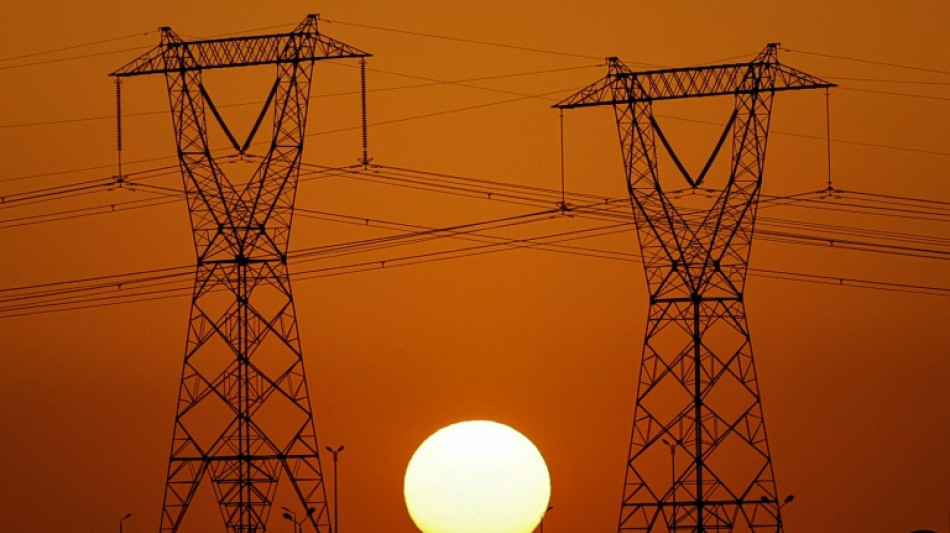
Egypt energy-saving measures power satirical reaction / Photo: © AFP

Sweltering without air conditioning during the day and plunged into darkness at night, many Egyptians have responded with anger and ridicule to government measures for reducing energy consumption.
Hours-long power cuts across Egypt, several times a day, prompted the directives as record temperatures hit the Mediterranean region this month.
After 11 days of daily blackouts, Prime Minister Mostafa Madbouli ordered civil servants on Thursday to work from home once a week, announced scheduled power outages at least through August, and proposed other solutions to Egypt's energy crisis.
But many Egyptians took to social media to criticise -- and poke fun at -- what they view as a failure on the government's part.
"Why do we export gas to Europe while we live in darkness?" wondered Egyptian resident Islam, 36, in comments to AFP. He gave only his first name.
Some were reminded of the last time the Arab world's most populous nation faced incessant power outages 10 summers ago, helping fuel popular discontent and protests against the short-lived presidency of the late Islamist leader Mohamed Morsi.
He was deposed in July 2013 by then-defence minister Abdel Fattah al-Sisi, whose ensuing administration has invested billions in improving the national power grid.
Until just a few weeks ago, officials were still insisting that Egyptians' years of suffering from unreliable mains supply were now gone.
- Satirical posts -
The public electricity company, in a statement last week that offered few details, recommended that Egyptians "avoid taking the lift around the start of every hour", when the power might go out "for no more than an hour".
The advice triggered mockery on Egyptian social media, where users widely shared satirical posts.
One suggested that people "avoid lifts between 10 to and 10 past the hour, for an hour, every hour of the day".
Another offered a train-like timetable, advising citizens that "if you miss the 12:50 pm elevator, you can catch the 1:10 pm."
From upper Egypt -- where temperatures regularly exceed 45 degrees Celsius (113 degrees Fahrenheit) -- to the upscale districts of Cairo, the main topic of conversation is the same: when will the power go out, for how long, and how many times a day?
Despite the government's assurances many complain that the cuts, often in the hottest part of the day, regularly last longer than two hours and occur outside of supposedly planned time slots.
- 'Honouring' Edison -
Even one of the country's richest men poked fun at the situation.
"When Edison, the inventor of the light bulb, died, the whole world turned off the lights for one minute. In Egypt... we continue to honour his memory to this day," business tycoon Naguib Sawiris posted.
Behind the humour lies genuine frustration from a populace that has been struggling to survive in a punishing economic crisis for more than a year.
The country's depleting foreign reserves have limited the ability to import essential goods while external debt has mounted, exacerbated by Russia's invasion of Ukraine early last year.
Even before, 30 percent of Egyptians were living below the poverty line, according to the World Bank.
Since then, Egypt's annual inflation hit a record 36.8 percent in June, and the currency has lost half its value against the dollar.
A freeze on electricity price hikes expires this summer, meaning family budgets could be strained even more.
"So it's only the load on the electricity that can be eased, not the pressure of electric bills?" human rights lawyer Mahienour El-Massry asked on Twitter, which is being rebranded as X.
A university professor, who gave his name only as Aymen, told AFP his work has been "massively affected" as most of it is carried out online.
"The (scheduled) power cuts don't help me... because the times of the outages are unexpected" and often last more than an hour, he said.
In his televised address, Madbouli blamed the energy shortage on soaring temperatures which led consumption to exceed the government's supply of fuel.
In 2015, authorities struck a deal with German firm Siemens to build three major power plants with investments estimated at six billion euros ($6.6 billion) in a bid to improve the network.
The plants connected 14.4 gigawatts to the national grid in 2018, boosting Egypt's generation capacity by more than 40 percent, the company said.
These and related projects enabled the country "to stand on this solid ground," Madbouli said.
He dismissed criticism of the developments, saying people "are upset with a three-hour power outage, but if it weren't for these projects, we would have only had power for three hours a day."
D.Wang--ThChM