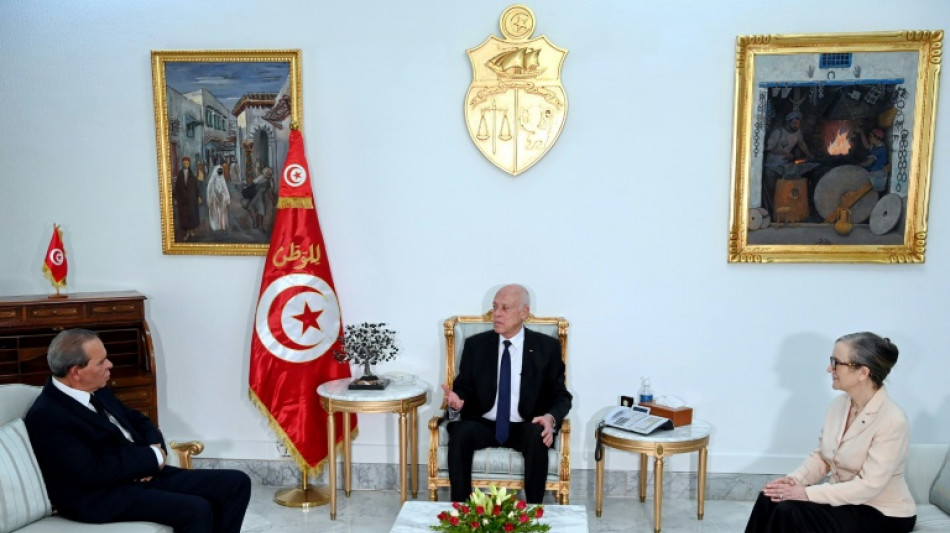
What's next after Tunisia's Saied sacked his PM? / Photo: © TUNISIAN PRESIDENCY/AFP

Tunisian President Kais Saied fired his prime minister Najla Bouden without explanation late Tuesday. Why did he do this, and what are the implications for the debt-ridden North African country?
Why was Najla Bouden sacked?
Media reports say Saied was unhappy with her handling of the shortage of flour, and therefore of bread in government-subsidised bakeries.
"This administration has a short fuse when it comes to problems, and the important thing for the president is that nothing can be seen to be his fault," essayist Hatem Nafti told AFP.
He said Saied's regime "looks for scapegoats -- judges, prisoners of conscience and most recently sub-Saharan migrants".
Economists attribute the lack of state-subsidised bread to shortages of grain. Suppliers no longer extend credit to Tunisia, where debt is around 80 percent of gross domestic product.
Since the 1970s, the state has supplied staples such as flour, cooking oil, sugar, milk and fuel, to the marketplace at subsidised prices.
Nafti said Bouden, whom Saied himself appointed in October 2021 as the country's first woman premier, had become "highly unpopular within the president's entourage".
Even among opposition circles she was seen simply as a "reassuring showcase for the West", he said.
Faced with the bread shortage and a deteriorating economy, "curiously, it is the government and opposition that bear the brunt of popular anger," rather than the regime itself in which the president holds all the power, according to political scientist Youssef Cherif of Columbia Global Centers in Tunis.
Appointing a new prime minister may "show that the president listens to the word on the street", he said.
Saied won a democratic election in October 2019, but granted himself sweeping powers on July 25, 2021, and now governs by decree. Since his power grab, he has dismissed half a dozen ministers.
What does Saied plan to do?
Some analysts believe that Saied may be making political preparations in advance of the presidential election due in autumn next year.
But the new prime minister, Ahmed Hachani, a lawyer who worked at the central bank, "is not a politician at all. He's an old comrade of the president from the law faculty" at the University of Tunis, Nafti said.
The premier's name and background "do not matter. He is only there to implement the president's wishes", he added.
According to political scientist Slaheddine Jourchi, "Kais Saied does not believe in the independence of government or its ministers".
Cherif said it seems probable that "the main ministerial portfolios will not be affected, and that changes will be limited to those that have had problems in recent months".
Economy Minister Samir Saied may find himself targeted, as he has fronted talks with the International Monetary Fund on a $1.9-billion bailout the president has repeatedly rejected as "foreign diktats that will lead to more poverty".
"That would be logical, for with Kais Saied, they are on two irreconcilable lines," said Nafti.
And the international consequences?
Analysts say it is hard to imagine that the IMF bailout talks will continue, given Saied's opposition to them and his calls for "a new global financial institution".
Saied rejects lifting subsidies and restructuring 100 state-owned firms that are often heavily indebted, two measures proposed by the Bouden government in exchange for the IMF loan.
The president says he will seek funding elsewhere. "This is part of his Third World and populist thinking, and helps to bolster his popularity," said Cherif.
Some funding may be possible with aid from Europe and some Arab countries such as Saudi Arabia, which recently announced financial aid of $500 million, including a grant of $100 million.
In mid-July, the European Union and Tunisia agreed on a "comprehensive partnership" providing for the payment of 255 million euros ($280 million) this year, including 150 million as a direct contribution to the budget.
In the future, Brussels may also provide a long-term loan of around 900 million euros, but this would be conditional on political reform and respect for human rights, according to EU rules for such aid.
"What counts most for Europe is that Kais Saied continue to guard Tunisia's frontiers and keep the migrants from sub-Saharan Africa" from trying to reach Europe, said Nafti.
Such international aid, as well as revenue from tourism and money sent home by Tunisians abroad, "will provide a respite for the public purse until winter", said Cherif.
But "more funds will be necessary later", and the risk of "default will continue to be an option", he added.
Z.Ma--ThChM