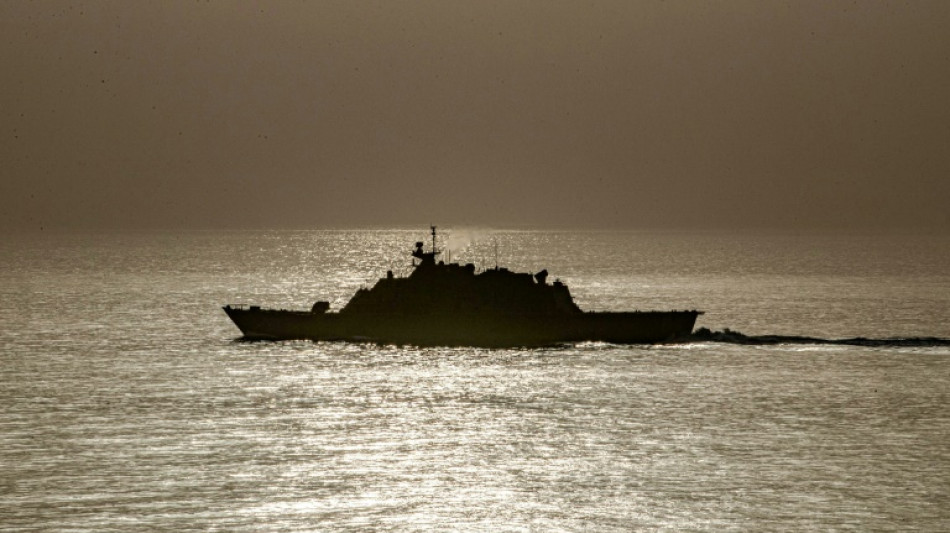
US beefs up Gulf deployment over Iran oil tanker threat / Photo: © DVIDS/AFP/File

As Iranian seizures threaten oil tankers plying the Gulf, the United States is raising its military presence -- a move long demanded by Gulf Arab states who accused Washington of retreating from the region.
Three thousand additional US personnel on troop-landing warships have already passed through the Red Sea, and US-led maritime forces are warning ships against approaching Iranian waters.
The moves follow a spate of capture and attempted capture of ships in and around the Strait of Hormuz, the U-shaped gateway to the Gulf of Oman and Arabian Sea that carries a fifth of world oil output.
"There is a heightened threat, a heightened risk to regional mariners in terms of seizures" by Iran in the strait, said Commander Tim Hawkins, spokesman for the US Navy's Fifth Fleet.
"Right now, our focus is on... increasing our presence in and near the Strait of Hormuz to ensure security and stability in a very critical waterway," Hawkins told AFP at the US Naval base in Bahrain.
The attacks on tankers came at a time of troubled relations between Washington and its wealthy Gulf allies, who have long relied on US protection for their oil assets and chafed at a perceived military drawdown.
The US military says Iran has either seized or attempted to take nearly 20 internationally flagged ships in the region in the past two years.
Most recently, Washington said its forces blocked two attempts by Iran to seize commercial tankers in international waters off Oman on July 5. In April and early May, Iran seized two tankers within a week in regional waters.
- 'Robust forces' -
On Saturday, a US-led naval coalition issued an advisory for commercial ships to "transit as far away" from Iran's waters as possible in what Hawkins called a "prudent step" in light of recent seizures.
Less than a week earlier, 3,000 US Marines and sailors arrived in the Red Sea on board the USS Bataan and USS Carter Hall warships, which can ferry troops ashore by aircraft and landing craft.
Washington had already promised fighter jets and said it deployed A-10 Warthog warplanes.
The buildup, according to Hawkins, affords Washington "more robust forces where needed".
They are in addition to the more than 30,000 US troops already in the Middle East.
Although Washington has previously sent troop reinforcements to the Gulf, including in 2019 as a response to Iran tensions, the US is now considering unprecedented measures.
It is preparing to put Marines and Navy personnel aboard commercial tankers transiting the Gulf as an added layer of defence, a US official told AFP in early August.
Hawkins said that although no formal announcement has been made about manning tankers, "we have sailors, we have Marines that are trained here in the region to carry out whatever mission they are tasked with".
But at the same time, the United States military buildup coincides with the first deal between President Joe Biden's administration and Iran's clerical leadership.
The delicate agreement would see Iran free five American prisoners in exchange for the unblocking of Iranian funds frozen in South Korea under US sanctions.
It followed exhaustive diplomacy between the Biden administration and longtime US adversaries Iran. Experts and diplomats said the deal could bring further, quiet efforts to address concerns -- but tensions persist.
The spokesman for Iran's Islamic Revolutionary Guard Corps, Ramazan Sharif, last week said his country "can reciprocate any vicious act by the US, such as seizing ships", according to state news agency IRNA.
- 'Bolster alliances' -
Washington's Gulf allies -- reliant on the shipping lane to deliver their oil to global markets -- have long demanded stronger US security commitments, especially after an uptick in seizures by Iran since 2019.
With Biden's increased emphasis on Asia adding to their frustrations, Saudi Arabia and the United Arab Emirates have boosted engagement with American rivals China and Iran.
Dina Arakji, an associate analyst at Control Risks consultancy, called the increased US presence a "shift in posture".
"The move by the US likely aims to reassure Gulf Arab states that Washington remains committed to the region's security," Arakji said.
"Increased Iranian hostility and Chinese engagement with the region has caught Washington's attention," she added, noting the US "now aims to bolster its alliances".
Despite the prisoner deal earlier this month, separate attempts to revive a landmark 2015 nuclear pact with Tehran have effectively collapsed.
"With no sign of a diplomatic agreement between the US and Iran, the only alternative is more effective deterrence," said Torbjorn Soltvedt of the risk intelligence firm Verisk Maplecroft.
But "the perception that the US isn't doing enough to deter Iranian attacks against international shipping will persist" as long as incidents continue.
V.Fan--ThChM