The China Mail - Germany bets on tax cuts to boost ailing economy

USD -
AED 3.672502
AFN 64.503778
ALL 81.338497
AMD 361.09675
ANG 1.789785
AOA 916.999706
ARS 1513.236465
AUD 1.447188
AWG 1.8
AZN 1.704172
BAM 1.743363
BBD 2.013184
BDT 122.946509
BGN 1.747831
BHD 0.377586
BIF 2991.638885
BMD 1
BND 1.281883
BOB 11.71977
BRL 5.0581
BSD 0.999594
BTN 94.961938
BWP 13.742418
BYN 3.017057
BYR 19600
BZD 2.010313
CAD 1.420705
CDF 2312.497903
CHF 0.830245
CLF 0.02503
CLP 985.13026
CNY 6.69275
CNH 6.691765
COP 3194.05
CRC 454.960757
CUC 1
CUP 23.989731
CVE 98.287665
CZK 21.727901
DJF 177.999037
DKK 6.669495
DOP 61.28243
DZD 134.609897
EGP 53.488596
ERN 15
ETB 163.269377
EUR 0.891991
FJD 2.262985
FKP 0.76043
GBP 0.754905
GEL 2.59004
GGP 0.76043
GHS 11.629742
GIP 0.76043
GMD 73.999893
GNF 8793.432336
GTQ 7.636425
GYD 209.06352
HKD 7.847315
HNL 26.837693
HRK 6.721404
HTG 130.889189
HUF 324.420995
IDR 17948.8
ILS 3.102398
IMP 0.76043
INR 94.91635
IQD 1514.36683
IRR 1790499.999886
ISK 121.679853
JEP 0.76043
JMD 158.941401
JOD 0.708953
JPY 157.993498
KES 129.849764
KGS 87.450241
KHR 4059.311949
KMF 441.999892
KPW 899.999961
KRW 1346.264987
KWD 0.31098
KYD 0.832995
KZT 453.004595
LAK 22483.097342
LBP 89509.87864
LKR 330.880551
LRD 170.423094
LSL 16.517836
LTL 2.95274
LVL 0.60489
LYD 6.421479
MAD 9.795696
MDL 17.962214
MGA 4502.324255
MKD 54.950394
MMK 2099.444361
MNT 3596.720368
MOP 8.079529
MRU 40.052235
MUR 47.241137
MVR 15.450065
MWK 1732.925677
MXN 18.523375
MYR 4.082603
MZN 63.910338
NAD 16.51791
NGN 1329.99989
NIO 36.787121
NOK 9.505505
NPR 151.938745
NZD 1.78582
OMR 0.384498
PAB 0.999586
PEN 3.438455
PGK 4.537108
PHP 63.080975
PKR 276.703496
PLN 3.899005
PYG 5692.357747
QAR 3.643608
RON 4.758995
RSD 104.739601
RUB 83.748846
RWF 1474.878661
SAR 3.783194
SBD 8.064647
SCR 13.861837
SDG 601.501324
SEK 9.972765
SGD 1.28298
SHP 0.754745
SLE 24.679745
SLL 20969.504398
SOS 571.283404
SRD 37.711975
STD 20697.981008
STN 21.838829
SVC 8.746189
SYP 13001.999685
SZL 16.511864
THB 33.543503
TJS 9.210912
TMT 3.51
TND 3.001547
TOP 2.40776
TRY 49.417598
TTD 6.784239
TWD 32.442499
TZS 2640.140335
UAH 44.837859
UGX 4022.801521
UYU 40.200736
UZS 11955.039354
VES 878.023596
VND 25873
VUV 119.689611
WST 2.781623
XAF 585.107973
XAG 0.017637
XAU 0.000241118694
XCD 2.70255
XCG 1.801465
XDR 0.707052
XOF 585.107973
XPF 106.304652
YER 236.150526
ZAR 16.55695
ZMK 9001.201832
ZMW 19.915944
ZWL 321.999592
SSP 5773.824733
MXV 2.091596
  • RYCEF

    0.4000

    19.71

    +2.03%

  • CMSC

    0.0000

    20.4

    0%

  • BTI

    0.4200

    56.05

    +0.75%

  • BP

    0.2800

    44.43

    +0.63%

  • RBGPF

    1.6000

    67

    +2.39%

  • RIO

    -0.1500

    94.41

    -0.16%

  • AZN

    -0.4300

    166.15

    -0.26%

  • GSK

    0.4600

    49.7

    +0.93%

  • BCE

    -0.4100

    20.56

    -1.99%

  • NGG

    -0.2500

    75.24

    -0.33%

  • VOD

    -0.0400

    16.58

    -0.24%

  • RELX

    -0.4500

    33.07

    -1.36%

  • BCC

    -0.5500

    76.59

    -0.72%

  • CMSD

    -0.0300

    20.27

    -0.15%

  • JRI

    -0.2500

    10.77

    -2.32%

Germany bets on tax cuts to boost ailing economy
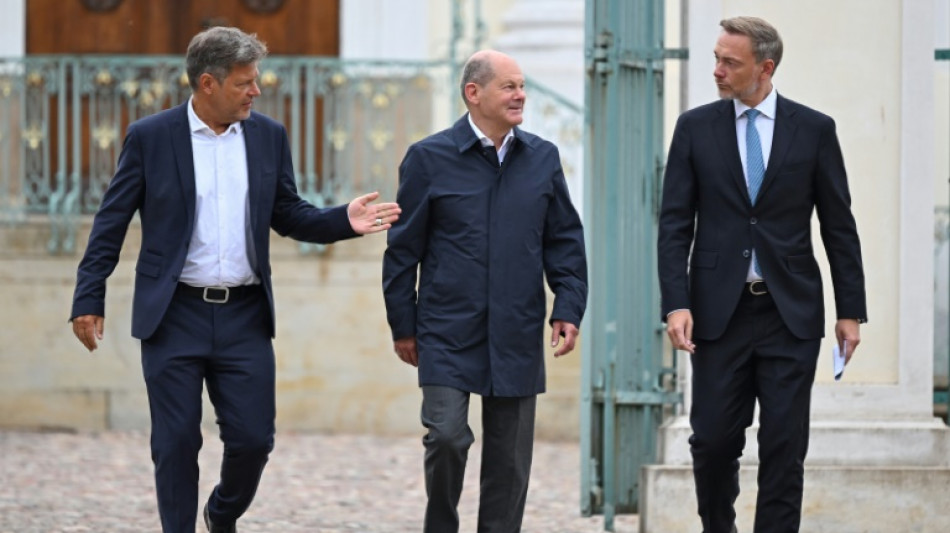
Germany bets on tax cuts to boost ailing economy / Photo: © AFP

Germany bets on tax cuts to boost ailing economy

Chancellor Olaf Scholz's government on Tuesday agreed a huge tax relief programme for companies in a bid to revive Germany's sputtering economy.

Text size:

The package would ease the burden on "small and medium-sized enterprises by around seven billion euros ($7.6 billion) per year", the government said in a statement.

While coalition parties have haggled over the extent of the tax cuts in recent months, Germany's economy has flatlined.

Europe's largest economy stagnated in the second quarter of 2023, having dipped into recession around the turn of the year.

The slowdown has come as Germany struggled to cope with the impact of the Russian invasion of Ukraine last year, which sent prices for energy and food soaring.

The sluggish growth figures were reason for the German government to go on the "offensive", Scholz said at a press conference on the first day of a ministerial retreat outside Berlin.

The tax cuts -- part of a 10-point plan put forward by the government -- were intended to "stimulate growth for our country" and make sure companies made the decision to invest in Germany, Scholz said.

Among the measures agreed were a premium for energy-saving investments, and rule changes to make it easier for companies to write off losses.

- 'Turnaround potential' -

Recent disappointing data have added to concerns that Germany will drag down the eurozone's economic performance this year, with the International Monetary Fund predicting it will be the only major advanced economy to shrink in 2023.

"We take it seriously that Germany is growing less dynamically than others," Finance Minister Christian Lindner said at the press conference.

The country however had a "huge turnaround potential", which would be unlocked via the targeted relief package, Lindner said.

The pain has been felt particularly acutely in recent months in Germany's key industrial sector, as exports have plummeted against a backdrop of high inflation and subdued global activity.

Consumer prices rose at a 6.2-percent pace in July -- down from last year's peak but still very elevated.

The post-coronavirus recovery in key trading partner China has meanwhile lost much of its momentum.

With the outlook still gloomy, the government has come under pressure to carry out more thorough reforms to breathe new life into the economy.

The recent crisis had "deepened structural problems that have existed for a long time", the influential BDI industry lobby said recently.

Among the concerns raised by business are continuing high energy costs, cumbersome regulations, a lack of skilled labour and a slow shift to a digital economy.

The government sought to address some of these issues in its 10-point plan, which noted efforts to speed up the expansion of renewable energy capacity and steps to reduce bureaucracy.

In June, Germany passed a law easing immigration rules for skilled workers in a bid to counter industry-wide shortages.

H.Au--ThChM