Kenya bets on carbon credits as it hosts climate summit / Photo: © AFP

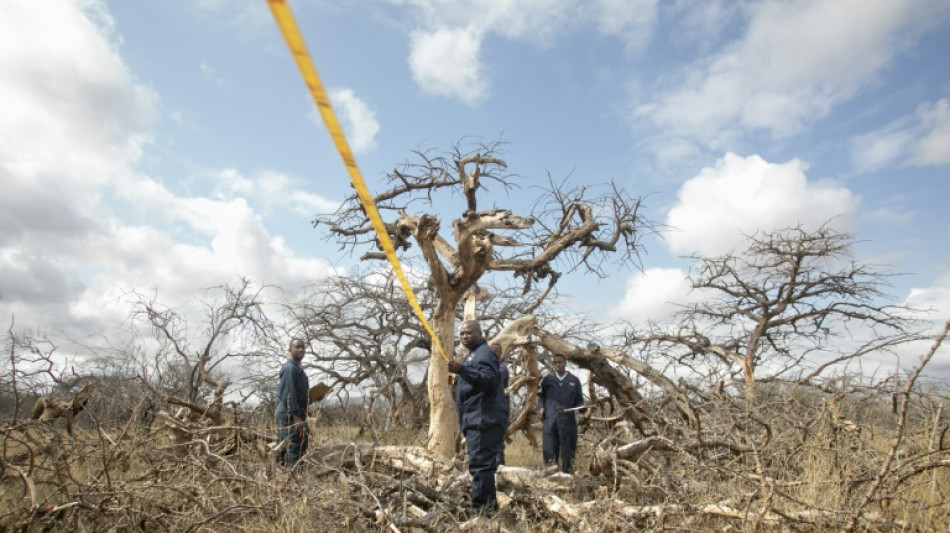
Deep within Kasigau, a sweeping wilderness of craggy hills and savannah roamed by elephants, a team armed with clipboards and measuring tapes is busy studying an unremarkable tree.
Gnarled and leafless, it nonetheless has great value: it stores carbon, and the team wants to know exactly how much is locked away across this semi-arid, half-a-million-acre (200,000-hectare) woodland in southern Kenya.
"We want to make absolutely sure we account for every single tree," said Geoffrey Mwangi, lead scientist at US-based company Wildlife Works, as the "carbon samplers" took the dimensions of another thorny specimen.
The data translates into carbon credits, and millions of dollars have been made selling these to corporate giants such as Netflix and Shell looking to offset their greenhouse gas emissions and burnish their green credentials.
As climate change accelerates and pressure mounts on companies and countries to lift their game, demand for carbon credits has exploded -- even as their reputation has taken a battering.
Cash-strapped African nations want a much bigger share of a $2-billion market that is forecast to grow five-fold by 2030.
Africa only produces 11 percent of the world's offsets yet boasts the planet's second-largest rainforest and tracts of carbon-absorbing ecosystems like mangroves and peatlands.
Kenyan President William Ruto, who is hosting a climate summit in Nairobi this week, said Africa's carbon sinks were an "unparalleled economic goldmine".
"They have the potential to absorb millions of tons of CO2 annually, which should translate into billions of dollars," he said on Monday.
- 'Massive interest' -
A single credit represents one tonne of carbon dioxide removed or reduced from the atmosphere. Companies buy credits generated through activities like renewable energy, planting trees or protecting forests.
Carbon markets are largely unregulated and accusations that some offsets -- particularly forest-based ones -- do little for the environment or exploit communities have sent prices crashing this year.
Kenya already generates the most offsets in Africa and despite market uncertainty, sees the potential for a much bigger domestic industry capable of creating much-needed jobs and economic growth.
"There is massive interest. We have 25 percent of the African market (for carbon credits) in Kenya, and it's our ambition to expand this," Ali Mohamed, the president's special envoy for climate change, told AFP.
In Kasigau, about 330 kilometres (205 miles) southeast of Nairobi, landowners and communities are paid to keep the forest intact under a flagship carbon credit project run by Wildlife Works, a for-profit business and largest offset developer in Africa.
Joseph Mwakima from Wildlife Works said project revenue had employed around 400 people and funded water, education and health infrastructure in a long-underserved part of Kenya.
"These are things that were never really there," he told AFP.
Wildlife Works founder Mike Korchinsky said at least half of revenue went to communities.
The forests protected under the scheme were once cleared for firewood and charcoal, degrading a carbon sink and critical wildlife habitat.
Avoiding deforestation serves climate goals by keeping carbon in the soil and trees instead of allowing them to be released into the atmosphere. The Kasigau Corridor REDD+ Project was the world's first to generate certified credits this way.
Wildlife Works says the project has been independently verified nine times since 2011, and has avoided roughly 22 million tonnes of CO2 emissions.
Kenya emits about 70 million tonnes of CO2 per year, according to Climate Watch, a platform managed by the World Resources Institute that tracks national greenhouse gas emissions.
- 'False solutions' -
The UN-endorsed African Carbon Market Initiative, launched at COP27 in November, believes 300 million credits could be generated annually on the continent by 2030 –- a 19-fold increase on current volumes.
For Kenya, this would mean more than 600,000 jobs and $600 million in annual revenue.
But these projections assume a carbon price far above current trades, and a massive increase in finance at a time of great volatility in a market struggling to build trust and integrity.
Ahead of the Africa Climate Summit in Nairobi, more than 500 civil society organisations wrote to Ruto urging him to steer the conference away from carbon markets and other "false solutions... led by Western interests".
"In truth, though, these approaches will embolden wealthy nations and large corporations to continue polluting the world, much to Africa's detriment," it read.
Ruto's appointee to lead the summit, Joseph Nganga, said carbon markets acted "not as an excuse for emissions but as a means to ensure accountability" as rich polluting nations bore the cost.
Countries are moving to regulate the sector. Earlier this year, Zimbabwe announced it would appropriate half of all the revenue generated from carbon credits on its land, sending jitters through markets.
Kenya is finalising its own legislation. Mohamed said the government did not want to "chase away investors" but ensure transparency and a fair share for communities.
Korchinsky expressed confidence the Kasigau project "will hold up to whatever scrutiny is applied".
X.So--ThChM