What we know about N. Korea-Russia ties / Photo: © AFP

The United States said North Korean leader Kim Jong Un will travel to Russia to meet President Vladimir Putin later this month, to discuss providing arms to Moscow for its war in Ukraine.
Pyongyang, already under a raft of international sanctions for its nuclear weapons programme, has repeatedly denied supplying arms to Russia.
But White House National Security Council spokeswoman Adrienne Watson said on Monday that North Korea's "arms negotiations" with Moscow were advancing and that Kim was due to travel to Russia.
The Kremlin on Tuesday said it had "nothing to say" on the reports of the planned meeting, adding that it was unable to confirm whether it would take place.
AFP takes a look at what we know about North Korean-Russian ties:
- What can North Korea offer Russia? -
Last week, Washington said that despite its denials, Pyongyang supplied infantry rockets and missiles to Moscow in 2022 for use by the privately controlled Wagner military group.
Joseph Dempsey, a researcher at the International Institute for Strategic Studies, said Moscow would be most interested in artillery shells that can be easily integrated.
"North Korea likely represents the largest stockpiles of Soviet-era legacy artillery shells and artillery that could be used to restock depleted Russian inventories from the Ukraine conflict," Dempsey told AFP.
North Korea's more sophisticated weaponry would be harder to integrate into Russian service, he added, and their capabilities and capacity to produce en masse remained unclear.
Pyongyang was able to supply Russia with munitions because "it has been preparing for war for 70 years," said Cho Han-bum, senior research fellow at the Korea Institute for National Unification.
- What does North Korea want in return? -
Analysts say Russia has everything that impoverished North Korea needs.
"Russia is a food export country, a fertiliser export country, an energy export country," said Cho.
It could also seek the transfer of "key technologies, knowledge and manufacturing capacity for North Korea's arms industry to advance and be more sustainable," added Dempsey.
A 2022 UN report highlighted the role of a North Korean diplomat in Moscow in procuring a range of ballistic missile technologies, and going as far as attempting to get some 3,000 kilogrammes of steel for Pyongyang's submarine programme.
North Korea could also get diplomatic gains from the deal by sending a message to China.
"Since the Cold War era, North Korea has always practised the so-called 'pendulum diplomacy' between China and the Soviet Union, going back and forth to maximise its benefit," said Park Won-gon, a professor at Ewha University.
"I can see some of that being practised now."
- What about summits in the past? -
Russia, a historic ally of Pyongyang, was a crucial backer of the isolated country for decades and their ties go back to the founding of North Korea.
But the Soviet Union reduced funding to the North as it began to seek reconciliation with Seoul in the 1980s. Pyongyang was hit hard by its demise in 1991.
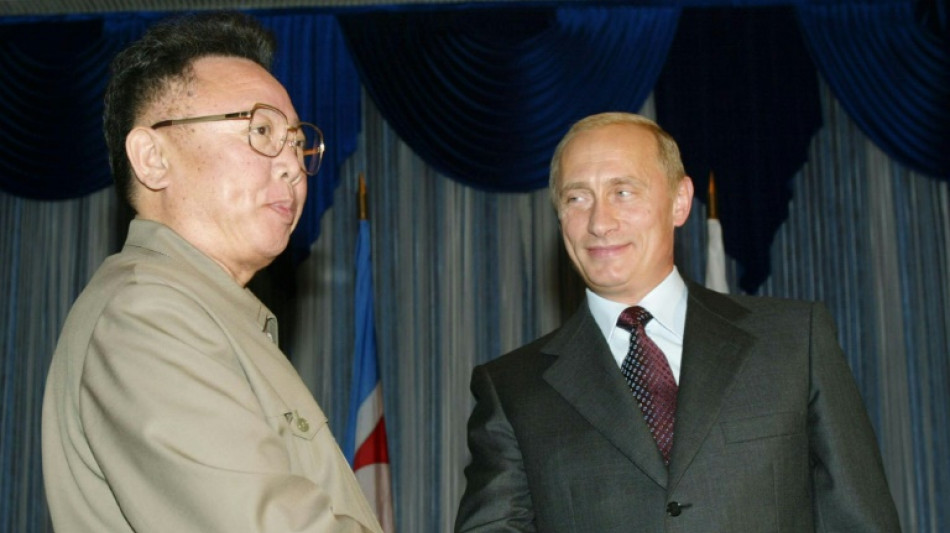
The Russian Federation and the North held their first summit in 2000, when a joint declaration -- which focused on economic cooperation and diplomatic exchanges -- was signed.
The signing of the agreement between Russian President Vladimir Putin and the late Kim Jong Il, the father and predecessor of North Korea's current leader Kim Jong Un, marked a significant milestone in revitalising bilateral relations after a period of stagnation.
Kim Jong Un made his first official visit to Russia in 2019, as he was seeking closer ties with the North's traditional ally amid a nuclear deadlock with Washington.
Kim and Putin released no joint statement at the time.
But Kim has been steadfast in his support for Moscow's invasion of Ukraine, including, Washington says, supplying rockets and missiles.
Putin in July hailed Pyongyang's "firm support for special military operations against Ukraine".
- What would a Pyongyang-Moscow deal mean? -
Last week at the United Nations, the United States, Britain, South Korea and Japan said any deal to increase cooperation between Russia and North Korea would violate Security Council resolutions forbidding arms deals with Pyongyang -- resolutions that Moscow itself had endorsed.
To avoid accusations of breaching the resolutions, the two allies are likely to "reach the deal behind closed doors without official announcement" Cheong Seong-chang, director of North Korean studies at the Sejong Institute told AFP.
"Kim and Putin are expected to simply say they agreed to cooperate in a wide range of areas without specifying what they are in an abstract manner."
If Moscow and Pyongyang proceed with shipments of arms, locating them will become the "responsibility of the international community" to hold them accountable.
"In case of shells, the North could transport them to Moscow via trains for their relatively small size."
Y.Parker--ThChM