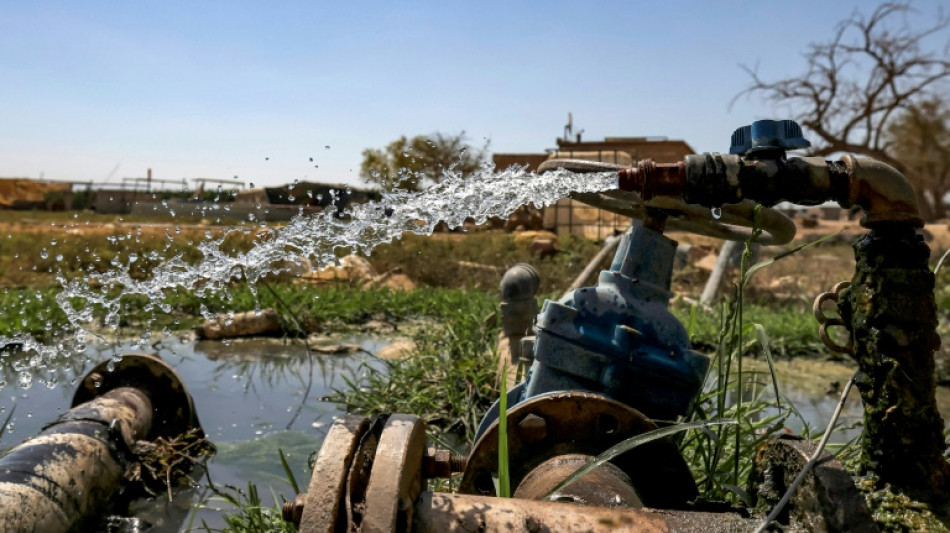
Palestinian water woes highlight dashed hopes of Oslo Accords / Photo: © AFP

Thirty years after the landmark Oslo Accords, Palestinian hopes for statehood seem as remote as ever and popular frustration is rife -- nowhere more than over access to water.
The Israeli-Palestinian dispute centres on land but also on the water resources that sustain life in the sun-parched land between the Mediterranean Sea and the Jordan river.
Hopes for peace were high when then-Palestinian leader Yasser Arafat shook hands with Israeli premier Yitzhak Rabin on the White House lawn on September 13, 1993, watched by US president Bill Clinton.
The historic deal they struck created a limited degree of Palestinian self-rule and was intended as a first step toward resolving the status of Jerusalem and the plight of Palestinian refugees.
The ultimate goal for many was the creation of a Palestinian state whose people would one day live freely and peacefully alongside Israel.
Instead, three decades on, Israeli settlements have mushroomed across the occupied West Bank, deadly violence has flared, and the blockaded Gaza Strip is littered with the ruins of several wars.
For Palestinian farmer Bassam Dudin, the most immediate concern is that he can no longer draw water from his wells, since Israeli forces came in July and poured cement into them.
"They didn't give me any advance warning," said Dudin, 47, standing amid sun-scorched vegetables on his field at Al-Hijra village in the West Bank's southern Hebron area.
"We are living in a very, very difficult situation."
Israeli military authorities argued that Dudin, who holds a land title dating back to the era of Ottoman rule over historic Palestine, had tapped the groundwater illegally.
The body running civilian affairs in the Palestinian territories, COGAT, argued that the wells were "drilled in violation of the construction agreement, harmed the natural water sources and posed a risk of contamination of the aquifer".
- 'Mickey Mouse forum' -
The peace push of 1993 was meant to secure both Israelis and Palestinians fair access to water from the Jordan river, the Sea of Galilee, and the Mountain and Coastal Aquifers that stretch below the divided land.
But today, Palestinians complain of unequal access to clean water, even as Israel boasts a world-class system with vast underground tunnels and pipes, coastal desalination plants, high-efficiency water usage and wastewater recycling.
Israel, which has occupied the West Bank since the Six-Day War of 1967, now controls its water infrastructure through the national water company Mekorot.
The Israeli firm also supplies 22 percent of water used by Palestinians in the West Bank and Gaza, according to Palestinian data.
Dudin is not allowed to dig for water on his land without permission, under rules that were cemented by the Oslo Accords of the 1990s and follow-up agreements.
His farm lies in the 60 percent of the West Bank that was declared "Area C" and placed under Israeli army control. (Area A is administered by the Palestinians and Area B is under mixed Israeli and Palestinian control.)
Area C residents must seek Israeli permits for any construction, including wells, but in practice these are almost impossible to obtain.
This is despite the establishment of a Joint Water Committee under the Accords.
Palestinian former water negotiator Shaddad Attili ridiculed the committee as a "Mickey Mouse forum" in which, he said, Israel often rejects projects or stalls them for years.
"Whenever we say no to an Israeli project, they implement it anyway, because they do have the power," he charged.
Israel's Water Authority declined to be interviewed and directed AFP to COGAT, which also refused repeated requests to discuss the topic.
- Dusty water pipes -
Rows of date palms and banana plants ring vegetable fields near the West Bank city of Jericho in the verdant Jordan Valley, seen as the Palestinian breadbasket.
Birdsong is interrupted by the occasional roar of Israeli warplanes above in the area from which, as well as from parts of the Gaza Strip, Israeli forces were meant to withdraw under the Oslo Accords.
But in many villages in the Jericho area too, water scarcity is an urgent problem, the result of what residents describe as unfair distribution of resources.
Looking at his dusty water pipes, farmer Diab Attiyyat said his farmland in Israeli-controlled Area C receives water just once a week, pumped from the Al-Auja spring a few kilometres away.
Attiyat harnesses drip irrigation to use the water sparingly.
"The situation is really miserable," said the 42-year-old, who receives support from the UN World Food Programme.
"You live in difficulty and stagnation. Sometimes the Al-Auja spring is operational and sometimes it's cut off."
In Palestinian-controlled Jericho city, part of Area A, there is water aplenty. Springs feed several water parks and palatial villas boast private swimming pools.
But Attili, the former negotiator, said the costs of pumping water to even nearby communities, and the difficulty of obtaining permissions, make it impossible to fairly distribute the water.
Daily water use around Jericho is about 183 litres per person -- more than double the average 86 litres elsewhere in the Palestinian territories excluding annexed east Jerusalem, according to 2021 data from the Palestinian Central Bureau of Statistics.
Attiyyat, the farmer, is galled too: "This bothers me, when I see others wasting water."
- 'Not fit for consumption' -
Water scarcity is no problem in the Israeli settlement bloc of Gush Etzion, said its spokesman Josh Hasten.
The Gush Etzion settlements, like other ones across the West Bank, are deemed illegal under international law and have expanded massively since the 1990s.
Excluding east Jerusalem, the occupied territory is now home to around 490,000 Israeli settlers.
Hasten praised the massive investments in seawater desalination, which now supplies 63 percent of Israeli domestic usage, and other "advancements and improvements".
He slammed the Oslo Accords as "a complete disaster in every which way, shape or form" and accused the Palestinian Authority of mismanaging natural resources.
Water scarcity suffered by Palestinians is most acute in Gaza, the crowded and impoverished coastal enclave blockaded by Israel that is home to around 2.3 million people.
Past wars and restrictions on imports of construction materials, spare parts and fuel have devastated much of Gaza's water and sanitation infrastructure, driving a public health crisis.
"Water in Gaza isn't fit for human consumption," said water plant technician Zain al-Abadeen, who blamed high salinity from seawater intrusion into the depleted aquifer.
In some districts, children bring plastic bottles to free drinking water stations run by charities, while wealthier residents pay private companies who deliver water by truck.
"Water is life" reads a slogan on the wall of one of Gaza's three small desalination plants, where Abadeen works.
The EU-funded plants now serve some 40 percent of the domestic needs of Gaza's people, according to the Coastal Municipalities Water Utility, but Abadeen said their expansion is urgently needed.
Access to safe water is a basic human right and the issue must be decoupled from politics, campaigners argue.
Nada Majdalani, Palestine director of the group EcoPeace, said that, three decades after the Oslo Accords, "there needs to be a holistic mechanism of managing water resources that would meet all needs."
Her Israeli counterpart Gidon Bromberg said it is "madness" that the water issue is still tied to a broader peace deal.
"We need the political will from both governments, both Israel and the Palestinian Authority, to recognise that the underlying rationale no longer holds water," he said.
P.Ho--ThChM