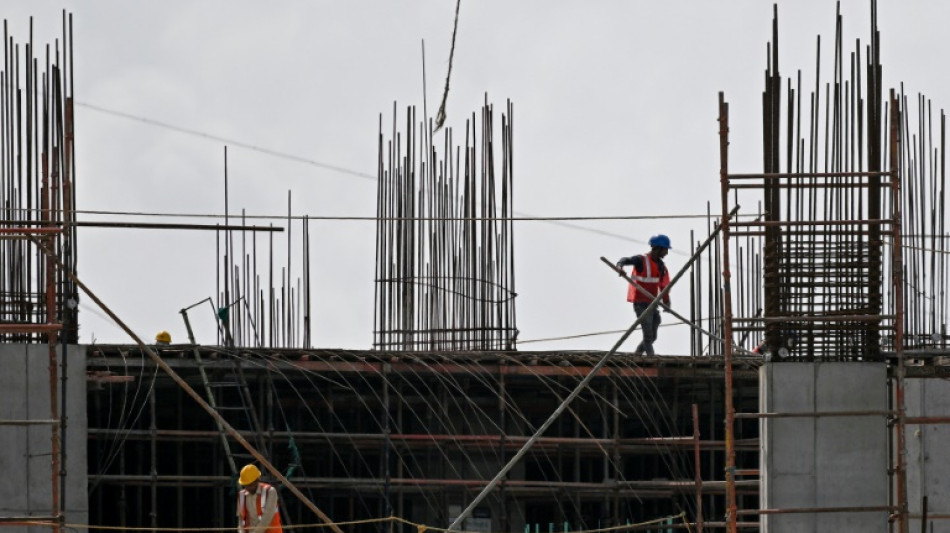
UN maps out decarbonisation of polluting construction sector / Photo: © AFP

The construction sector -- the most polluting and difficult to decarbonise -- must build less, use more sustainable materials and clean up conventional ones to slash its emissions, the United Nations said on Tuesday.
The industry is responsible for 37 percent of global carbon dioxide emissions and growing urbanisation is spurring the construction of new buildings made from carbon-heavy materials, especially concrete and steel.
Mushrooming urban environments -- which add new buildings in an area equivalent in size to Paris every five days -- damage life-sustaining ecosystems and pose serious challenges to fighting climate change.
A report published by the UN Environment Programme (UNEP) and Yale Center for Ecosystems and Architecture on Tuesday called on the sector to prioritise a "circular" approach that avoids waste.
Net zero by 2050 in construction is achievable if "governments put in place the right policy, incentives and regulation to bring a shift the industry action", said Sheila Aggarwal-Khan, director of UNEP's industry and economy division.
Building less and repurposing existing structures generates 50-75 percent fewer emissions than new constructions, the report said.
Switching to renewable bio-based materials such as timber and biomass could see emissions savings of up to 40 percent by 2050 in some regions, it added.
Conventional materials that cannot be replaced -- concrete, steel, aluminium, glass and bricks -- must find ways to decarbonise further, said the report.
Electrifying production, scaling up innovative technologies, and using more recycled materials would accelerate efforts to clean up these especially carbon-intensive materials.
Concrete, aluminium and steel alone account for 23 percent of overall global emissions.
The share of concrete in world construction should be cut by half between 2020 and 2060 for an effective decarbonisation of the sector, the report recommended.
Two-thirds should be "circular" -- concrete that has been recycled, reused or created using low-carbon cement.
The remainder would be new, low-emissions cement.
Anna Dyson, a lead author of the report and a professor at the Yale Schools of Architecture in the United States, said the sector needed a "revolution", including a "dramatic reduction" in new concrete production.
"But it's going to be gradual," she told AFP.
Steel and concrete "often give only the illusion of durability, usually ending up in landfills and contributing to the growing climate crisis", said Aggarwal-Khan.
- 'Back to the future' -
Until the mid-20th century, building materials were usually sourced locally and from renewable or organic sources such as stone and timber.
Buildings were designed "with climate conditions in mind", and only in recent decades have materials mostly used "extractive, toxic and non-renewable methods", said Dyson.
The construction industry must cooperate with the forest and agricultural sectors to manage wood and biomass resources and the materials needed for future cities, she added.
"It's a kind of back-to-the-future revolution."
Living biomass on walls or roofs can be an important low-carbon material for cities in the future, Dyson added.
There is no "silver bullet" to decarbonise the industry, said fellow lead author Naomi Keena of Canada's McGill University.
"It's about adding new materials" and "shifting the processes", she said.
The report, which drew on contributions from researchers and architects from across the world, will be presented during a climate gathering of ministers and business leaders in New York next week.
It will also play an important role in an international meeting due in Paris in March 2024 bringing together government ministers responsible for construction and climate, according to a UN source.
Some countries could make "breakthrough" commitments during UN climate talks in Dubai starting in November, just as they did for the transport, energy, steel, agriculture and hydrogen sectors in 2021, the source added.
S.Davis--ThChM