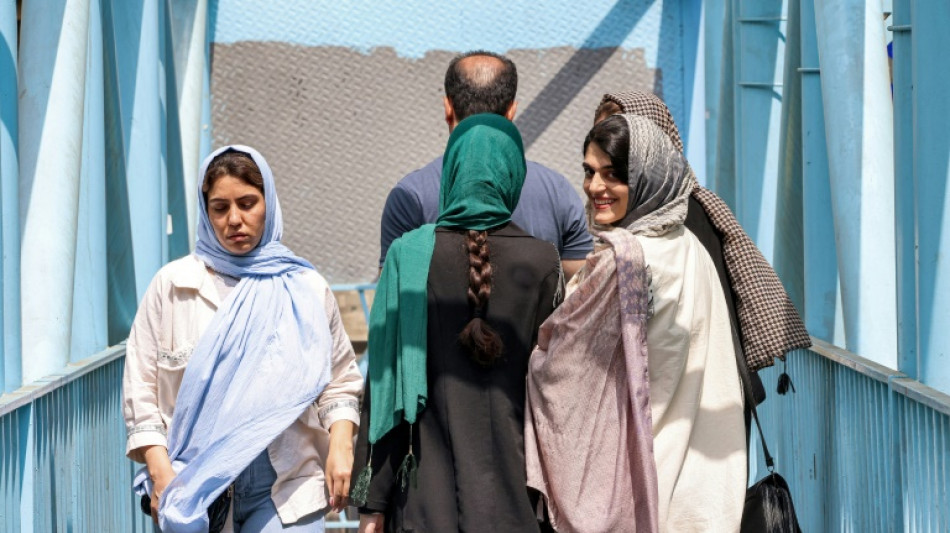
Iranians hit by internet curbs in year since protests / Photo: © AFP

Iran has imposed curbs on the internet in the year since protests erupted over Mahsa Amini's death, forcing people to find other ways to run their businesses or keep in touch with loved ones.
Amini, a 22-year-old Iranian Kurd, died on September 16, 2022 after her arrest in Tehran for an alleged breach of the Islamic republic's strict dress code for women.
Her death triggered months of nationwide protests in which hundreds of people were killed, including dozens of security personnel, before authorities moved to quell what they branded "riots", including restrictions on the use of social media.
Alma Samimi, who makes a living by selling leather bags online, said her business had suffered since the blackout came into force.
"The damage has been irreversible," she said, with profits linked to her Instagram account -- which had amassed thousands of followers -- nosediving 80 percent.
"Online interactions have dramatically dropped since last year," she said.
The restrictions, which affected online activity including on Instagram and WhatsApp, come as millions of Iranians struggle to make ends meet, grappling with an economic crisis marked by soaring inflation and the Iranian rial's sharp decline.
Iran's economic woes were significantly compounded by Washington's 2018 decision to reimpose sanctions on Tehran after then-president Donald Trump unilaterally withdrew the United States from a landmark nuclear deal.
"We cannot plan for the future anymore," Samimi lamented.
- 'Added cost' -
Some 1,200 business owners have since called on Iran's President Ebrahim Raisi to lift the restrictions, according to local media.
To keep her business afloat, Samimi resorted to using virtual private networks and anti-filter tools to bypass the censorship.
Daily demand on VPN services in Iran rocketed to "3,082 percent higher than before the protests" last year, according to Top10VPN, a British-based digital security advocacy group.
Mohammad Rahim Pouya, a psychologist who offers online therapy sessions, said he lost more than 50 percent of his clients in the early days of the blackout.
The 32-year-old said he could maintain communication lines with clients in Iran but it was more challenging with those abroad.
For him, the use of anti-censorship tools was "an added cost and probably has security flaws".
"But what are the options?"
Finding ways around internet curbs has become commonplace in Iran where authorities have repeatedly blocked access over the years at times of unrest.
In 2009, access to social media networks was blocked during mass protests -- which became known as the Green Movement -- following a contentious presidential election that saw the populist Mahmoud Ahmadinejad take office.
Popular social media networks including Facebook and X, formerly known as Twitter, have since been blocked.
A decade later, harsher curbs were imposed after protesters took to the streets over a government decision to raise fuel prices by 200 percent.
- Costly curbs -
In March, Iran's telecommunications minister Issa Zarepour urged foreign companies to introduce representative offices in Iran, saying "no one wants to limit the internet and we can have international platforms".
Meta, the American giant that owns Facebook, Instagram and WhatsApp, has said it has no intention of setting up offices in the Islamic republic, which remains under crippling US sanctions.
The internet curbs have been costly.
The government spent $773 million in 2022 alone to impose them, making it the second biggest spender on restrictions after Russia, according to Statista, a Germany-based data collection website.
In February, Iran's reformist Shargh daily reported that the country's internet service providers suffered 40 percent losses because of the restrictions.
With the bans on Western apps in place, Iranians have been left with little choice but to rely on state-backed apps.
But the homegrown alternatives for social networks and messaging apps -- like Bale, Ita, Rubika and Soroush -- have failed to garner significant popularity compared with their international alternatives.
Samimi says she has yet to "find any alternatives" to her now-dwindling online business on Instagram.
Likewise, Pouya insists on using international platforms through anti-censorship tools but he fears a total blackout.
"I wouldn't know what to do if they shut down (the internet) completely."
N.Wan--ThChM