'Made in Russia' fashion struggles to fill gap / Photo: © AFP

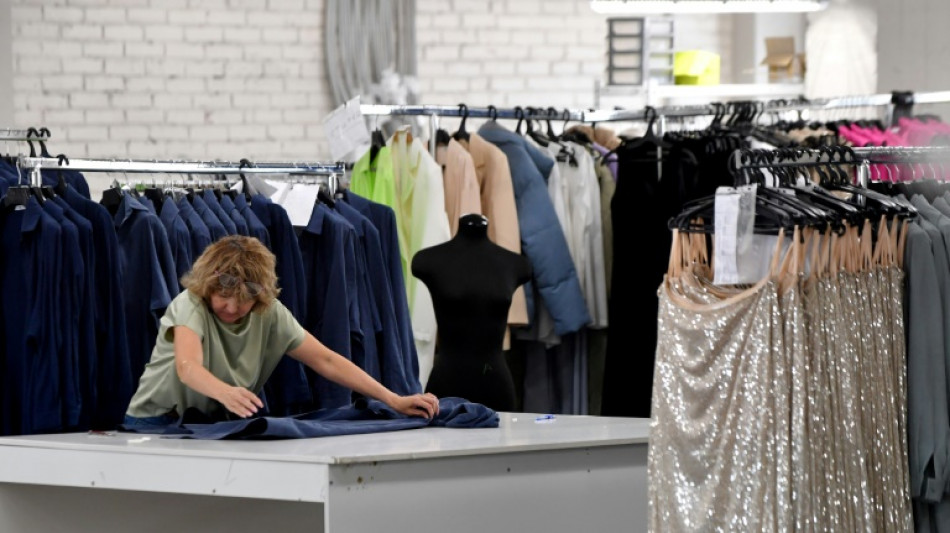
Despite staff shortages, a lack of equipment and dwindling fabric supplies, Russia's fashion industry is rushing to fill the gap left by the departure of major Western labels.
Dozens of brands like Adidas, H&M and Zara have shut up shop in Russia since the conflict in Ukraine began last year, while Western sanctions have cut off access to foreign goods.
Moscow saw its European clothing imports drop by 37.2 percent last year, according to the Fashion Network site.
The Kremlin has cast the sanctions as an opportunity to bolster domestic firms, returning to Soviet-style manufacturing after years of foreign dependence.
But while the state has poured subsidies into industries like clothing, Moscow faces an uphill battle to sell customers on the "Made in Russia" label.
- Industrial revolution -
Nadezhda Samoylenko, who has worked in the sector since 1978, said that when the Soviet Union collapsed, so too did the country's light manufacturing industry.
Russia stopped producing fabrics and lost the knowledge needed to train managers, as the Soviet-era schools that trained staff closed.
Factories are between 25 percent and 50 percent short of the specialists they need as a result, one industry expert told AFP.
While Western brands such as H&M and Uniqlo have been superseded by Russian replacements like LIME and "Lady & Gentleman", most manufacturing still takes place abroad.
"Major Russian clothing brands produce in the same Asian factories as the Western brands that left Russia," said Tatyana Belkevich from RAFI, an association that represents Russia's fashion industry.
In Saint Petersburg, the YOU clothing brand has positioned itself as an alternative to Spain's Massimo Dutti, part of the Inditex group that closed more than 500 stores in the wake of Moscow's offensive.
The company does produce in Russia, but volumes remain low.
YOU said it doubled its production last year, to 4,000 items. The company is aiming to double this again by 2024, "even though delivery times for raw materials and supplies from Asia have also doubled", CEO Yevgeniya Moseychuk told AFP.
The brand has tripled its workforce in 18 months and opened six stores, but it is still a long way from mass production.
And it lacks a quarter of the sewing staff it needs.
- Patriotic customers? -
Still, the number of clothing companies is on the rise.
According to the Rosakkreditatsiya registration service, the number of companies in the sector increased by 20 percent between 2021 and 2022.
When it comes to marketing, the overwhelming majority of brands have chosen English names in favour of Russian ones.
"In their hearts, Russian consumers are still under the influence of Western soft power," Belkevich said.
Clothing consultant Stanislava Nazhmitdinova said fashion choices might also be dictated more by financial circumstances than patriotism.
"For consumers now, it is more important to buy cheap than to buy (Russian)," she said.
According to the Fashion Consulting Group, clothing prices have gone up by 30 percent as sanctions disrupt supply chains and the ruble lingers at historic lows against the dollar.
"Russians say now that they are more interested in local brands, but in fact, do they have a choice?" Nazhmitdinova said.
And, in any case, more than half of Russians continue to buy Western brands ordered via third countries, according to the audit and consultancy firm B1, the former Russian arm of accounting giant EY.
"When Westerners return to Russia, they will still find their loyal customers here," Nazhmitdinova said.
"If they are still alive, of course."
V.Liu--ThChM