The China Mail - Foragers and popsicle sellers: a micro-economy among US migrants

USD -
AED 3.672499
AFN 64.999916
ALL 81.612415
AMD 361.429417
ANG 1.789785
AOA 917.000014
ARS 1515.013675
AUD 1.438249
AWG 1.8025
AZN 1.700214
BAM 1.747405
BBD 2.013572
BDT 123.421934
BGN 1.747831
BHD 0.377753
BIF 2993.687766
BMD 1
BND 1.282034
BOB 11.711836
BRL 5.048501
BSD 0.999772
BTN 95.182957
BWP 13.733399
BYN 3.020865
BYR 19600
BZD 2.010641
CAD 1.428685
CDF 2312.496248
CHF 0.83934
CLF 0.025067
CLP 986.569921
CNY 6.692151
CNH 6.70015
COP 3199.72
CRC 455.660238
CUC 1
CUP 23.993531
CVE 98.516424
CZK 21.93055
DJF 178.022773
DKK 6.72558
DOP 61.224946
DZD 134.824654
EGP 53.071104
ERN 15
ETB 163.294038
EUR 0.899696
FJD 2.253302
FKP 0.754659
GBP 0.760725
GEL 2.594977
GGP 0.754659
GHS 11.661597
GIP 0.754659
GMD 74.000188
GNF 8795.13605
GTQ 7.639869
GYD 209.069102
HKD 7.84837
HNL 26.840523
HRK 6.774401
HTG 130.910423
HUF 327.813001
IDR 17987.8
ILS 3.097598
IMP 0.754659
INR 95.200404
IQD 1515.48045
IRR 1779859.999568
ISK 122.720223
JEP 0.754659
JMD 158.765613
JOD 0.708973
JPY 158.933973
KES 129.779826
KGS 87.450008
KHR 4061.41256
KMF 439.99971
KPW 899.999961
KRW 1342.859621
KWD 0.31205
KYD 0.833099
KZT 451.695332
LAK 22493.623218
LBP 89523.405358
LKR 330.891222
LRD 170.452667
LSL 16.481157
LTL 2.95274
LVL 0.60489
LYD 6.422994
MAD 9.847399
MDL 17.89398
MGA 4501.940954
MKD 55.018986
MMK 2100.02843
MNT 3599.679138
MOP 8.081626
MRU 40.049676
MUR 47.439976
MVR 15.459908
MWK 1733.742534
MXN 18.55201
MYR 4.085202
MZN 63.926725
NAD 16.480347
NGN 1330.069802
NIO 36.792495
NOK 9.554205
NPR 152.293053
NZD 1.796445
OMR 0.38452
PAB 0.999736
PEN 3.442394
PGK 4.53782
PHP 62.956996
PKR 276.801369
PLN 3.93499
PYG 5704.585558
QAR 3.644591
RON 4.801205
RSD 105.635355
RUB 83.877246
RWF 1475.009269
SAR 3.74887
SBD 8.078071
SCR 13.864706
SDG 601.500861
SEK 10.087235
SGD 1.287135
SHP 0.754518
SLE 24.669714
SLL 20969.504398
SOS 571.364753
SRD 37.71204
STD 20697.981008
STN 21.88956
SVC 8.747783
SYP 13001.999685
SZL 16.474351
THB 33.724969
TJS 9.227237
TMT 3.5
TND 2.988314
TOP 2.40776
TRY 49.392098
TTD 6.799166
TWD 32.150946
TZS 2630.012996
UAH 44.933885
UGX 4039.293995
UYU 40.187267
UZS 11957.007308
VES 875.701597
VND 25897
VUV 119.372685
WST 2.788609
XAF 590.1616
XAG 0.017847
XAU 0.000244767483
XCD 2.70255
XCG 1.801832
XDR 0.707052
XOF 590.1616
XPF 106.553496
YER 236.195602
ZAR 16.66414
ZMK 9001.201353
ZMW 19.868757
ZWL 321.999592
SSP 5748.524006
MXV 2.094954
  • RYCEF

    0.4000

    19.71

    +2.03%

  • CMSC

    0.0000

    20.4

    0%

  • BTI

    0.4200

    56.05

    +0.75%

  • BP

    0.2800

    44.43

    +0.63%

  • RBGPF

    1.6000

    67

    +2.39%

  • RIO

    -0.1500

    94.41

    -0.16%

  • AZN

    -0.4300

    166.15

    -0.26%

  • GSK

    0.4600

    49.7

    +0.93%

  • BCE

    -0.4100

    20.56

    -1.99%

  • NGG

    -0.2500

    75.24

    -0.33%

  • VOD

    -0.0400

    16.58

    -0.24%

  • RELX

    -0.4500

    33.07

    -1.36%

  • BCC

    -0.5500

    76.59

    -0.72%

  • CMSD

    -0.0300

    20.27

    -0.15%

  • JRI

    -0.2500

    10.77

    -2.32%

Foragers and popsicle sellers: a micro-economy among US migrants
Foragers and popsicle sellers: a micro-economy among US migrants / Photo: © AFP

Foragers and popsicle sellers: a micro-economy among US migrants

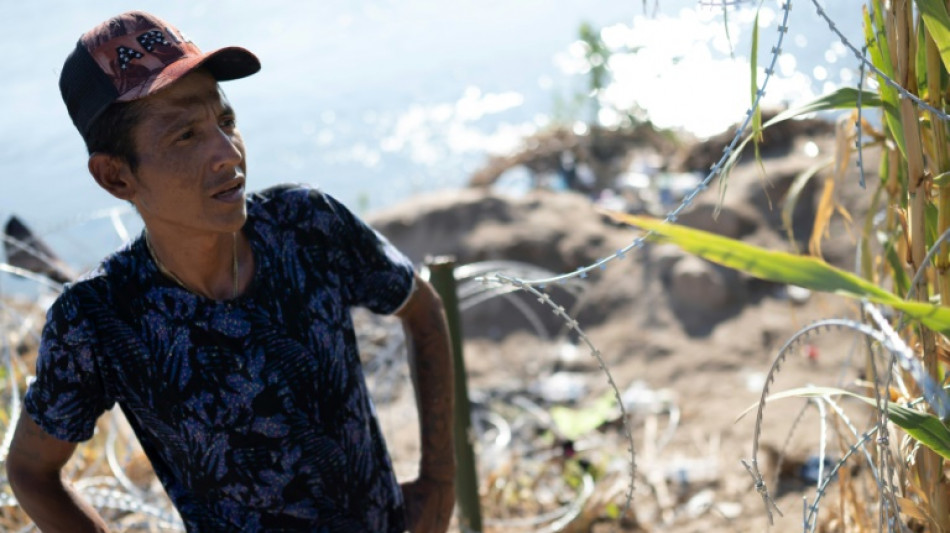
Marco Gonzalez used to fish the river between Mexico and Texas, but now he has a more lucrative harvest -- possessions abandoned by the thousands of migrants crossing the border from the south.

Text size:

Crowds of people reach the border every day, after long, dangerous and difficult journeys from Africa, Asia or South America.

Their discarded backpacks, clothes or blankets sustain a cottage industry of foragers, part of a micro-economy that feeds off the stream of humanity desperate to get into the United States.

"Once, when I was fishing, I found $100 in a bag, and so I started coming here," 37-year-old Gonzalez told AFP on the banks of the Rio Grande.

"And since now there's a ton of clothes here all over... I thought, I'm staying."

- 1.8 million -

In the last 11 months, at least 1.8 million people have reached the southern US border, many of them searching for safety and economic opportunity they could not find in their own countries.

The soaring numbers are a political headache for President Joe Biden, whose Republican opponents are hammering the issue, a year out from an election.

Thousands enter the country illegally every day, some swimming across the perilous waters of the Rio Grande. As they do, they often abandon possessions that weigh them down.

"I only kept my papers and some shoes," Venezuelan Francis Ibarra told AFP.

"I left the clothes from the river there because they were all wet."

For officers patrolling the US side of the banks and islands on the Rio Grande, the scavenging is now just part of the daily landscape.

"It's become a way of life for people who live on the border," one Texas National Guardsman told AFP, on condition of anonymity because he was not authorized to speak to the media.

"You see them in cities -- they come to look for things to sell or exchange. Some make a living from it; others do it to help migrants."

Clothes and bags dot the island that lies halfway between the Mexican city of Piedras Negras and Eagle Pass in Texas, cast off by people who stopped to rest after their first dash into the current.

As an AFP team watched, a man and two children picked through the detritus, looking for anything worth having.

Even more accumulates on the US side of the river, where migrants believe they will be ordered to leave their possessions if they meet Customs and Border Protection officers on the other side of the razor wire.

For Gonzalez, it is here that offers the richest pickings.

What he gathers, he can give to an NGO that helps migrants in Piedras Negras.

"The woman there, since she already knows me, gives me a good meal, rice, beans, oil, and toilet paper," he said.

More enterprising still is Sixto Gomez, who used to sell popsicles in Piedras Negras, but now plies his trade on the river.

"I sell more here than in the city, and no one bothers me, who is going to come here?" he asks.

On the island in the middle of the river he asks 15 pesos (85 US cents) for a popsicle, but on Sunday when a logjam formed at the razor wire, he crossed to the US bank to peddle his wares -- and raised his price to 20 pesos.

"Here it is more expensive," he told AFP. "This is America."

V.Liu--ThChM