Largest climate fund seeks new funding for vulnerable / Photo: © AFP

The world's largest multilateral climate fund will aim to boost cash flow in a donor conference on Thursday, with all eyes on what the United States will provide for vulnerable nations.
The Green Climate Fund (GCF) was set up as part of the landmark 2015 Paris Agreement to funnel grants and loans to developing countries for adaptation and mitigation projects in a warming world.
The fund plays a part in the promise by rich countries to supply $100 billion of climate finance to poorer nations every year -- one which has already missed an initial 2020 deadline.
Financing is one of the most contentious topics in international climate diplomacy as the world aims to limit warming to 1.5 degrees Celsius above pre-industrial levels.
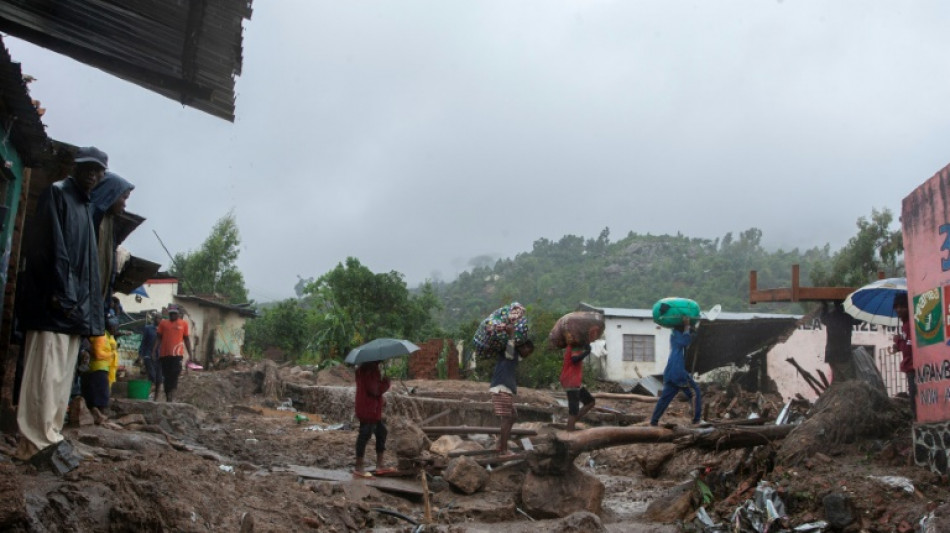
Developing countries least responsible for climate change are seeking support from the richer polluting nations -- both to adapt to the increasingly ferocious and expensive consequences of extreme weather and for their energy transitions.
The issue will play a major role in crunch UN talks beginning in Dubai on November 30.
- $50 billion by 2030 -
The GCF says Thursday's conference in the German city of Bonn will allow it to invest more in a decade it sees as critical for climate action.
It has laid out a "50by30" vision to manage $50 billion by 2030 -- almost triple its current capital of $17 billion. It aims to focus efforts in developing countries in 2024-2027.
Its current portfolio of projects is mostly dedicated to Africa, the Asia-Pacific region, Latin America and the Caribbean.
Rolling out solar panels in Pakistan and making Philippine agriculture more resilient in the face of unpredictable weather are among projects that have been approved.
This year, Britain and Germany pledged billions of dollars to the GCF, while France followed suit last month with a commitment of 1.61 billion euros (around $1.7 billion).
Austria, Canada, the Czech Republic, Denmark, Iceland, Luxembourg, Monaco, Slovakia, Slovenia, South Korea and Spain have also made commitments.
But a huge gap remains to be plugged, with the United States yet to announce how much, if anything, it will offer.
It pledged around $3 billion for the fund's first resource mobilisation in 2014 under former president Barack Obama, but his successor Donald Trump offered nothing five years later.
- 'Unique potential' -
GCF executive director Mafalda Duarte called on the fund's supporters to fully honour its "initial vision and unique potential".
Posting on X, formerly known as Twitter, she wrote: "We're in this together. The GCF replenishment is an opportunity to show global solidarity."
The GCF currently has more than 100 implementing partners and various financial instruments. A first tranche of replenishment funds worth $10 billion was pledged for the 2020-2023 period.
According to the Organisation for Economic Cooperation and Development (OECD), developed countries helped to supply $83.3 billion in climate finance in 2020.
But experts say the real needs in developing countries are much higher.
The UN's Independent High-Level Expert Group on Climate Finance last year estimated developing nations would need more than $2 trillion a year by 2030 to fund climate resilience and development priorities.
"The GCF has a critical role to play but to date has struggled to define its function and comparative advantage within a fractured climate financing landscape," said the Lowy Institute, an Australian international policy think tank.
M.Chau--ThChM