One year after Tigray peace deal, rights abuses persist / Photo: © AFP/File

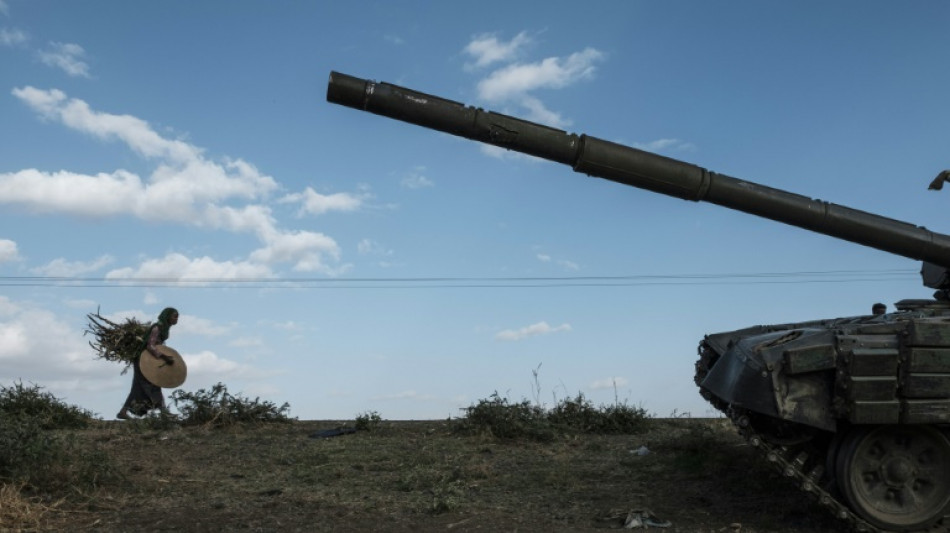
One year after a deal to end the war in Ethiopia's Tigray region, there were global calls Thursday for more to be done to protect civilians and ensure justice for victims of atrocities.
Human Rights Watch, the European Union and 10 foreign governments said rights abuses were continuing in Africa's second most populous country despite the peace agreement reached in Pretoria on November 2, 2022.
The two-year conflict between forces loyal to Prime Minister Abiy Ahmed's government and the Tigray People's Liberation Front killed half a million people, according to the United States, with all sides accused of atrocities such as massacres and rapes.
The African Union-brokered deal ended fighting in Tigray but clashes have since erupted in other parts of the country, notably in the Amhara region, whose forces supported federal troops during the war.
"While the Ethiopian government and its international partners tout the tremendous progress made in the past year, civilians in conflict areas are still bearing the brunt of atrocities," said HRW's deputy Africa director Laetitia Bader.
HRW said Eritrean forces, which backed Abiy during the conflict, had "carried out killings, sexual violence, abductions, and pillage, and obstructed humanitarian assistance, and impeded the work of AU monitors" following the peace deal.
"The United Nations and concerned governments should maintain pressure on the Ethiopian government to deliver on its commitments to ensure that civilians are protected and to set clear benchmarks for ensuring victims' access to justice," it added.
On Thursday, US Secretary of State Antony Blinken praised the "significant progress" that had been made since the deal was reached, but acknowledged the "challenges that remain".
"Eritrean forces must fully withdraw. Both Ethiopia and Eritrea must refrain from provocation and respect the independence, sovereignty and territorial integrity of all countries in the region," he said.
Asmara subsequently denounced a "smear campaign", accusing Washington and European countries of using Eritrea as an "easy political punching bag".
- 'No consequences' -
EU foreign policy chief Josep Borrell urged Ethiopia's government to "conduct investigations into all allegations of human rights violations and abuses, and violations of international humanitarian law, and prosecute those responsible".
The 27-member bloc inked a 650-million-euro ($693-million) development deal with Ethiopia last month in a bid to normalise relations following the Tigray conflict.
But Brussels has not resumed budgetary aid to Ethiopia which was suspended in December 2020, a month after the war started.
"Further progress on accountability and justice is decisive for... normalisation," Borrell said.
The federal government's decision to impose a six-month state of emergency in early August in Amhara has also raised fears, with the UN-backed International Commission of Human Rights Experts on Ethiopia warning of an increase in abuses in the region.
The Ethiopian Human Rights Commission (EHRC) -- an independent federal state body -- said on Monday that the use of heavy weapons and aerial bombardment in Amhara had killed, injured and displaced many civilians.
It also condemned the "executions of arrested civilians" by security forces and the assassinations and abductions of local civilian leaders by armed groups.
A spokesman for the Ethiopian government, Legesse Tulu, on Thursday criticised the report for being "based on unreliable elements and lacking impartiality" and for "not taking into account the context".
He said the authorities had detained about 3,200 suspects since the state of emergency was imposed.
HRW spoke to a 24-year-old woman in the North Gondar zone in Amhara who said: "People are getting killed and arrested. Things are much worse. I don't feel safe right now. No one is feeling safe."
Tensions surged after Abiy's government announced in April that it was dismantling regional forces across the country, triggering protests by Amhara nationalists.
Bader urged countries supporting Ethiopia's truce not to look away as "past violators repeat patterns of abuses without consequences".
- 'More needs to be done' -
The embassies of 10 nations including Britain, Australia, Norway, Canada and Japan hailed the Tigray deal as a "momentous achievement" but warned that more needed to be done to protect and realise peace in the face of "continuous human rights violations".
Rights groups have voiced concern about the scrapping last month of the UN-backed rights commission, with Amnesty International describing it as a betrayal of victims of atrocities.
It is impossible to verify the situation on the ground in Amhara or Tigray as media access is heavily restricted.
Although services including banking, electricity and internet have resumed in some parts of Tigray over the past year, one million people remain displaced across the region, according to the International Organization for Migration.
X.So--ThChM