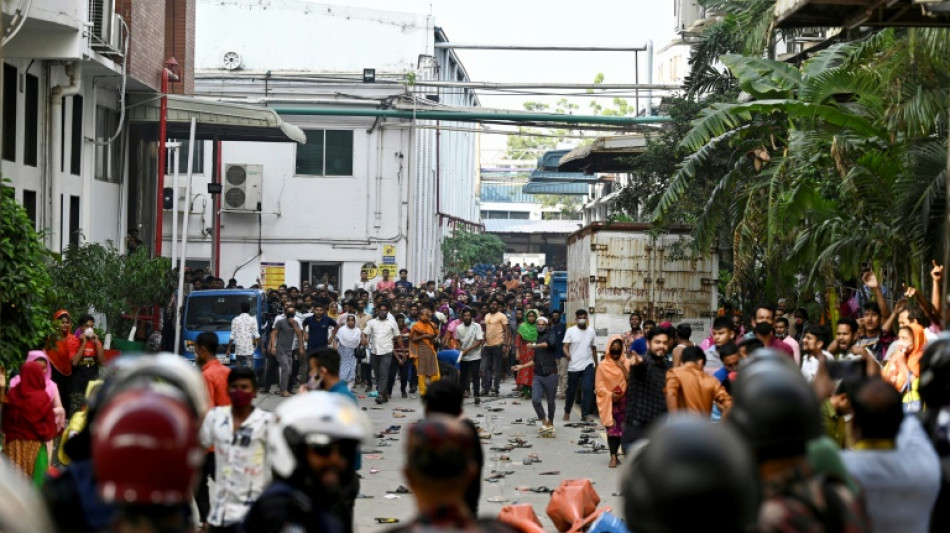
Bangladesh PM rejects further pay hike after garment worker protests / Photo: © AFP

Bangladesh's Prime Minister Sheikh Hasina has rejected any further pay hikes for protesting garment workers demanding a nearly tripled wage increase, after violent clashes with police and factories were ransacked.
Bangladesh's 3,500 garment factories account for around 85 percent of its $55 billion in annual exports, supplying many of the world's top brands including Levi's, Zara and H&M.
But conditions are dire for many of the sector's four million workers, the vast majority of whom are women whose monthly pay starts at 8,300 taka.
A government-appointed panel raised wages on Tuesday by 56.25 percent to 12,500 taka ($113) for the South Asian nation's garment factory workers, who were demanding a 23,000 taka minimum wage in all plants.
"I would say to the garment workers: they have to work with whatever their salary is increased, they should continue their work," Hasina told a meeting of her ruling Awami League party late Thursday.
The protests have left at least three workers dead and more than 70 factories ransacked since last week, according to police.
- 'Climate of fear' -
"If they take to the streets to protest at someone's instigation, they will lose their job, lose their work and will have to return to their village," the prime minister added.
"If these factories are closed, if production is disrupted, exports are disrupted, where will their jobs be? They have to understand that."
Hasina said 19 factories were "attacked and destroyed", businesses that "give them bread and butter and food and employment".
A union leader, speaking on condition of anonymity, said Hasina's speech had created a "climate of fear" in the industry, warning it had given security forces permission to crack down further on protests.
Police have arrested more than 100 protesters including several union leaders over charges of violence and vandalising factories, two police officers told AFP.
On Thursday, police reported violence in the key industrial towns of Gazipur and Ashulia, outside the capital Dhaka, after more than 25,000 workers staged protests in factories and along highways to reject the wage panel's offer.
Hasina said what was offered to the workers was a bigger rise than what civil servants would get, although union leaders said garment worker wages were meagre in comparison.
"Government officers have got a five percent hike, since there is inflation all over the world -- and they (garment workers) will get 56 percent raise," she said.
- 'Poverty wage' -
But unions said they had dismissed the panel's decision, because the pay hike does not match the soaring cost of food, rent, healthcare and school fees for their children.
The Netherlands-based Clean Clothes Campaign, a textile workers' rights group, has dismissed the new pay level as a "poverty wage".
"If brands backed the 23,000 taka amount demanded by trade unions and committed to absorbing the cost of the wage increase, workers would not have to go out on the streets and protest," group spokesman Bogu Gojdz told AFP.
"We see living wage-committed brands -- such as ASOS, Uniqlo, H&M, C&A, M&S, Aldi and Next -- as particularly responsible in this situation," Gojdz added.
"While they claim to be committed to paying their workers fair wages, they refuse to support the bare minimum wage workers need to survive".
Rashedul Alam Raju, a garment union leader, urged Hasina to listen to workers' demands.
"The prime minister can raise the wages after reconsidering the situation," Raju said.
Washington has condemned violence against protesting workers.
The United States, which is one of the largest buyers of Bangladesh-made garments, has called for a wage that "addresses the growing economic pressures faced by workers and their families".
W.Tam--ThChM