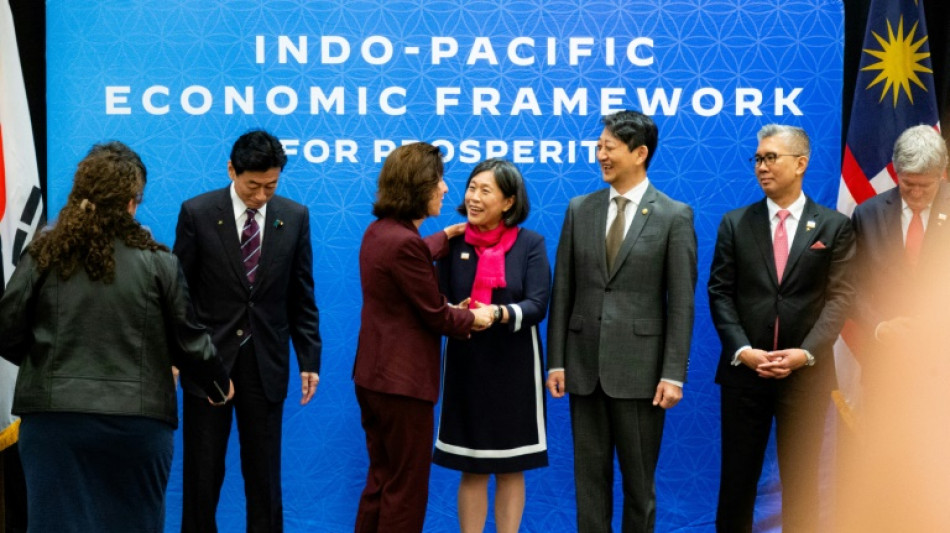
Asia trade talk stumble is another setback for US: analysts / Photo: © AFP

The United States stumbled again in trade negotiations with Asia-Pacific partners this week, a setback that analysts say could weigh on America's standing as a partner in the face of China's growing influence.
While Washington had for decades used free-trade pacts to forge relationships around the world, a more isolationist mood has gripped domestic politics.
The Indo-Pacific Economic Framework for Prosperity (IPEF) failed to materialize at the Asia-Pacific Economic Cooperation (APEC) forum, holed by US fears over the impact on workers at home.
Pushback from President Joe Biden's own party underscores the challenges, with congressional Democrats concerned it could impact their prospects in next year's elections.
A failure to deliver IPEF could look like a replay of the Trans-Pacific Partnership (TPP), which former president Donald Trump denounced as bad for US jobs.
One of his first actions in office was to yank the US out of the TPP, a huge multi-national deal yoking major Asian allies that had been years in the making, and which had been a key plank of foreign policy.
That withdrawal smarted in Asian capitals, particularly in Japan which had worked for years on the project.
The White House insists IPEF is not dead, just that it needs a bit more work to get it over the line.
- 'Imbalance' -
But, say analysts, the US is skating on thin ice.
"To see the United States fail to deliver on trade negotiations in the Indo-Pacific again would further damage US credibility as a trade partner in the future," said Thibault Denamiel of the Center for Strategic and International Studies.
Into that breach steps China, whose lavish spending on infrastructure projects all around the world over the last few decades -- under its Belt and Road Initiative -- have won it friends and favor in many places.
Beijing has also forged its own Regional Comprehensive Economic Partnership with 14 other Pacific-rim countries, all resulting in "an imbalance in economic engagement" in favor of Beijing, said Denamiel.
IPEF could help rebalance that, he told AFP.
While IPEF falls short of a traditional multinational deal -- it doesn't include market access -- participants have hoped it would lead to greater US engagement, analysts say.
US officials and partners this week trumpeted the conclusion of talks on three of four segments in IPEF, which seeks to create common rules and standards across countries that make up 40 percent of the global economy.
Leaders signed a deal on supply chains, and reached agreements on climate and anticorruption.
Trade remains the last holdout, a blow to Biden who launched the initiative last year bringing together the United States and 13 other nations -- including Japan, India and much of Southeast Asia, although notably not China.
- Durable partner -
Asia Society Policy Institute vice president Wendy Cutler noted the lack of a deal "is a major setback for US trade policy."
Beijing's active trade agenda ought to nudge Washington towards a "bolder approach," or it risks having its influence undermined as partners work with each other and China, Cutler argued in an earlier commentary.
While she conceded a November deadline was "ambitious" as trade talks typically require more time, she warned that prospects are slim for further progress as the 2024 elections draw close -- the trade section has drawn criticism in part due to a lack of worker protections, an issue that looms large for US voters.
US Commerce Secretary Gina Raimondo lauded progress this week at the APEC summit in San Francisco.
She said agreements on climate, the energy transition and combating corruption were worthwhile, as was the creation of a ministerial council for cooperation.
IPEF, she said, "was never conceived to be a trade agreement."
She added in separate remarks that the US aims to be a "durable force and partner" in the Asia-Pacific, a region from which it had been largely absent in the years before Biden took office.
- Difficult reality -
It is "difficult to judge" the scale of commitments made without the full texts of the latest agreements, said Inu Manak, a fellow for trade policy at the Council on Foreign Relations.
"It is concerning that the trade pillar was not concluded because the IPEF has been pitched as the answer to US withdrawal from the TPP," she added.
"One of the most difficult realities of the last few years has been that the United States has stepped down from its leadership role on trade," Manak told AFP.
"Even if the IPEF trade pillar is concluded, the absence of high standard digital trade rules would weaken its overall value."
C.Smith--ThChM