Cold, mud and mice: Ukraine enters second winter of war / Photo: © AFP

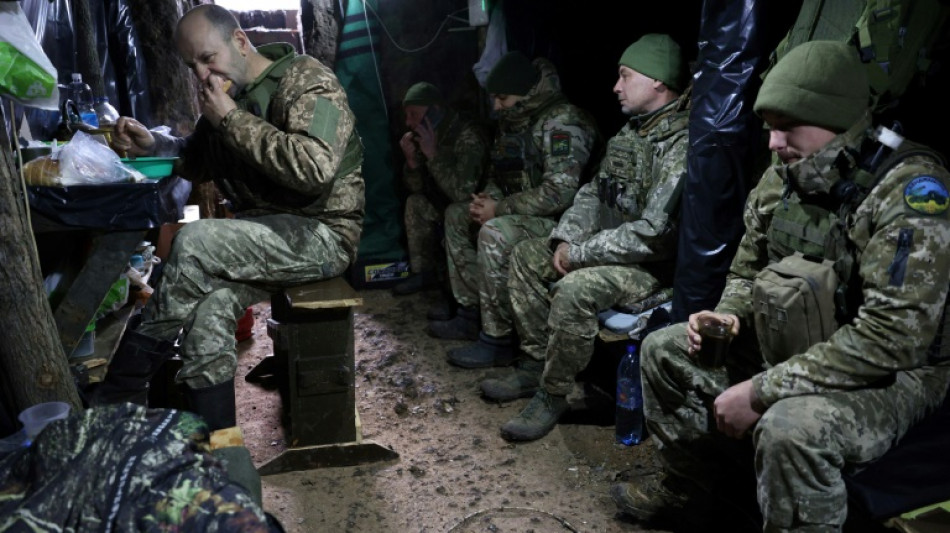
In a heated shelter near the eastern front line, Ukrainian serviceman, Dmytro, looked on as a mouse sniffed the air and then scuttled behind plastic sheeting insulating the walls and ceiling.
"I didn't see any mice last winter, but this autumn and early winter there have been loads," said the 36-year-old, who operates a BM-21 "Grad" self-propelled multiple rocket launcher.
His unit is positioned close to the industrial town of Bakhmut, an area of the front line that has seen some of the heaviest fighting of Russia's nearly 22-month invasion.
Hidden from view under a thicket, their shelter measuring about 20 square metres (215 square feet) was furnished with bunk beds, a kitchen area and -- crucially -- a small diesel-powered car heater and electricity supply powered by car batteries.
Inside, it was about 20 degrees Celsius (68 Fahrenheit) compared to around zero outside. The sky was grey and the air damp and cold after constant rain in recent days.
The first snow of the year fell last week, signalling the start of the second winter of war for Dmytro and some fellow fighters.
The first was harsh, but the servicemen said they have learned to manage, particularly by installing heating.
- 'Three pairs of trousers' -
"I froze my ass off. When I got back from my shift, I pulled on everything I could find: three pairs of trousers, loads of jackets," Dmytro said, recounting last winter.
"We were always combat-ready. We were firing constantly, all day. It was very cold," he said, a blue woolly hat pulled down over his ears.
Dmytro was set to spend the next three days at the position near Bakhmut, sheltering in the dugout from bombardment and attack drones.
Inside, three dead mice were stuck to a glue trap.
"The problem is, they gnaw at the cables," says Volodymyr, the unit's 45-year-old commander, pointing to the one used to connect to the internet via Starlink satellite.
Seeking warmth and food, the rodents also munch through soldiers' clothes.
"My wife only bought me this sweater last month and a mouse has already started eating it," Dmytro told AFP.
As well as bringing cold and mice, the winter strips foliage from branches, exposing the troops to Russian drone cameras.
Plus the icy roads make it harder to move weapons systems and in early winter, vehicles get stuck.
"Now there is mud. Later there will be snow," said Volodymyr, pointing to deep ruts in the dark sticky soil of the Donbas region, dug by heavy military vehicles.
A few kilometres (miles) away, near Bakhmut, a doctor who goes by the military call sign, Osmak, said he was also better prepared for this winter.
In the basement of the solid-walled, frontline medical facility he runs, staff have insulated doors and windows using mineral wool and boards.
- Chemical hand warmers -
There is a wood-burning stove and car heaters have been installed in some of the rooms.
Last winter, "it was a lot harder to work because we didn't have the time to get properly equipped. We were working in the cold," the doctor said.
In rooms used to treat patients, "a comfortable temperature" should be "28, 29 or 30 degrees (Celsius)," he explained, wearing a short-sleeved T-shirt like other staff.
This is because wounded soldiers sometimes suffer from blood loss and hypothermia after spending a long time lying in the open.
Medics wrapped him in a foil blanket and placed a pipe inside blowing hot air, powered by a large generator outside.
As temperatures fall below zero, the doctor said he expects to see cases of frostbite.
But he said he had noticed how more soldiers were now using chemical hand warmers.
"When the wounded come in, even at such a time, you often see they have chemical handwarmers on their bodies, under their jackets and in their gloves," he said.
"Last winter you saw that a lot less. Guys didn't use them as often. Now they are taking care of themselves," he added.
D.Peng--ThChM