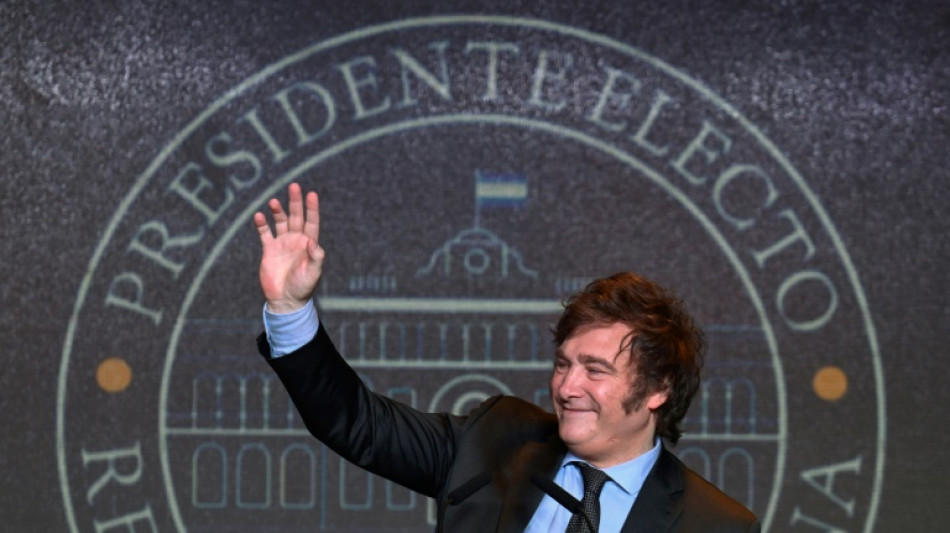
Fed-up voters put Latin American leaders on thin ice / Photo: © AFP

Latin American governments are learning not to get too comfortable in office, as disgruntled voters repeatedly topple incumbents, often in favor of outsiders or inexperienced politicians.
In many cases, things have not gone well for the newcomers.
The election of brash Argentine upstart Javier Milei shows that an anti-incumbent trend over the past decade is becoming a fixture, analysts say.
"There is no left-wing wave or right-wing wave. There is no clear ideological trend. You simply have governing parties losing," said Ignacio Labaqui, a professor in Latin American politics at the Argentina Catholic University.
From Chile to Peru, Colombia and Ecuador, voters have simply opted to boot out the government of the day in favor of someone new. In Brazil, voters swung from outsider Jair Bolsonaro and then back to veteran leftist Luiz Inacio Lula da Silva.
Since 2018, the only government to hold onto power in a free and fair election has been in Paraguay, said Labaqui.
- 'Tired of everything' -
Gerardo Munck, an Argentine professor of international relations at the University of Southern California, told AFP that in the past decade, 80 percent of elections have been won by an opposition party, since a commodities boom fizzled out.
The economic fallout from the Covid-19 pandemic only made things worse.
"Voters are basically just tired of everything," he said, pointing to Argentina, where Milei swept to power on a wave of fury over decades of economic decline under the long-dominant Peronist coalition.
While the economy has been a big driver of exasperation, many voters are also increasingly concerned with crime, as drug and gang violence -- once only an issue north of Colombia -- spreads into new countries, such as Chile, Ecuador and even normally stable Uruguay.
Milei is also one of several examples of presidents elected not out of fervent adoration, but rather rejection of the other candidate, with many Argentine voters describing him as "the lesser evil".
Analysts say the collapse of powerful traditional parties has allowed outsiders like Milei to flourish.
- 'Unhappy record' -
Milei, a former television pundit, will take office next month with very little political experience and 38 out of 257 seats in Congress, leaving a cloud of uncertainty over what he will be able to accomplish.
If he looks to the precedent elsewhere in the region it has been an "unhappy record" for new governments who have struggled or seen their popularity swiftly plummet, said Michael Shifter of the Inter-American Dialogue think-tank in Washington.
In Peru, rural teacher Pedro Castillo burst from obscurity to the top office, but with little experience and a minority in Congress, chaos quickly ensued. He overhauled his cabinet four times in six months, and faced multiple impeachment proceedings.
Castillo was removed from office and arrested in December 2022, after 18 months in power, after attempting to dissolve Congress and rule by decree.
Chile's Gabriel Boric, elected in 2021, and Colombia's Gustavo Petro, elected in 2022, have both seen their popularity slide as they have struggled to implement their promised reforms.
Boric, 37, lost control of his key reform of the country's constitution reform process to the far-right and has battled rising crime and inflation.
Meanwhile, Colombia's ruling left took a beating in local elections as Petro's "total peace" plan has struggled, with the country instead experiencing a surge in violence from armed groups.
The Argentine professor, Munck, said a lot of the recently elected leaders in Latin America were "amateurs. They haven't run anything. (Milei) talks about economic theory but running a government is totally different."
Munck said the message to Latin American governments was: "It's easy to win an election, but it's hard to govern."
- The unknown -
Analysts agree that the only newcomers who have retained their popularity were Mexico's President Andres Manuel Lopez Obrador and El Salvador's President Nayib Bukele -- both facing re-election next year.
Bukele's war against violent gangs has won him adoration at home, even as he has come under fire from human rights organisations over arbitrary arrests and growing authoritarianism.
Noam Lupu, Associate Director of the Latin American Public Opinion Project, said the problem with outsiders was "that you don't really know what they're going to do (or) how committed they are to the political system. And often they do something very different from what they say in their campaigns."
"My guess is Milei is going to be a prime example of that."
O.Yip--ThChM