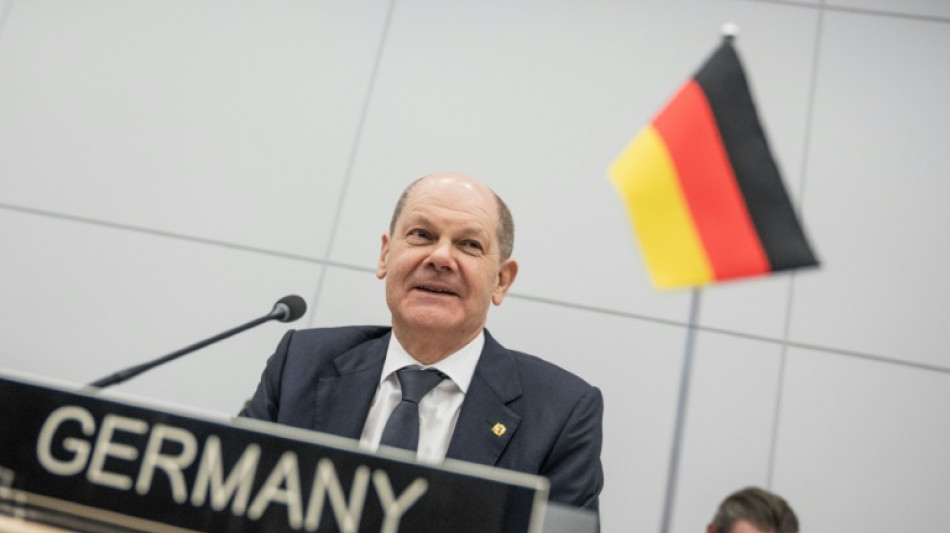
Scholz's SPD in first election test

Just over 100 days after taking power, Chancellor Olaf Scholz and his Social Democrats face their first electoral test on Sunday, with regional polls in the small state of Saarland.
Voters from the western state bordering France will be electing their next regional parliament, controlled since 1999 by former chancellor Angela Merkel's CDU party.
The vote will kick off a series of similar regional polls this year, including that of Germany's biggest state North Rhine-Westphalia in May.
Surveys in the run-up to the ballot suggest that Scholz's SPD has a good chance of upsetting the CDU.
Largely written off just months before his own election, Scholz come from behind to replace Merkel, who was retiring, in a major upset in September.
The surprise victory breathed new life into his party and the latest polls show the SPD at 41 percent in Saarland, well ahead of the CDU at 28 percent.
At the last Saarland election in 2017, the CDU came out on top and has since been governing regionally in a power-sharing coalition with the SPD.
The question remains, how much of the national picture can be extrapolated from the election in such a small state.
National surveys actually show support for the SPD dipping, as Scholz faces criticism for failing to take a more assertive stance against Russia's invasion of Ukraine or in handling the coronavirus pandemic.
In Saarland itself however, his SPD is benefiting from voters' reluctance to rock the boat against the backdrop of the conflict.
"Everything that is said and done at the moment is influenced by the war. It's not the right time to put up opposition," said CDU lawmaker Thorsten Frei.
- Firewall -
The SPD and CDU are likely to renew their partnership in the region, although this time with the centre-left party as the senior partner.
Other parties like the Greens or the far-right AfD risk not even crossing the threshold of five percent of the vote needed to enter parliament.
The Social Democrats are counting on the popularity of their regional candidate, Anke Rehlinger, 45, a lawyer who holds the state shot putt record.
Rehlinger, currently in charge of Saarland's economy, is winning over locals with her action for victims of de-industrialisation.
Her rival, the incumbent state premier Tobias Hans, 44, is meanwhile struggling to hold on to the region he has controlled for four years, accused of a wavering stance during the pandemic.
Hans was installed in 2018 to succeed former regional chief Annegret Kramp-Karrenbauer, then tapped as CDU national leader and a possible successor to Merkel.
After crashing in national elections to the SPD, the CDU has named Friedrich Merz, a former Merkel nemesis, as its new chief.
Merz cancelled his participation at a rally for Hans on Thursday, sparking speculation he had already concluded the election was lost.
"We get the impression that the CDU is trying to build a firewall to block out Saarland, to not bear the brunt in the impending defeat," said Spiegel weekly.
"In the end, the results always come back on the federal parties -- no matter how strong the firewall that has been erected may be," it warned.
The CDU, it noted, was struggling to pick up momentum.
It will have to shift gears to stand any chance in the next elections of the year, which besides that of the most populous state NRW, will also include Schleswig-Holstein in May and Lower Saxony in October.
J.Liv--ThChM