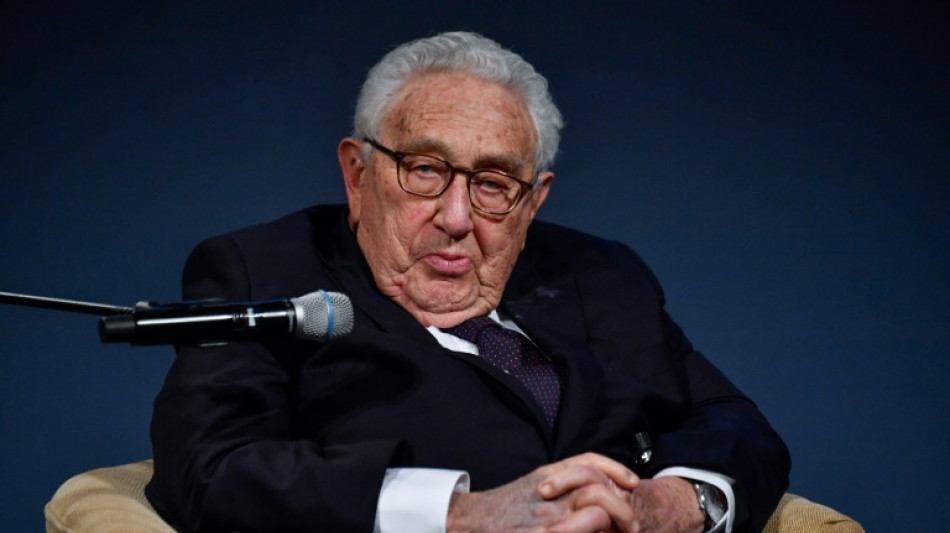
Kissinger, giant of statecraft, molded post-war US history / Photo: © AFP/File

Brilliant, abrasive and ruthlessly ambitious, Henry Kissinger towered over post-World War II US foreign policy like no one else and shaped a fateful new course for the world's relationship with China.
As secretary of state to presidents Richard Nixon and Gerald Ford, Kissinger was a master tactician whose intellectual gifts were begrudgingly acknowledged even by his many critics, who nevertheless faulted his disregard for human rights and democracy in the Vietnam War and elsewhere.
Instantly recognizable for a sharp-witted monotone that never lost a touch of his native German as well as his bookishly thick glasses, Kissinger -- the author of several weighty tomes -- became viewed by the public as the epitome of an international power-broker, an image he capitalized upon as a consultant for decades after leaving office.
Kissinger died Wednesday at his home in Connecticut, a statement from his consulting firm said. He was 100 years old.
The name Kissinger is often paired with "realpolitik" -- diplomacy based on power and practical considerations.
Lauding his cold-eyed view of advancing US interests, admirers compared him to history's great statesmen such as Bismarck, Metternich or Richelieu.
But for many, especially on the left, Kissinger was seen as an unindicted war criminal for his role in, among other events, expanding the Vietnam War to two more countries, supporting Chile's 1973 military coup, green-lighting Indonesia's bloody invasion of East Timor in 1975 and turning a blind eye to Pakistan's mass atrocities during Bangladesh's 1971 war of independence.
- 'Fortuitous series of events' -
Born Heinz Alfred Kissinger into a Jewish family in Fuerth, Germany, on May 27, 1923, the future architect of American foreign policy fled the Nazi regime in 1938 with his father, a schoolteacher, his mother and a younger brother. The family resettled in New York.
"I thought I'd be an accountant," he told USA Today in 1985. "I never thought I'd teach at Harvard. It wasn't my dream to become secretary of state."
"I could not have had a more fortuitous series of events occur."
Kissinger worked at a shaving brush factory while he attended high school at night.
Upon graduation, he studied accounting at the City College of New York but was drafted into the army in 1943 before he could graduate.
His knowledge of German landed him in an infantry division intelligence unit tasked with identifying Nazis as the Allies advanced in Europe.
In the army, Kissinger met his first mentor, fellow German refugee Fritz Kraemer, a political scientist who persuaded him to transfer to Harvard, where he earned a bachelor's degree in 1950 and doctorate in 1954.
The young professor's first book, "Nuclear Weapons and Foreign Policy" (1957) -- on how the new, ultra-destructive weapons should be adapted to the requirements of diplomacy -- quickly rocked the field.
- Redefining US relationships -
Kissinger's ambitions went beyond academia: he wrote for think tanks and took consulting jobs for the National Security Council and State Department under presidents John F. Kennedy and Lyndon Johnson.
These included trips to Vietnam, where the United States was becoming increasingly involved as part of its Cold War doctrine of containing communism.
Seeking government service, Kissinger supported New York governor Nelson Rockefeller, a liberal Republican who unsuccessfully ran for president three times. In 1968, Kissinger switched support to Nixon, who would make him his national security advisor.
Distrustful of the State Department's career diplomats, Nixon accurately believed that his dogged advisor would make the White House the center of foreign policy and he named a low-profile secretary of state, William Rogers, who was seen as lacking the intellectual heft of Kissinger.
But by late 1973, with Nixon becoming embroiled in the Watergate scandal that would end his presidency, Rogers quit and Kissinger became secretary of state, keeping the post until January 1977 following Ford's election defeat to Jimmy Carter.
In an unprecedented arrangement that demonstrated his absolute influence, for two years Kissinger remained national security advisor while serving as secretary of state.
Nixon had built his political name on strident anti-communism but he welcomed Kissinger's concept of "detente," a methodical effort to find areas in which the United States could ease tensions with the Soviet Union.
Kissinger shepherded the Strategic Arms Limitation Talks (SALT) with Moscow, the most serious effort to control the Cold War nuclear arms race. In 1972, the superpowers reached the Anti-Ballistic Missile Treaty, imposing limits on their arsenals.
As part of a strategy of isolating the Soviet Union, as well as shaking up diplomacy on Vietnam, Kissinger took a landmark decision that would arguably become his most consequential -- reaching out to communist China.
Self-isolated amid the destruction brought on by Mao Zedong's Cultural Revolution, mainland China since the 1949 communist victory had been cut off from the United States, which recognized the defeated nationalists who had fled to Taiwan.
Kissinger secretly flew to Beijing in 1971 via Pakistan and met Premier Zhou Enlai, paving the way for Nixon's breakthrough trip a year later in which the president clinked glasses with Zhou, visited the ailing Mao and set the stage for diplomatic relations and, decades later, the intertwining of what would be the world's two largest economies.
- Cold-eyed tactician -
"That China and the United States would find a way to come together was inevitable given the necessities of the time," Kissinger wrote four decades later in "On China," one of some 20 books.
"That it took place with such decisiveness and proceeded with so few detours is a tribute to the leadership that brought it about," he wrote with an understated immodesty typical of him.
Kissinger's overtures eventually led the way for Western businesses to flock to China, which by the 21st century had grown into an emerging rival to the United States.
Domestically, ending the divisive Vietnam War was a top priority. Nixon campaigned on achieving "peace with honor" and upon taking office, he and Kissinger began a policy of "Vietnamization" that would force the South Vietnamese allies to take on a larger role so that US troops could withdraw.
Seeking to strengthen the US hand ahead of peace talks, Nixon and Kissinger authorized a 1969-1970 bombing campaign in Laos and Cambodia aimed at disrupting rebel movement into South Vietnam.
The bombing, which was not authorized by Congress and kept secret from the public, did not halt the infiltration but killed thousands of civilians and helped spawn the genocidal Khmer Rouge.
Kissinger traveled several times to Paris, at first discreetly, for talks with North Vietnamese negotiator Le Duc Tho.
An agreement was finally signed in January 1973 that effectively ended US military operations, and the two men were jointly awarded the Nobel Peace Prize, although only Kissinger accepted it.
Showing his cold calculus, taped conversations with Nixon revealed that Kissinger had fully expected South Vietnam to fall after the accords.
In another example of his realpolitik, Kissinger recommended that the United States delay weapons shipments to ally Israel after it was attacked in the 1973 Yom Kippur War, believing Arab states would be more confident to make peace after achieving initial victories.
- Overlooking abuses -
The record of Kissinger -- who headed the "40 Committee" that directed foreign intelligence operations -- has drawn intense scrutiny.
In a 2001 book, "The Trial of Henry Kissinger," writer Christopher Hitchens made a case that he should be prosecuted for war crimes and crimes against humanity.
Declassified documents show a direct US role in undermining the government of Chile's Marxist elected president Salvador Allende, including support for officers who murdered a general who refused to participate in a 1970 coup attempt and backing for the eventual 1973 takeover by General Augusto Pinochet.
Kissinger was also criticized for allowing the Indonesian regime of Suharto, a close anti-communist ally, to use his US-equipped military to seize East Timor in 1975. The invasion was launched one day after Kissinger and Ford met Suharto in Jakarta.
More than 100,000 East Timorese died during the Indonesian occupation that ended in October 1999, according to a 2005 estimate by the now independent nation's truth commission.
Kissinger similarly showed little compunction when Greece's military junta deposed the elected leader of Cyprus, Archbishop Makarios, and Turkey invaded the island in response.
Nonetheless, Kissinger's intellect made him a brief, if niche, sex symbol as rumors swirled of his relationships with Hollywood celebrities.
In 1974, at the pinnacle of his power and a decade after his first marriage ended, Kissinger wedded the former Nancy Maginnes, the strikingly tall former aide to Rockefeller. She survives him, as do two children from his first marriage, David and Elizabeth.
Kissinger was kept at arm's length when the Republicans returned to power under Ronald Reagan, who began with a more ideological bent.
But Kissinger rarely passed up opportunities to dispense advice, readily shuttling from his Manhattan penthouse to Washington when leaders called.
As Kissinger wryly observed in the 1970s, "Power is the ultimate aphrodisiac."
B.Carter--ThChM