US facing growing Middle East crisis tied to Israel-Hamas war / Photo: © US NAVY/AFP/File

Washington is facing an increasingly complex and dangerous crisis resulting from the Israel-Hamas war, which has sparked repeated militant attacks and drawn US military attention and assets back to the Middle East.
The United States has deployed two aircraft carriers and other forces in a bid to deter a devastating region-wide conflict. But the current violence in the Middle East -- while not rising to that level -- still carries significant danger.
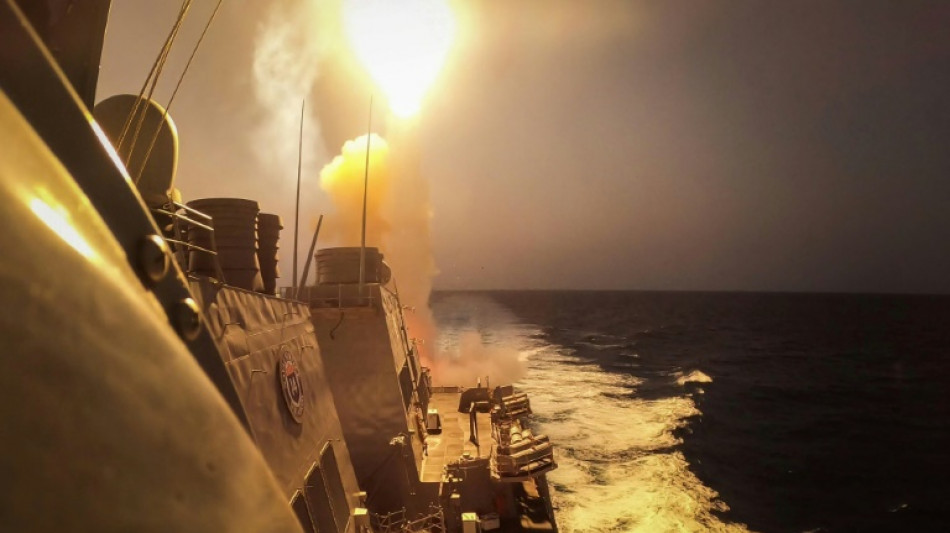
Iran-backed Huthi rebels in Yemen raised the stakes over the weekend by striking commercial vessels in the Red Sea, while a US Navy destroyer shot down several inbound drones as it operated in the area and responded to distress calls.
"Without question there's been escalation," but all parties, especially the United States, "are trying to manage these clashes in ways that do not explode into a regional war," said Jeffrey Feltman, a visiting fellow at the Brookings Institution and former US assistant secretary of state for near eastern affairs.
However, "I think we should be deeply, deeply worried that step-by-step escalation, while perhaps no party intends it to turn into a regional conflagration, could lead us there," he said.
- 'Have their cake' -
The Huthis said they targeted two of the three ships that were hit in the Red Sea on Sunday, claiming they were Israeli vessels and that such attacks would continue "until the Israeli aggression against our steadfast brothers in the Gaza Strip stops."
The US Navy shot down three drones launched from Yemen the same day -- the targets of which were unclear -- and others as well as missiles during the past six weeks, while the Huthis downed an American drone last month.
Feltman said the Huthis and Lebanon's Hezbollah, which has repeatedly traded fire with Israel since the outbreak of the war with Hamas on October 7, "are basically trying to have their cake and eat it too."
"They're trying to say that they are part of the resistance, that they are standing in solidarity with the beleaguered Palestinian population in Gaza," but "they're doing it in a way, I think, that they believe will prevent a full-scale war," he said.
The latest round of conflict between Israel and Hamas began when the Palestinian militant group carried out a shock cross-border attack that Israeli officials say killed 1,200 people.
Israel responded with a relentless land and air campaign that the Hamas-run government in Gaza says has left more than 16,200 people dead.
In addition to the attacks launched from Yemen and Lebanon, US troops in Iraq and Syria have been targeted by rockets and drones on dozens of occasions since mid-October, with the militants who claimed responsibility repeatedly citing the situation in Gaza.
Washington has blamed Iran-backed groups for the attacks and has carried out multiple strikes against those forces as well as sites in the region it said were linked to Tehran.
- 'Testing limits' -
The US military fought a bloody war in Iraq from 2003 to 2011, later provided support to local forces in that country and Syria as they battled the Islamic State jihadist group, and has carried out numerous raids and strikes against militants in the region over the years.
But Washington is seeking to move on from the counterinsurgency-centric "War on Terror" conflicts in the Middle East and Afghanistan to put greater focus on countering China, which it has identified as its most consequential challenge.
The United States has shifted significant military assets to the Middle East since October 7, but that does not necessarily undermine efforts in the Asia-Pacific region.
"While a long-term focus on the Middle East would detract from readiness in East Asia, near-term responses are unlikely to provoke a near-term crisis in East Asia," said Jon Alterman, director of the Middle East Program at the Center for Strategic and International Studies.
Additionally, "the demonstrated ability to deploy quickly to defend allies and interests is watched carefully in Asia, among allies and adversaries alike," he said.
Alterman said the situation in the Middle East could potentially "go in a bad direction," but that he does not see the conflict as being out of control at this point.
"The United States remains the preponderant power," he said, while America's adversaries are "carefully testing limits."
A.Kwok--ThChM