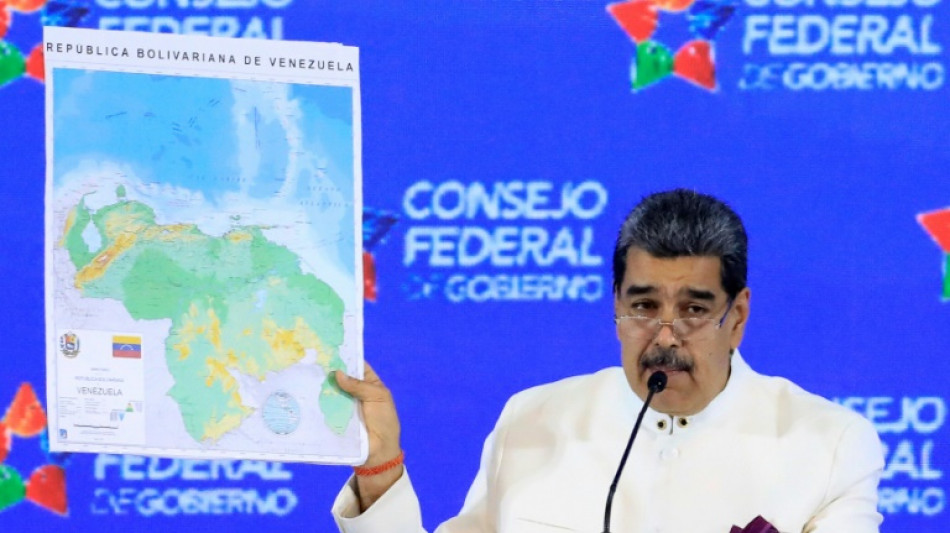
Venezuela, Guyana agree to keep talking as border tension mounts / Photo: © Venezuelan Presidency/AFP

Guyana and Venezuela agreed Wednesday to keep "communication channels open" in a fast-escalating feud over an oil-rich region, as Brazil reinforced its troops near its own border and Washington urged calm.
In Caracas, the government said its top diplomat Yvan Gil had a phone call with Guyanese counterpart Hugh Todd "to discuss the issue of the territorial dispute" over the Essequibo region both countries lay claim to.
The discussion took place at Guyana's request, it said in a statement, and concluded with the parties agreeing to "keep the communication channels open."
The Brazilian army, meanwhile, said it was reinforcing its presence in the northern cities of Pacaraima and Boa Vista as part of efforts "to guarantee the inviolability of the territory."
And the United States said it was closely watching the situation.
"It's concerning, we're watching this very, very, very closely," National Security Council spokesman John Kirby told reporters.
"We obviously don't want to see any violence occur here or conflict occur," he added.
The long-running dispute over Essequibo, administered by Guyana for over a century and comprising some two-thirds of its territory, has intensified since ExxonMobil discovered oil there in 2015.
On Tuesday, Caracas proposed a bill to create a Venezuelan province in Essequibo and ordered the state oil company to issue licenses for extracting crude in the region.
Emboldened by an overwhelming "yes" vote in a controversial referendum on Essequibo's fate held Sunday, President Nicolas Maduro also gave an ultimatum to oil companies working under concessions issued by Guyana to halt operations within three months.
Guyanese President Irfaan Ali called Maduro's statements a "direct threat" against his country and said he would seek relief from the UN Security Council.
Guyana's armed forces were on "alert," Ali added in a rare address to the nation late Tuesday, and were in contact with "partners" including the United States.
- 'Protection of the national territory' -
Venezuela on Wednesday also confirmed it had arrested an American citizen -- Savoi Jadon Wright -- on accusations of "conspiring" with ExxonMobil to stop Sunday's referendum. US media said the arrest happened on October 24.
Attorney General Tarek William Saab said a Donald Trump advisor named Damian Merlo and members of the Venezuelan opposition were also involved in the "plot," though not yet arrested.
Venezuela's foreign ministry also accused Ali of giving the "green light" for a United States military presence in Essequibo, "over which Guyana maintains a de facto occupation."
Essequibo is home to 125,000 of Guyana's 800,000 citizens.
Litigation is pending before the International Court of Justice (ICJ) in The Hague over where the region's borders should lie.
Last week, two days before the referendum, the ICJ ordered Venezuela to "refrain from taking any action which would modify the situation that currently prevails in the territory in dispute."
It did not, however, grant an urgent request by Guyana to stop Sunday's referendum.
Guyana, a former British and Dutch colony, insists the Essequibo frontiers were determined by an arbitration panel in 1899.
But Venezuela -- which does not accept the ICJ's jurisdiction in the matter -- claims the Essequibo River to the region's east forms a natural border recognized as far back as 1777.
Caracas called a referendum after Guyana started auctioning off oil blocks in Essequibo in August.
Venezuelan voters were asked to respond to five questions, including whether Venezuela should reject the 1899 arbitration decision as well as the ICJ's jurisdiction.
They were also asked whether Venezuelan citizenship should be granted to the people -- currently Guyanese -- of a new "Guyana Esequiba State."
Officials in Caracas said 95 percent of voters supported the measures.
International Crisis Group analyst Mariano de Alba said Wednesday Maduro's threats may be a strategy of generating uncertainty in order to put "pressure on the Guyanese government to sit down and negotiate."
Guyana has repeatedly said it considers the ICJ the final arbiter in the matter.
"In the short term, the rhetoric of confrontation will continue, but at the same time, I consider that an armed conflict is unlikely," De Alba told AFP.
However, the slightest error in such tense circumstances could spark a rapid escalation, he warned.
The Brazilian army said an infantry brigade with almost two thousand soldiers had "intensified" a military presence in the border region.
The troops are tasked with "surveillance and protection of the national territory."
The army said armored vehicles that will be sent from Brazil's southern and central regions to reinforce the northern deployment.
Asked about the dispute in New York, a spokesman for UN chief Antonio Guterres said "the secretary-general strongly supports the use of solely peaceful means to settle international disputes."
L.Kwan--ThChM